
A patient with severe persistent asthma has suspected coronary artery disease, cannot exercise because of severe osteoarthritis, and the department stocks only Tc-99m perfusion agents. Which stress agent and radiopharmaceutical pairing should be selected?
Select an answer to reveal the explanation.
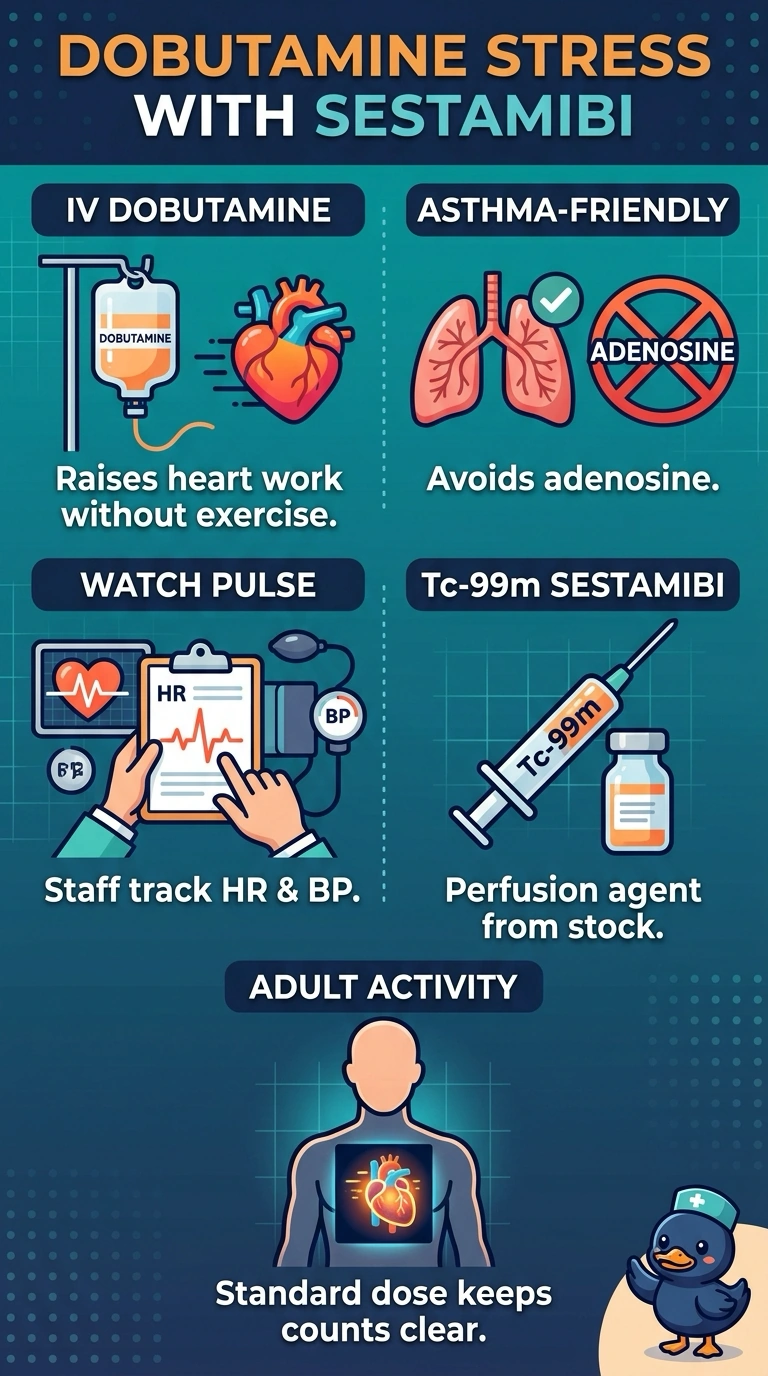
Short Explanation
You're after stress that dodges both exercise and adenosine receptors, and dobutamine delivers it through an IV while the airways stay calm. It raises cardiac work the same way a treadmill does, so the perfusion images stay diagnostic. The exercise, adenosine, and thallium routes each break one stated limit.
Full Explanation
Dobutamine with Tc-99m sestamibi is appropriate because the patient cannot exercise, severe persistent asthma makes adenosine-mediated vasodilator stress unsuitable, and Tc-99m agents are the only perfusion radiopharmaceuticals stocked. Dobutamine raises heart rate and myocardial oxygen demand to create a stress response without relying on a coronary vasodilator that may provoke bronchospasm. Treadmill exercise with sestamibi is a standard approach when a patient can exercise adequately, but severe osteoarthritis prevents this patient from doing so. Adenosine with sestamibi is also a commonly used pharmacologic perfusion protocol, but adenosine can cause bronchoconstriction and is inappropriate in severe persistent asthma. Dobutamine with thallium-201 is an established stress-imaging combination, but thallium is unavailable in this department, so it does not meet the stated inventory constraint. Exam caveat: vasodilator agents are often preferred for pharmacologic perfusion testing when safe; dobutamine is selected here because the asthma changes that risk-benefit choice. Before testing, confirm the local dobutamine protocol and Tc-99m dose, review relevant contraindications and medications, and ensure ECG and blood-pressure monitoring with appropriate rescue capability.