
A patient with a palpable thyroid nodule needs both a quantitative uptake value and a scintigram. The physician specifies that the value reflect iodine organification and that the images keep sharp resolution. Which radiopharmaceutical and schedule satisfies both requirements?
Select an answer to reveal the explanation.
Short Explanation
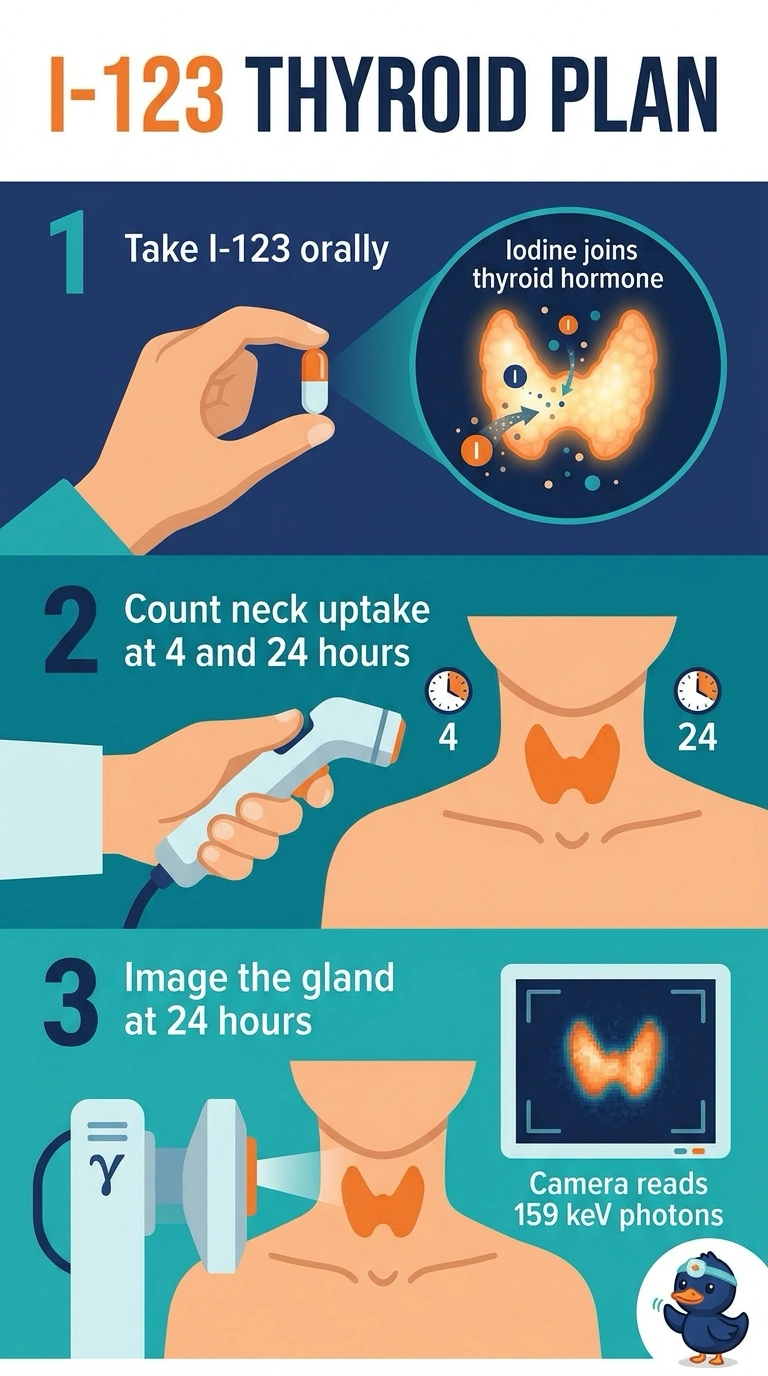
Give I-123 by mouth so it follows iodine’s full route through your thyroid, including organification, like a tracer reaching its destination. Measure neck uptake at 4 and 24 hours, then image the gland at 24 hours for sharp resolution.
Full Explanation
Oral I-123 is taken up by the thyroid and incorporated into organified iodine, so its measured uptake reflects the process specified. Counting neck activity at 4 and 24 hours provides quantitative uptake values, while imaging at 24 hours gives a scintigram with good spatial resolution because I-123 emits photons well suited to gamma-camera imaging. Tc-99m pertechnetate can provide a useful thyroid scintigram and a quantitative trapping measurement, but it is not organified; its uptake therefore does not meet the requirement that the value reflect iodine organification. Imaging after oral I-123 can produce a suitable scintigram, but omitting the uptake measurement leaves the requested quantitative value unavailable. I-131 uptake can reflect iodine handling and be measured at 24 hours, but its higher-energy emissions require a high-energy collimator, which compromises spatial resolution compared with I-123 imaging. Exam caveat: uptake values vary with recent iodine exposure, medications, and thyroid status, so the patient’s preparation and reference range matter. Practical check: confirm the administered isotope and assay schedule, and verify that the uptake probe or camera measurements include background correction and the appropriate standards.