
A PET/CT protocol calls for dynamic imaging of the first pass with frame boundaries that the reviewer may change after the images are seen. The patient's injected activity and bed time are fixed by protocol, and the scanner can acquire either in list mode or in preset frames. Which acquisition format should the technologist select?
Select an answer to reveal the explanation.
Short Explanation
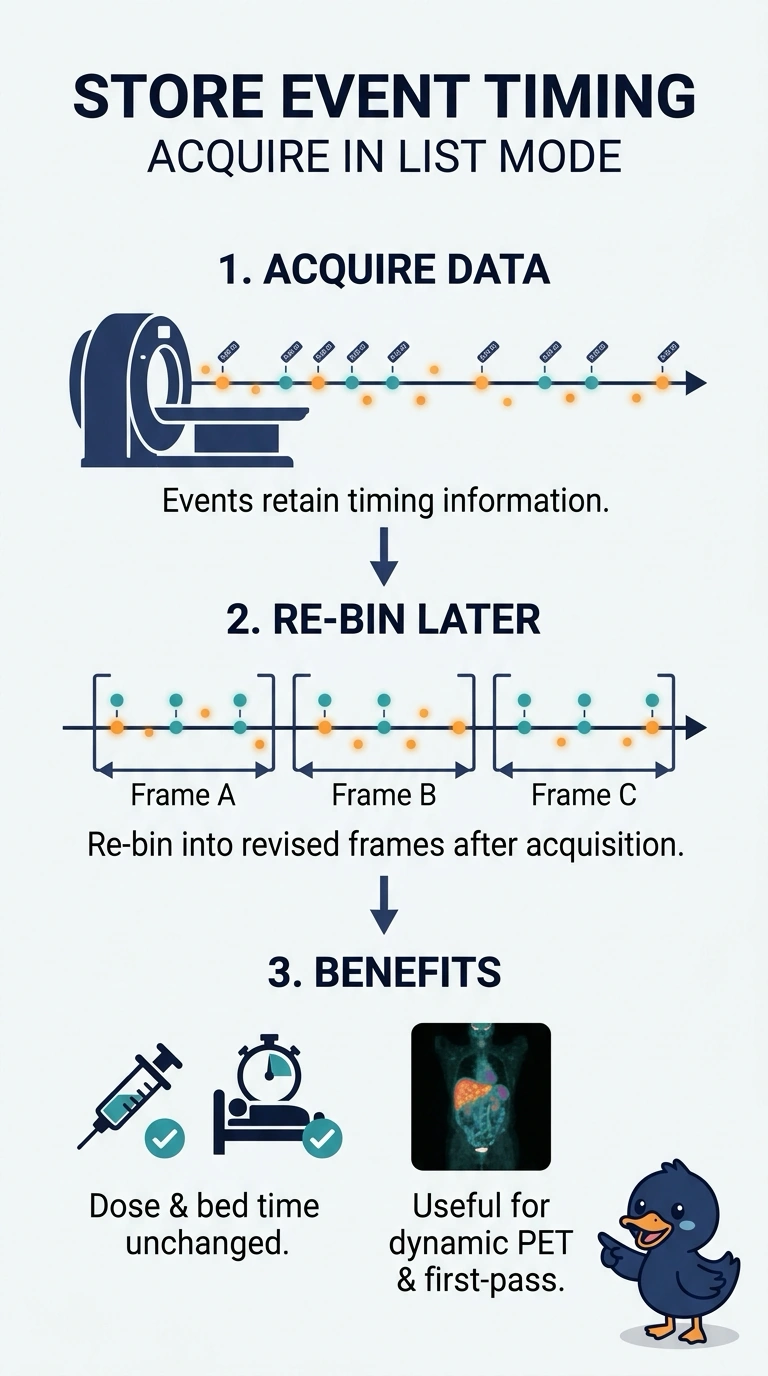
List-mode acquisition stores timing information for detected events, so you can recut frames when the reviewer changes plans. Preset-frame images are like film cut into fixed strips; if only those images are retained, you can't recut them afterward.
Full Explanation
List-mode acquisition is the appropriate choice because it records event timing, allowing the reviewer to define new frame boundaries and re-bin the same acquired data after reviewing the images. The prescribed activity and bed time can remain unchanged; changing the temporal grouping does not require extending the scan or altering the injection. Preset frames with uniformly fine sampling are a reasonable way to characterize rapid first-pass kinetics, but their boundaries are established during acquisition, so they do not provide the requested post-acquisition revision. Nonuniform preset framing, with shorter early intervals and longer later ones, is also commonly used to balance temporal resolution and count statistics; it fails for the same specific reason if the reviewer later needs different boundaries. Respiratory-gated preset frames can support motion-aware review, but gating does not make the stored frame boundaries retrospectively adjustable. A useful exam caveat is that list mode enables re-binning only within the events actually recorded; it cannot recover events lost to truncation, inadequate counts, or a limited acquisition window. In practice, confirm that the scanner is configured to save list-mode event data for the full prescribed bed time and that the reconstruction workflow supports the desired retrospective frame schedule.