
A 66-year-old scheduled for a same-day Tc-99m sestamibi rest and stress study cannot walk a treadmill because of hip pain and takes theophylline daily for asthma. The protocol requires a higher activity at stress than at rest. Which stress agent and injection pattern fits this patient?
Select an answer to reveal the explanation.
Short Explanation
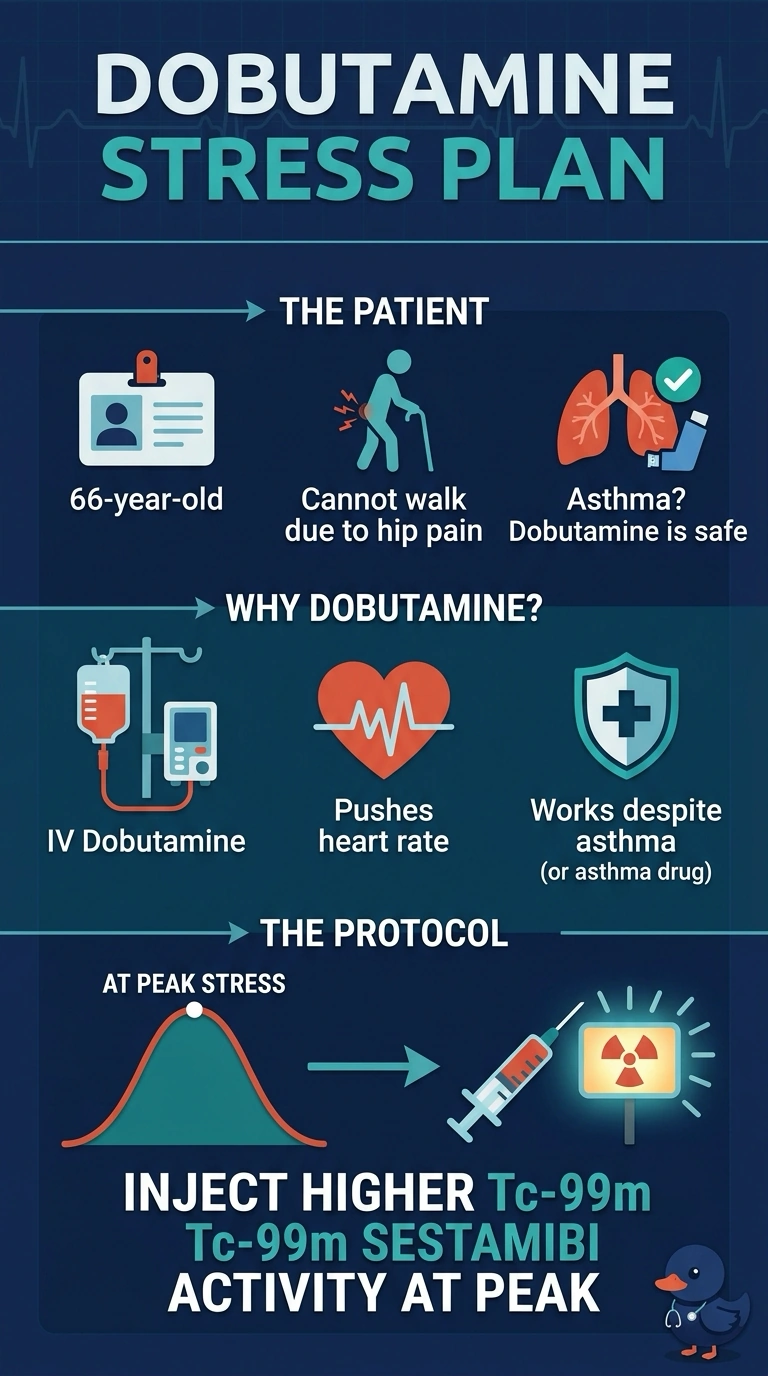
With hip pain keeping you from walking and theophylline blunting adenosine’s effect, dobutamine can raise your heart’s workload for stress imaging. Give the higher Tc-99m sestamibi activity at peak stress, as the protocol requires.
Full Explanation
Dobutamine is a beta-adrenergic agonist that raises heart rate, contractility and myocardial oxygen demand, producing a supply-demand mismatch that appears on perfusion images much like flow-limited stress. It fits when hip pain prevents treadmill exercise and theophylline, a methylxanthine, competitively blocks the adenosine receptors needed for adenosine’s vasodilator effect. In the same-day protocol described, the stress activity must exceed the rest activity, and the higher activity is injected at peak stress so the stress image set has the strongest count statistics. Treadmill exercise cannot meet the mobility requirement because hip pain prevents adequate exertion. Adenosine infusion may have a blunted response because theophylline antagonizes its receptor-mediated effect, and injecting the lower rest activity at peak dobutamine stress reverses the required activity relationship and weakens stress images. Exam caveat: washout windows and exact activity ratios vary by institution, so follow the current written protocol. Practical check: verify the medication and exercise limitation in the chart against the stress order before drawing activity.