
During video-EEG monitoring, a 24-year-old with drug-resistant seizures has electrographic seizures lasting about two minutes followed by several minutes of confusion. The team orders ictal Tc-99m ECD SPECT and plans a separate interictal study for subtraction analysis. At what point in the seizure cycle should the tracer for the ictal study be injected so the perfusion pattern of the seizure focus is trapped?
Select an answer to reveal the explanation.
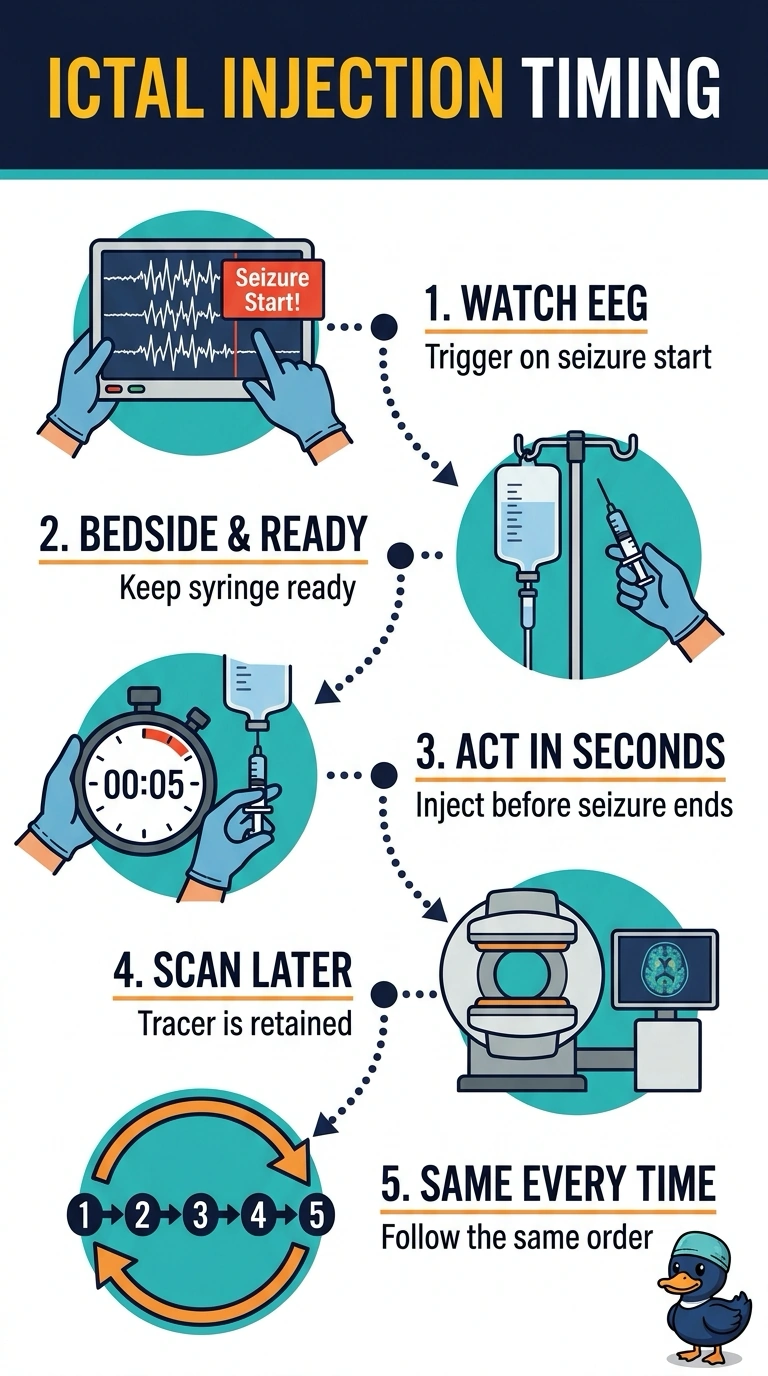
Short Explanation
You should inject Tc-99m ECD at bedside within seconds of EEG seizure onset, while the seizure is still happening, so its perfusion pattern is captured. The tracer stays in the brain after uptake, so later imaging is fine—but waiting to reach the camera is like starting a security recording after the break-in.
Full Explanation
Tracer delivery, rather than image timing, is the mechanism behind ictal SPECT. Tc-99m ECD crosses the blood-brain barrier and is retained in brain tissue after uptake, so the perfusion pattern around injection is reflected in the later images; injecting at the bedside as soon as possible after electrographic onset helps capture the ictal pattern. Delaying injection until the seizure ends can miss the ictal pattern, because postictal perfusion changes vary and may obscure or alter localization. An interictal injection addresses baseline physiology rather than the ictal event, so it yields the comparison study instead of the study that answers the referral question. Waiting until the patient reaches the camera delays injection and risks missing the ictal pattern; acquisition can occur after injection. Injections delayed well after onset may be unreliable for localization, so timing language carries most of the weight in these questions. A practical check is to have the drawn syringe, a patent line, and the injector physically at the bedside before monitoring begins.