
A patient with heart failure and a reduced ejection fraction is scheduled for Tc-99m PYP imaging to evaluate for transthyretin cardiac amyloidosis. The cardiologist wants myocardial retention graded about one hour after injection, and department protocol requires cross-sectional imaging to keep blood pool activity out of that grade. The patient has eaten breakfast and taken the usual morning medications. Which acquisition plan best completes this amyloid study?
Select an answer to reveal the explanation.
Short Explanation
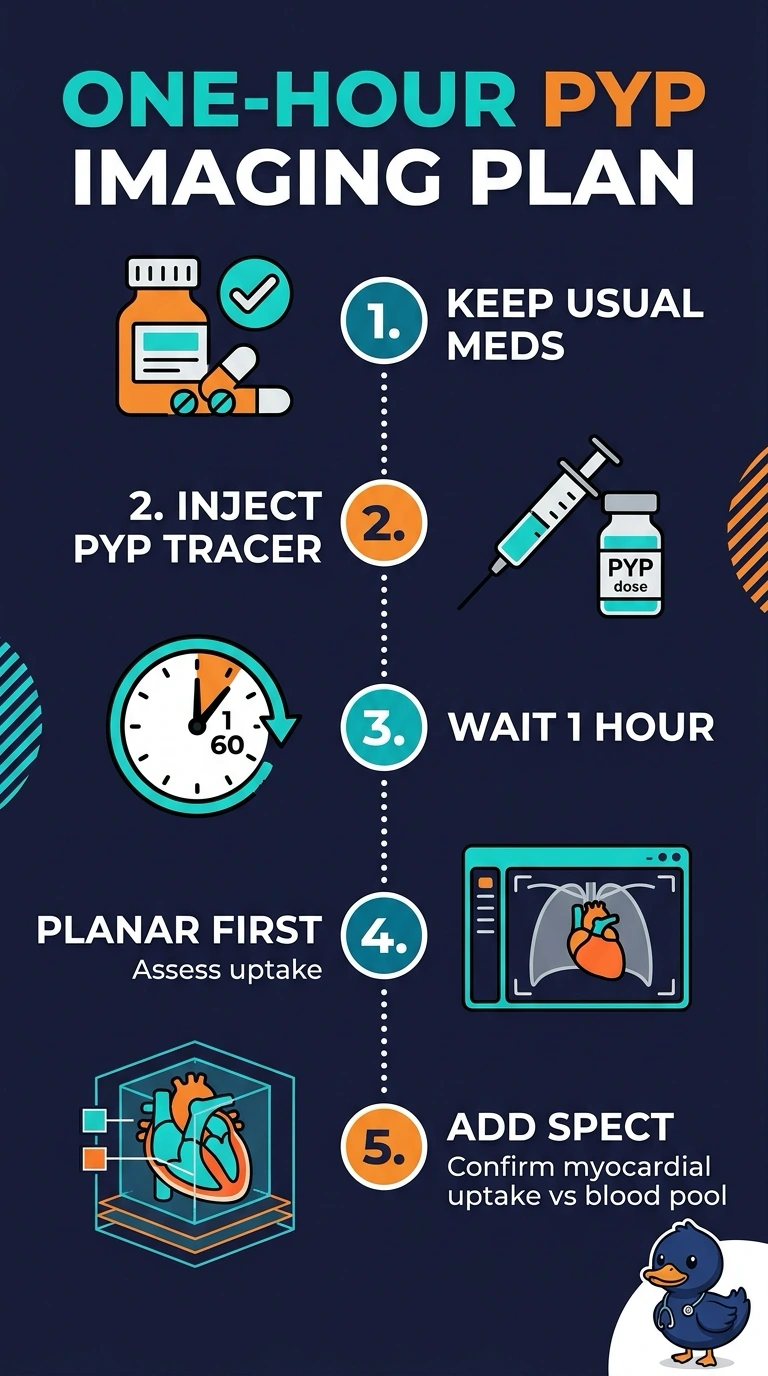
Keep your usual morning medications, then get the tracer and one-hour planar images followed by SPECT. Planar images are like a flat snapshot, while SPECT helps you tell whether the signal is in the heart muscle or just blood still in the heart.
Full Explanation
The correct plan preserves the usual medications, obtains planar imaging at the requested approximate one-hour time point, and uses SPECT to determine whether apparent cardiac activity is truly myocardial rather than activity in the cardiac blood pool. That distinction is essential for reliable assessment of myocardial PYP retention in suspected transthyretin cardiac amyloidosis. Delaying SPECT until three hours can be a reasonable protocol when blood-pool activity persists, but it does not meet this cardiologist’s request to grade retention at about one hour; later imaging should not silently replace the specified grading time. A heart-to-contralateral-lung ratio is a familiar planar quantitative measure, but using it alone does not provide the cross-sectional localization required by this department and may be confounded by blood-pool activity. Acquiring SPECT but assigning the grade from planar images alone also fails: collecting cross-sectional data is not enough if that data is not used to distinguish myocardial uptake from blood pool. Exam caveat: PYP interpretation depends on the complete imaging pattern and appropriate clinical context; a positive scan alone does not establish ATTR disease without considering monoclonal protein testing. Practical check: verify the injection-to-acquisition interval and review the SPECT slices for blood-pool activity before finalizing the myocardial grade.