
A patient with COPD and suspected pulmonary embolism needs ventilation imaging that includes a washout phase, and every ventilation view must be matched to the later perfusion view. Which ventilation agent and acquisition plan meets both requirements?
Select an answer to reveal the explanation.
Short Explanation
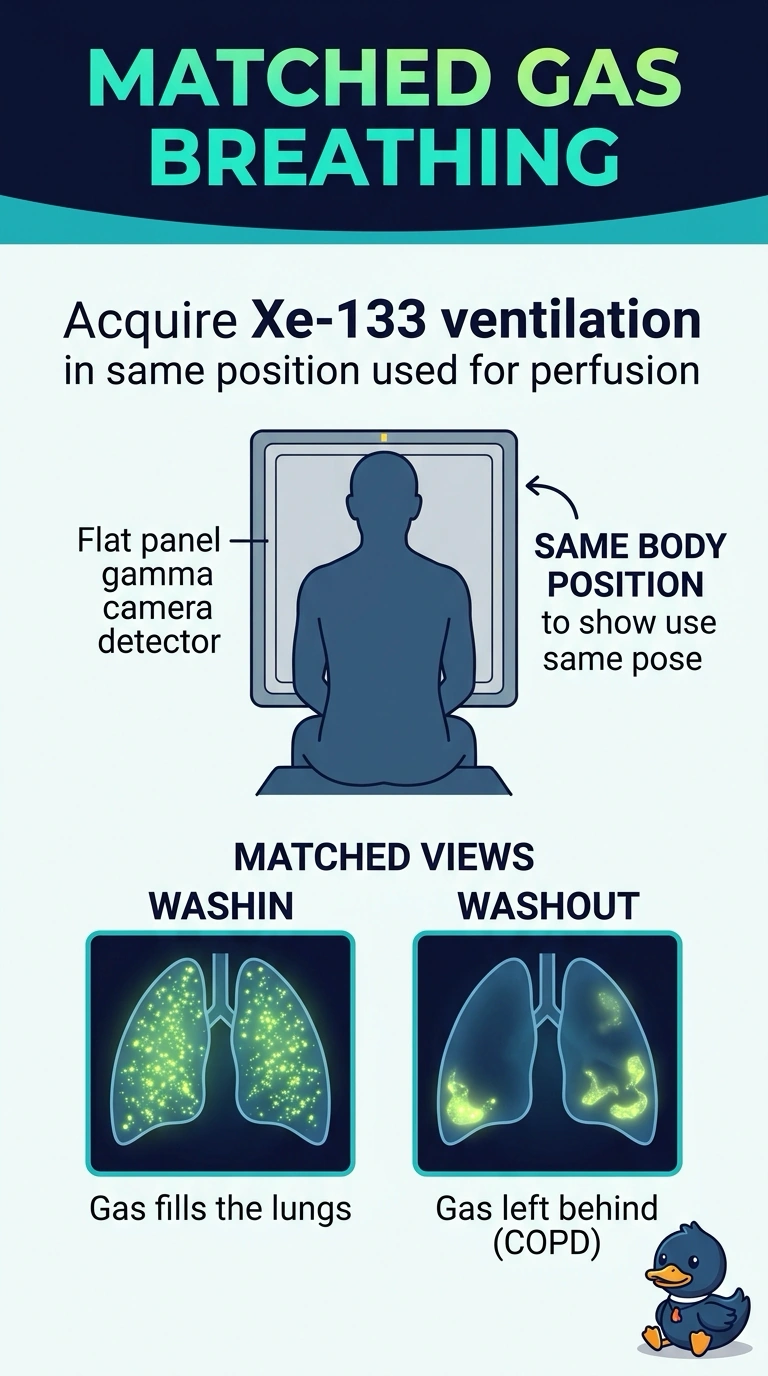
Because you're hunting air trapping, you need a gas that can be cleared and imaged again, and Xe-133 supplies that washout phase. Matching the position keeps both studies lined up, like two photos taken from the same spot. Aerosol and krypton plans look right on the camera, but neither gives you a usable washout series.
Full Explanation
Xe-133 travels as a true gas, so it fills the lungs during washin and can be cleared and imaged again during washout; that second series exposes air trapping in COPD, because retained gas marks the regions that do not empty. Ventilation and perfusion views are read side by side, so each ventilation view must be acquired in the position later used for perfusion, or gravity-dependent gradients will mimic mismatched defects. Aerosol ventilation deposits particles in the airways rather than circulating free gas, so it gives deposition images but no genuine washout phase, which misses the washout requirement. Krypton-81m ventilation is a standard matched-view technique, yet its half-life is measured in seconds, so activity fades before a usable washout series can be formed, missing that same requirement. Imaging the gas study seated while perfusion is acquired supine drops the matched-position requirement, since posture alone changes regional perfusion distribution. Exam caveat: view sets and image order vary by department, so follow the local written protocol rather than recall. Practical check: before injecting MAA, confirm the queued view list and patient position for ventilation will be repeated exactly for perfusion.