
A busy hot lab has sent all of its lead syringe shields to decon, so a technologist must draw ten Tc-99m doses from unshielded vials using only a lead L-block. Each syringe is checked against the logbook before release, and the bench is too narrow to step away from. Which technique best keeps extremity exposure ALARA during these draws?
Select an answer to reveal the explanation.
Short Explanation
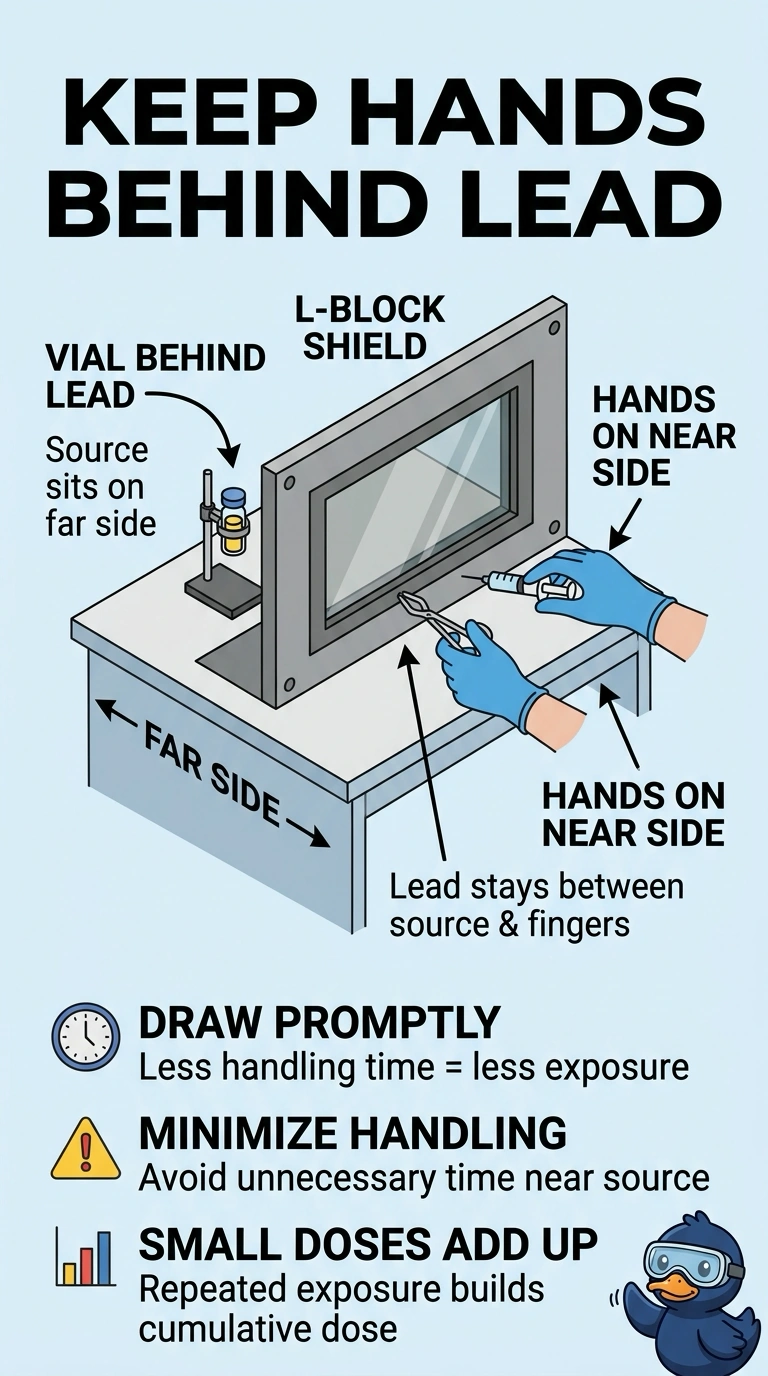
With no room to step away, use the L-block to place shielding between the vial and your hands, and minimize the time spent handling the unshielded source. Keep your hands on the protected side of the barrier throughout the draw.
Full Explanation
The best technique is to place the vial behind the L-block, keep hands on its near side, and minimize handling time. The lead barrier attenuates radiation traveling from the vial toward the fingers, while keeping hands on the protected side uses the shielding as intended; shorter handling time reduces the duration of exposure. Working close to the syringe barrel to read graduations is a close-position approach that sacrifices distance and does not improve shielding. Repeating graduation checks at the bench is a redundant-verification approach that prolongs time near the unshielded source; the stated logbook check should still be completed before release. Drawing at arm’s length is a distance-based approach, but with the hands unshielded it gives up the L-block’s attenuation, so distance alone is not the best choice in this setup. Exam caveat: ALARA balances time, distance, and shielding; do not assume an L-block protects fingers that are on the source side or outside its shielded area. Practical check: before each draw, confirm the vial is behind the L-block and hands remain on its near side, then verify the dose against the logbook before release.