
A nuclear pharmacy elutes the same Mo-99/Tc-99m generator every morning. On the column between elutions the Tc-99m rises for about a day and then falls, even though Tc-99m alone has a 6-hour half-life. Which principle explains that rise and slower decline?
Select an answer to reveal the explanation.
Short Explanation
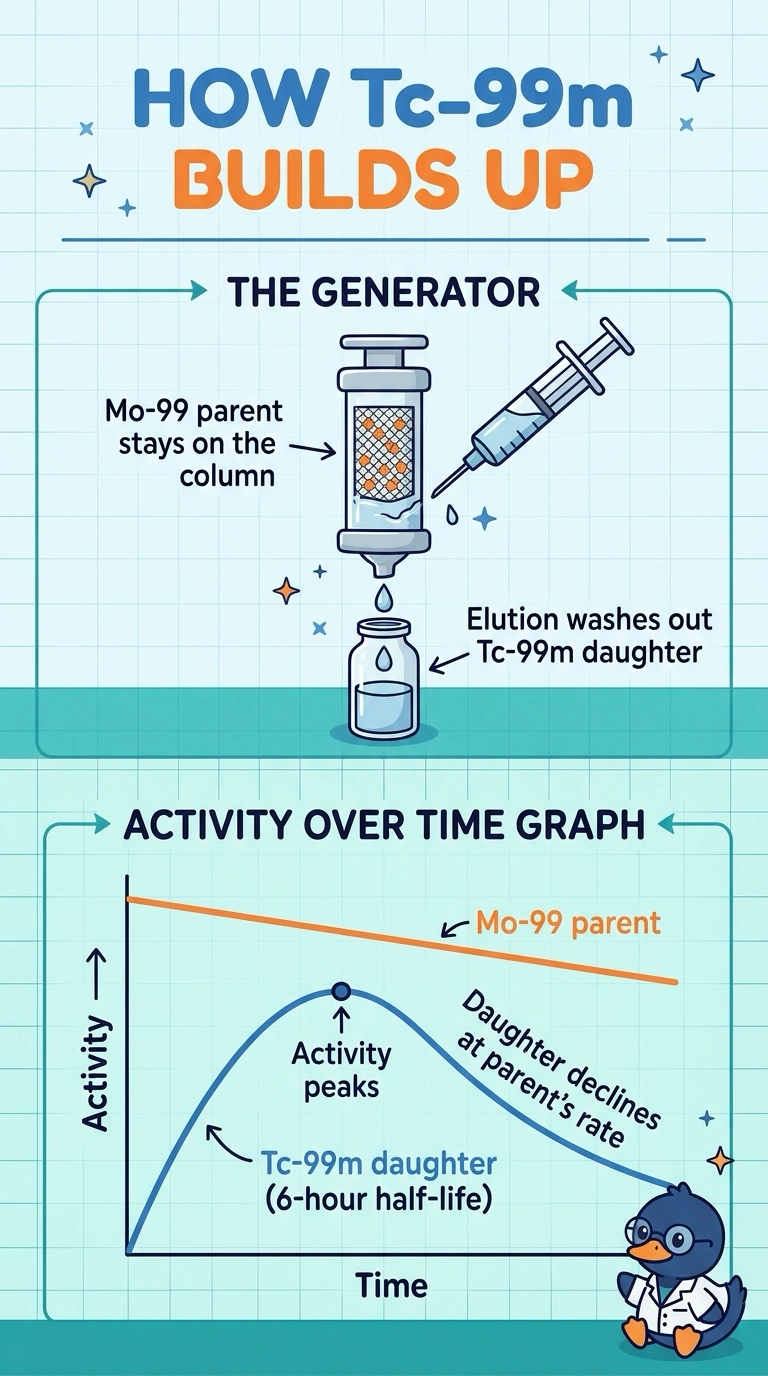
Your generator keeps cooking up fresh Tc-99m for days after each elution, so early on supply outpaces loss. Only the daughter is washed off the column; the parent stays put. That's the transient equilibrium that makes the curve rise for about a day, then fall at the parent's pace.
Full Explanation
Mo-99 has a physical half-life of about 66 hours while Tc-99m has about 6 hours, so on the alumina column the daughter is created much faster than it can disappear. Ingrowth continues until production and loss balance roughly a day after elution, and past that point the Tc-99m declines at the parent's slower pace, the classic signature of transient equilibrium, with daughter activity settling slightly above parent activity once equilibrium is reached. Treating the column as pure Tc-99m decay fails because elution strips only soluble pertechnetate and leaves Mo-99 bound to the adsorbent. The parent-exhaustion idea contradicts the 66-hour parent half-life, since substantial Mo-99 persists for days. The slow-release idea is chemistry explaining a physics effect: rising counts come from nuclear transmutation, not from material leaching off the resin. Exam caveat: equilibrium describes the column, not the eluate vial, where Tc-99m decays on its own 6-hour clock. Practical check: log every elution time and yield, because a yield that peaks near 24 hours after elution then falls confirms normal behavior.