
A nuclear medicine department runs one well counter for thyroid uptake samples and serum binding assays whose activities vary more than tenfold. The QC log includes a 10-minute background count, a reference-source spectrum, a chi-square test on repeated counts, and a series of counts from sources spanning the activity range used clinically. Which log entry shows the counter stays trustworthy across that whole range?
Select an answer to reveal the explanation.
Short Explanation
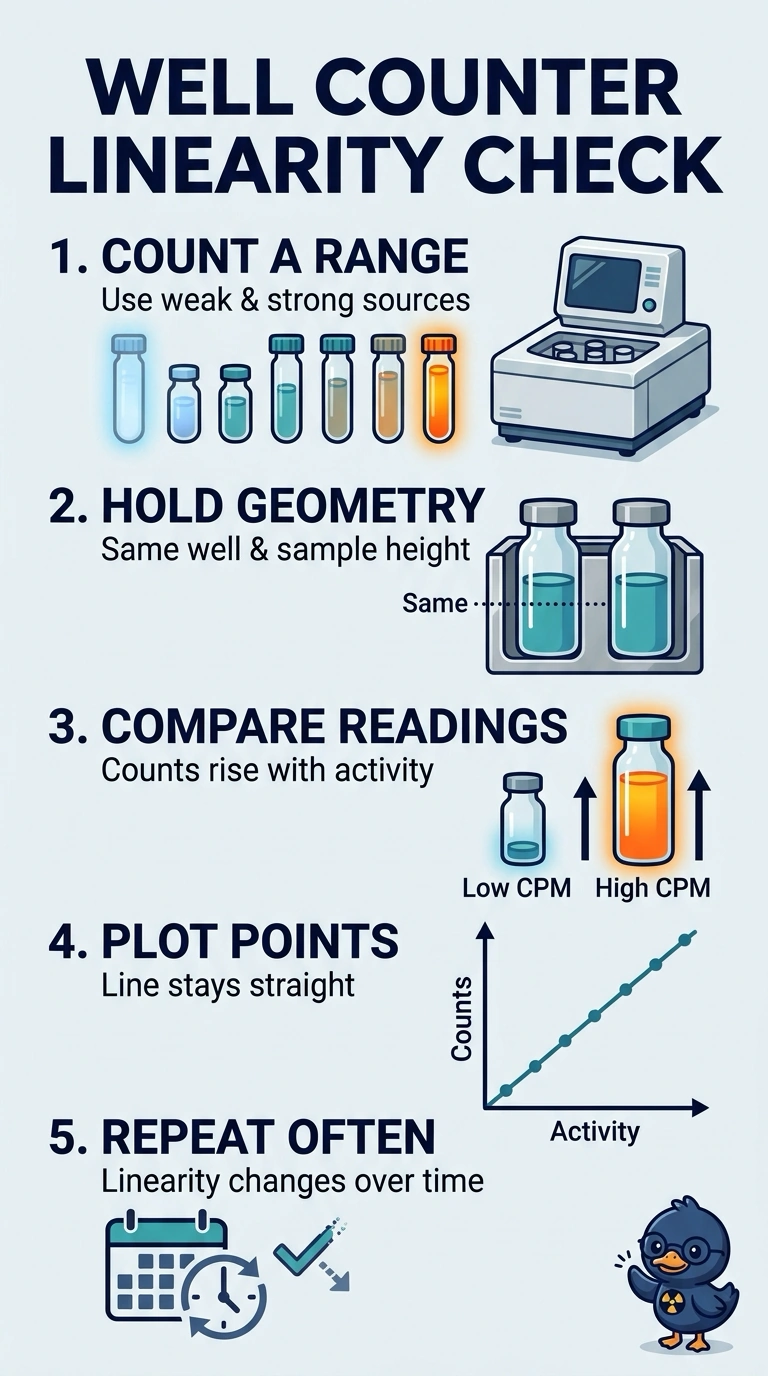
Linearity shows you whether counts rise in step with activity across the full range of samples you process. The chi-square test, reference-source spectrum, and background count each check a narrower feature, so a counter that flattens out at high activity can still look healthy. It’s like a bathroom scale that weighs your groceries correctly but lies about your suitcase.
Full Explanation
Counting linearity asks whether the counter produces counts proportional to activity across the range of samples you actually process. Counting sources that span that range and comparing counts with activity confirms that the counter responds consistently to both a faint serum sample and a concentrated one, so a value at one activity level means the same thing at another. The chi-square test measures reproducibility: repeated counts should vary within expected statistical limits, but this says nothing about proportionality. A counter can be repeatable and still read low at one end of the activity range. The reference-source spectrum checks that the photopeak stays centered in the counting window, protecting energy-window placement; a stable peak alone does not prove a proportional response across activity levels. The 10-minute background count checks that shielding keeps ambient counts low, which matters for weak samples but does not assess response at higher activities. An exam caveat is that these are distinct QC checks, and a question may pair a routine measurement with a purpose it cannot establish. A practical check is to count sources at low and high activities and confirm that the counts remain proportional to their activities across the clinically used range.