
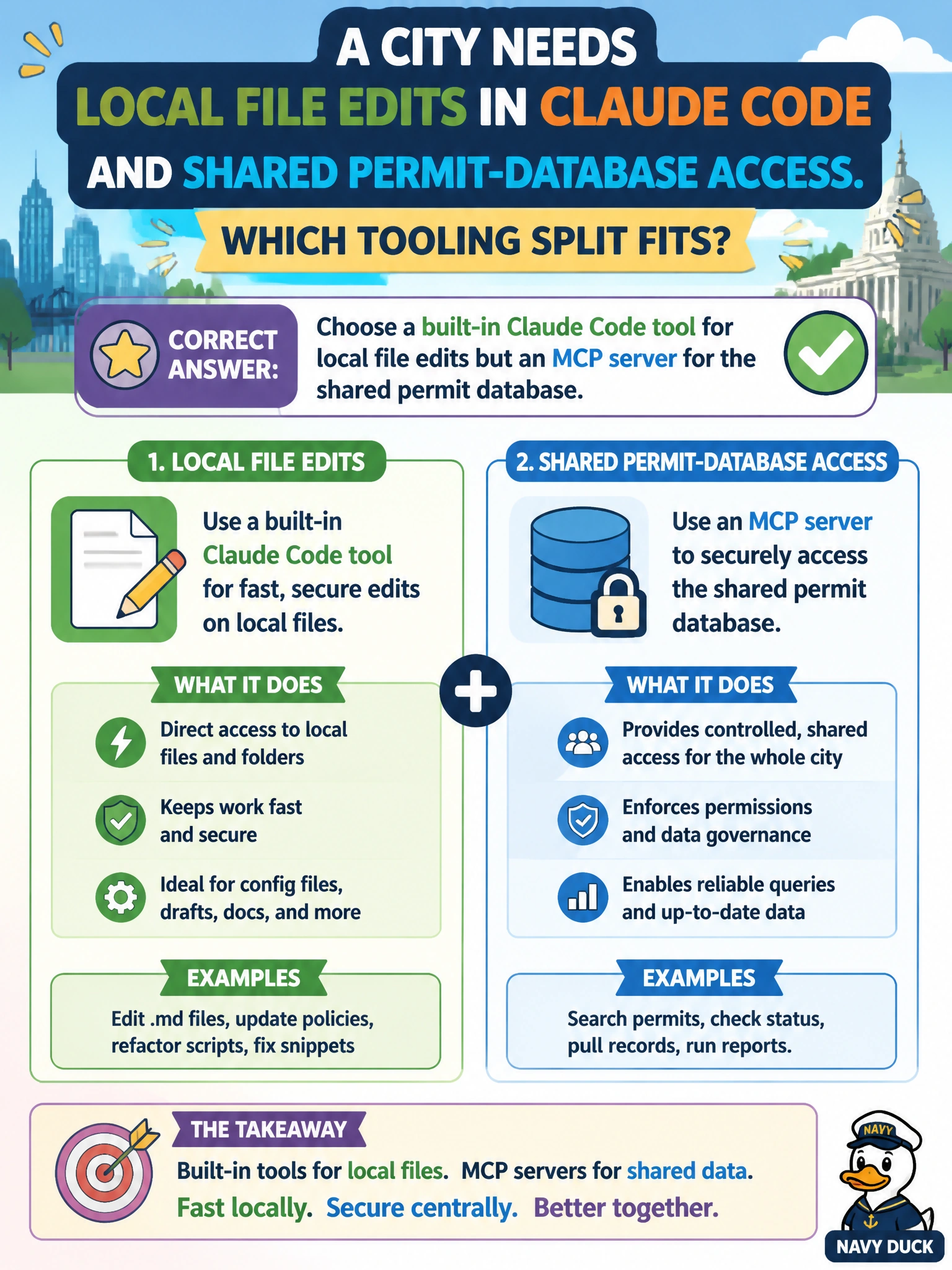
A city needs local file edits in Claude Code and shared permit-database access. Which tooling split fits?
Select an answer to reveal the explanation.
Short Explanation
Edit local files with built-in Claude Code tools; reach the shared permit database through an MCP—different jobs, different tools.
Full Explanation
Cities using Claude Code often need both local workspace edits and live shared municipal data. The fitting split is built-in Claude Code tools for local file edits—read, write, and search in the working tree—plus an MCP server for the shared permit database that many systems must query consistently. That matches locality: filesystem tools stay local to the engineer’s workspace; shared database access is centralized with one auth and schema path. Using a built-in Claude Code tool for shared permit database queries and an MCP server for local file edits reverses the correct split—built-in tools are scoped to the local workspace and cannot serve shared municipal systems, while an MCP server is unnecessary overhead for simple local edits. Using a Skill for local file edits and another Skill to run shared permit database queries misuses Skills, which are meant for guidance and context rather than direct filesystem writes or live database queries, so neither task belongs in a Skill. Keeping permit database usage guidelines in CLAUDE.md and accessing live permit rows with a Skill is wrong because Skills cannot perform live queries and return current permit rows, while live shared data belongs behind an MCP server. Exam caveat: Skills can document how to use the permit MCP, but documentation is not a substitute for the live query tool itself, and built-in file tools should not be pointed at production database files as a back door. Operational check: edit a local draft with built-in tools, query permits via MCP, confirm CLAUDE.md contains no bulk permit tables, verify a Skill alone cannot return live permit status without the MCP tool, and ensure permit credentials are held by the MCP host.