
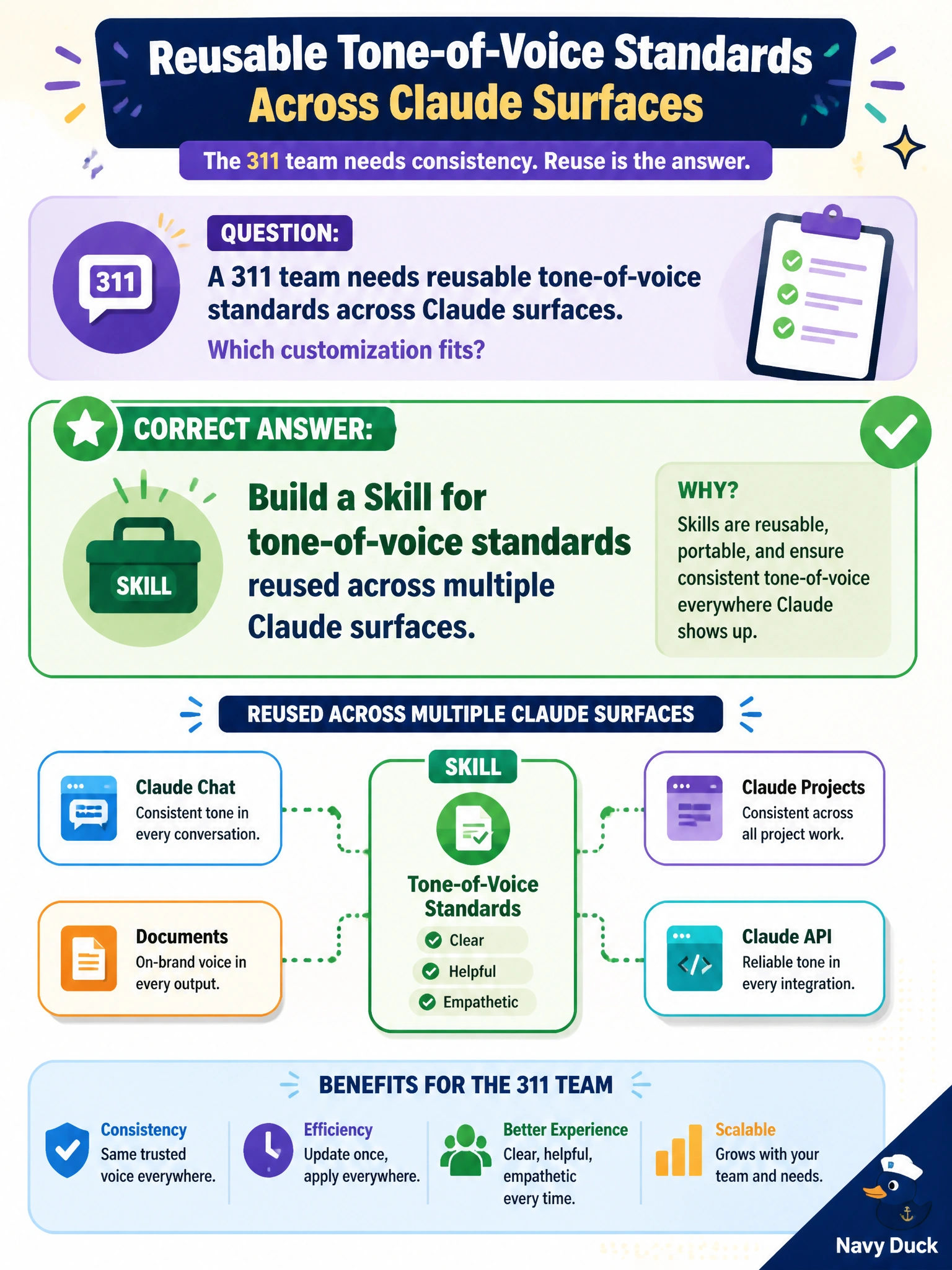
A 311 team needs reusable tone-of-voice standards across Claude surfaces. Which customization fits?
Select an answer to reveal the explanation.
Short Explanation
Tone-of-voice is guidance, not a database call—package it as a Skill and reuse it everywhere 311 speaks.
Full Explanation
Reusable tone-of-voice standards for 311 across Claude surfaces are procedural guidance, not live system access. Packaging them as a Skill lets multiple apps, chatbots, and agent harnesses load the same civic voice rules—plain language, empathy, escalation phrasing—without hosting tone rules as an MCP server for live retrieval, isolating them in one Project, or rewriting finalized replies through Hooks. Hosting tone-of-voice standards as an MCP server for live content retrieval turns static guidance into a networked service and adds operational burden without returning live data, when a Skill can simply be loaded by any Claude surface. Storing tone-of-voice standards in a single Project for isolated team use traps the rules in one workspace instead of sharing them across web, SMS, and call-center channels, guaranteeing drift and duplicated maintenance whenever communications policy changes. Applying tone-of-voice standards through a Hooks script that rewrites finalized replies confuses style instructions with output mutation and risks altering resident-facing responses after generation instead of guiding them consistently at the source. Exam caveat: Skills do not fetch live ticket state or create work orders—pair tone Skills with tools or MCP when the agent must read or write 311 systems, and keep tone Skills free of secrets. Operational check: attach the same tone Skill to two 311 surfaces, change one style rule in the Skill, confirm both surfaces reflect it on the next load, verify no MCP server for live retrieval, isolated Project, or Hooks rewrite is required to update voice guidance, and spot-check that responses still refuse to invent work-order creation from tone text alone.