
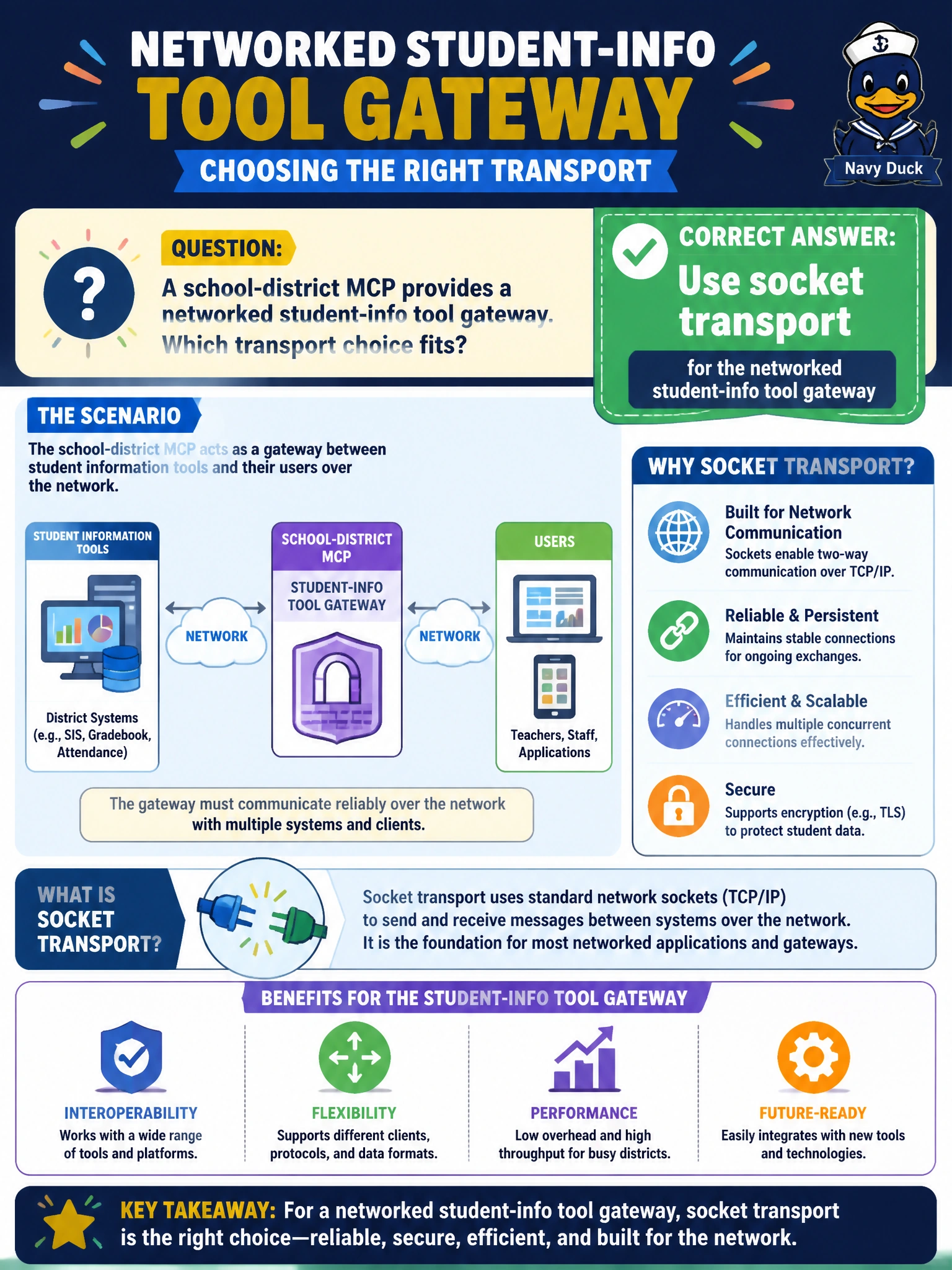
A school-district MCP provides a networked student-info tool gateway. Which transport choice fits?
Select an answer to reveal the explanation.
Short Explanation
You need sockets for a networked student-info gateway. Stdio's for local one-process chats, not campus-wide clients.
Full Explanation
A school-district MCP that provides a networked student-info tool gateway must use a transport suited to many remote clients—socket transport—so multiple campus or departmental consumers can connect concurrently over the network with proper authentication. Using stdio transport for the networked student-info tool gateway is a local, single-process pipe model and does not scale as a campus-wide gateway for attendance, roster, or counselor tools. Choosing stdio transport for the networked student-info tool gateway mismatches transport to topology and leaves remote apps unable to attach cleanly. Exposing Streamable HTTP on localhost for remote district clients binds the gateway to the local machine, so remote district clients cannot reach it and the topology does not match a district-wide network. Routing gateway calls through local in-memory pipes for remote schools keeps traffic on a single host and cannot reach remote schools, so it cannot support low-latency tool calls during school-day operations. Exam caveat: sockets require TLS, authentication, authorization, and network controls appropriate for student PII; choosing sockets without hardening is not a complete design, and logging must avoid dumping full student payloads into shared chats. Operational check: connect two remote MCP clients to the gateway over sockets, invoke the same student-info tool, confirm concurrent success with distinct service identities, verify stdio transport cannot serve those remote clients by design, and confirm unauthorized clients are rejected.