
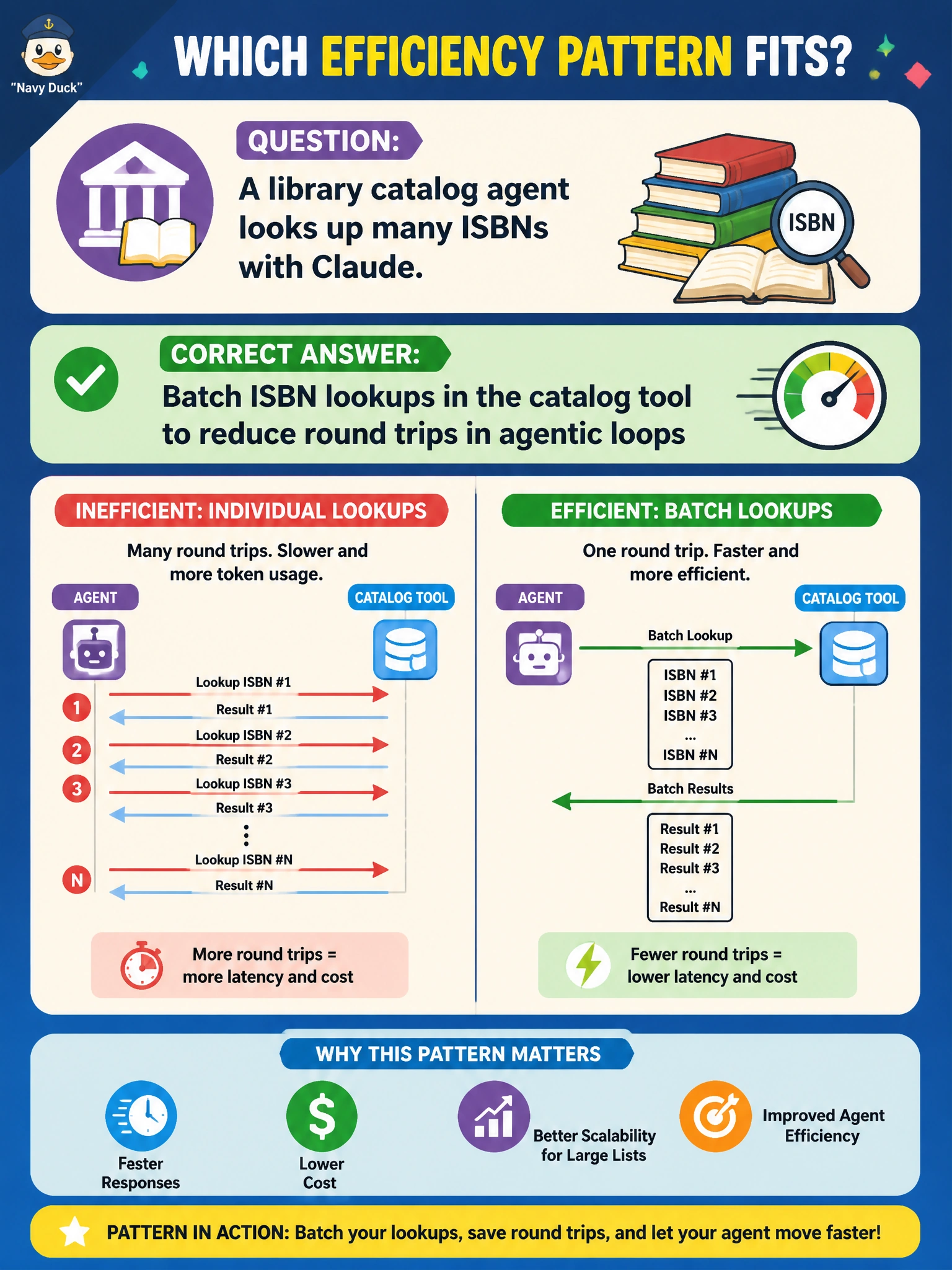
A library catalog agent looks up many ISBNs with Claude. Which efficiency pattern fits?
Select an answer to reveal the explanation.
Short Explanation
Caching catalog query prefixes in prompts won't cut your ISBN round trips—batch those catalog lookups instead. You'll still need one batched tool call to resolve many ISBNs at once.
Full Explanation
Library catalog agents that resolve many ISBNs inside agentic loops should batch lookups in the catalog tool to cut round trips, latency, and rate-limit pressure while keeping results structured for Claude. Batching is an efficiency pattern: one tool call returns many ISBN resolutions instead of serial chat-tool-chat cycles that dominate multi-title acquisition, weeding, or holds workflows. Caching catalog query prefixes in prompts to cut repeated token costs across loop turns does not reduce catalog round trips or parallelize ISBN lookups, so it fails to address the loop's main latency and still leaves per-ISBN serial calls. Splitting ISBNs across parallel subagents to cut per title lookup latency in large catalog runs adds orchestration overhead, risks rate-limit collisions, and does not reduce the total catalog round trips as cleanly as a single batched tool call. Compressing ISBN responses with summarization to keep context windows compact in loops loses the structured per-ISBN identifiers and availability the agent needs, and summarization does not eliminate the underlying catalog round trips. Exam caveat: batch size should respect API limits and failure isolation—partial batch errors must still return per-ISBN structured results so one bad ISBN does not invalidate the whole set. Operational check: resolve a list of N ISBNs with a batched tool versus N single calls, compare wall-clock time and tool-call counts, confirm failed ISBNs in a batch do not mark successful ones as found, and verify Claude can continue the loop using the structured per-ISBN map.