
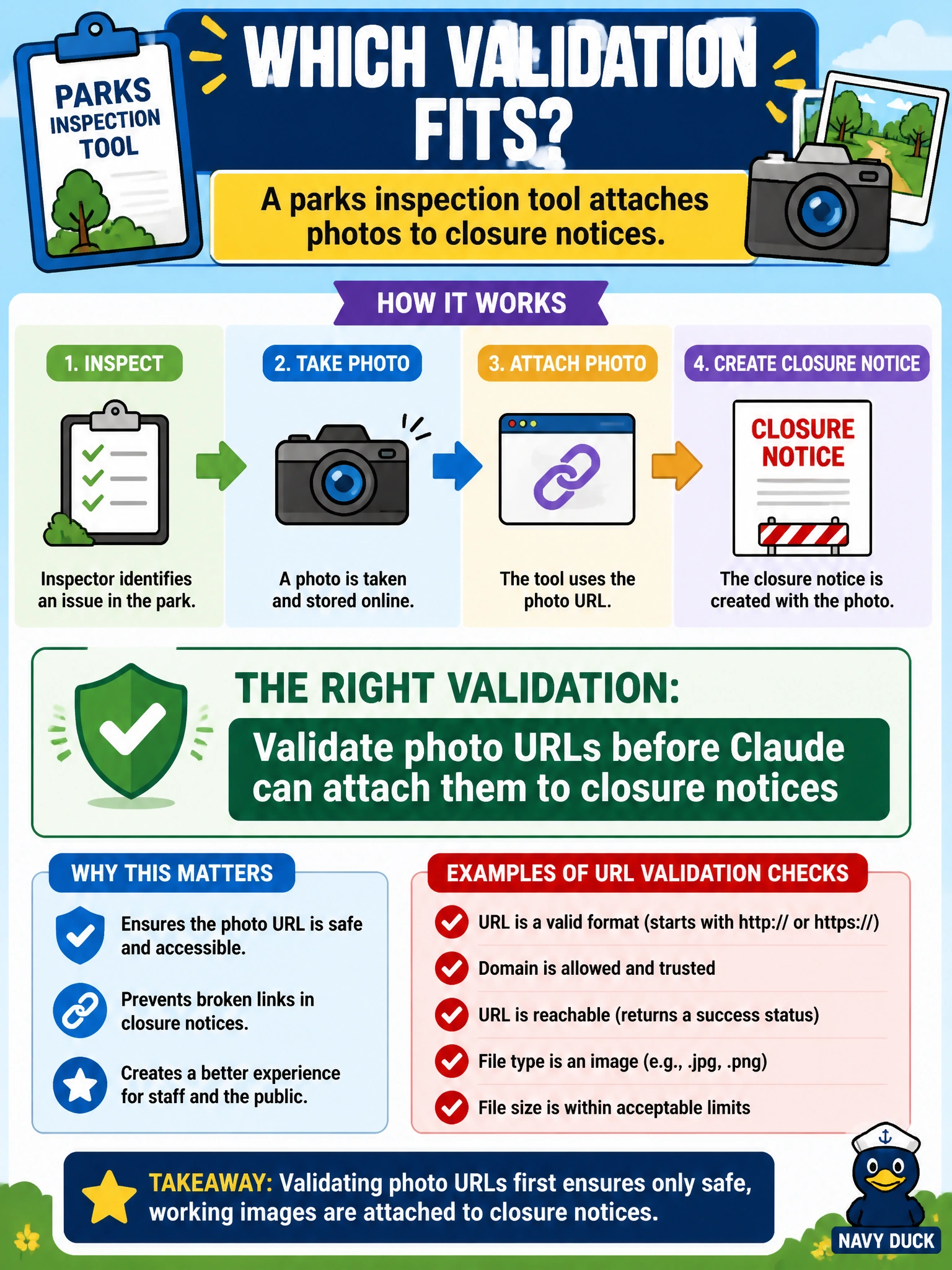
A parks inspection tool attaches photos to closure notices. Which validation fits?
Select an answer to reveal the explanation.
Short Explanation
Before a closure notice gets a photo glued on, validate that URL—junk links don't belong on park signs. Checking the file size, the display dimensions, or the notice text afterward doesn't catch a bad link before it's already attached.
Full Explanation
Parks inspection tools that attach photos to closure notices must validate photo URLs—and similarly local paths—before attachment so public notices do not embed attacker-controlled, internal, or broken content. Validation typically checks scheme, allowlisted hosts or object-store prefixes, optional reachability or content-type checks, and rejects arbitrary remote URLs that could enable SSRF or malware hosting through municipal publishing channels. The correct fit is validating photo URLs before Claude can attach them to closure notices. Validating photo file size after Claude attaches it to closure notices comes too late; the image is already embedded in the notice, so size checks cannot prevent attacker-controlled or broken content from reaching park gates and websites. Verifying photo display dimensions when rendering closure notices for reviewers addresses only how an image looks on screen, not whether its URL is safe or allowlisted, so it does not stop unsafe remote content from being attached in the first place. Validating closure notice text with a policy check before attaching approved photos reviews the notice wording but says nothing about the photo URLs themselves, leaving the door open for unvalidated or malicious image links in published notices. Exam caveat: validation belongs in the tool or server boundary, not only in prompt instructions that Claude might ignore under pressure; client-side checks alone are insufficient for public publishing. Operational check: submit a well-formed allowlisted object-store URL, a disallowed script-based URI scheme, and an off-allowlist https URL; confirm only the allowlisted asset attaches, that rejected attempts return structured errors without modifying the notice, and that published HTML contains no unvalidated remote src values.