
A public-health chatbot handles sensitive encounter details with Claude. Which confidentiality practice fits?
Select an answer to reveal the explanation.
Short Explanation
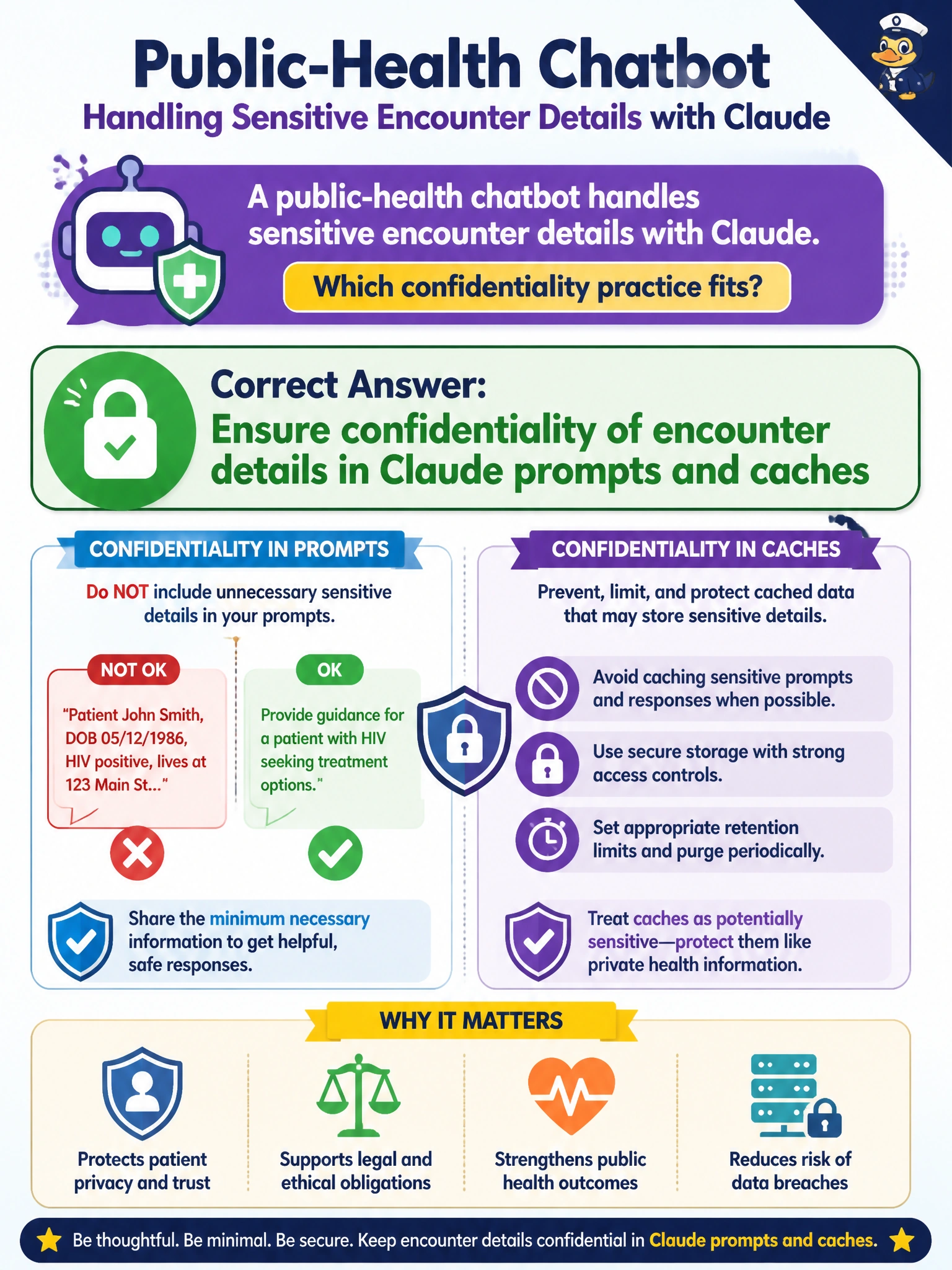
Encounter details are sensitive—keep them confidential in both the Claude prompts and any caches you keep.
Full Explanation
Ensuring confidentiality of encounter details in Claude prompts and caches is the right privacy practice for public-health chatbots. That practice works because encounter text may include diagnoses, locations, and identifiers; those details must be protected not only in the live response but also in prompt construction, temporary caches, and reuse buffers that operators might overlook. Confidentiality across prompt and cache surfaces reduces leakage in municipal health operations.
Enabling Claude prompt caching for encounter details to reduce latency fails because prioritizing speed can leave sensitive clinical context in caches without the confidentiality controls the correct option requires. Routing encounter details through standard logging pipelines for quality audits fails because standard logging pipelines are not designed to protect sensitive clinical encounter data with the required confidentiality controls. Applying content safety filters to encounter prompts to block harmful outputs fails because content safety filters address harmful outputs, not the confidentiality of sensitive encounter details.
Exam caveat: confidentiality controls must match the data class—de-identification, encryption, TTL, and access logging may all be required depending on health and municipal policy. Operational check: classify encounter fields, encrypt or avoid caching raw details, set short TTLs, restrict cache ACLs to the health app service account, and audit prompt/cache stores for residual encounter text after sessions end.