
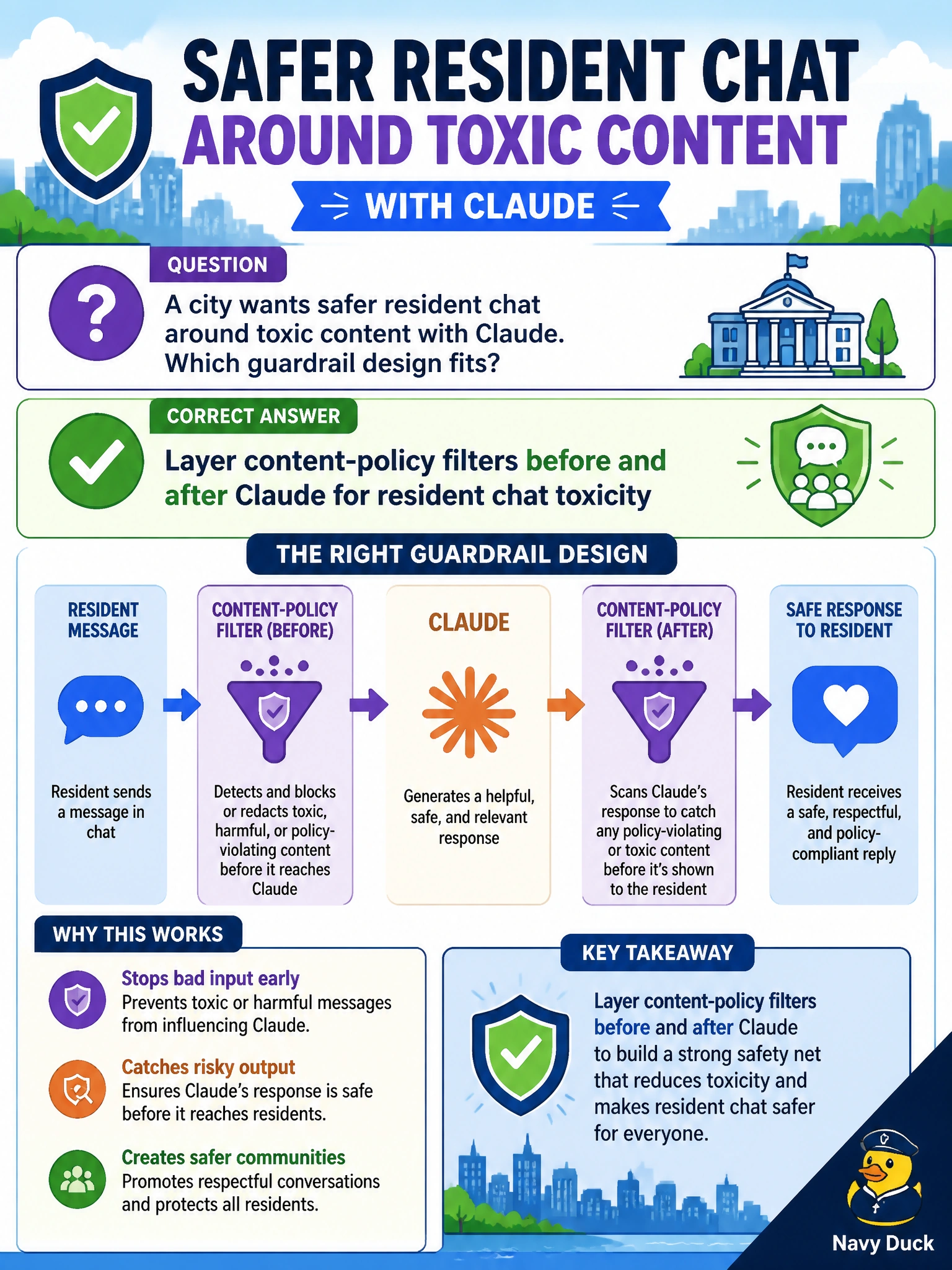
A city wants safer resident chat around toxic content with Claude. Which guardrail design fits?
Select an answer to reveal the explanation.
Short Explanation
Sandwich Claude with content-policy filters before and after so toxic resident chat doesn't slide into public 311 threads. You need input screening to stop bad text from entering the model and output screening to catch anything the model still generates. That defense-in-depth keeps civic channels safer.
Full Explanation
Layering content-policy filters before and after Claude for resident chat toxicity is the guardrail design cities should use for safer public assistants. That design works because input filters can block or scrub toxic resident text before it enters the model context, while output filters catch unsafe generations before they reach 311 or other civic channels. Defense in depth reduces single-point failure when either the model or one filter misses a case.
Filtering incoming resident messages with a slur blocklist for chat toxicity control fails because it protects only the input boundary; Claude can still emit unsafe resident-facing text under adversarial or heated prompts, and a blocklist alone is not a control. Screening Claude outgoing replies with a post-output toxicity classifier for safety while skipping input screening fails because toxic input can enter the model context and shape the response, and a single classifier leaves a single point of failure. Logging resident chat toxicity events to a dashboard for later moderator review fails by leaving the municipal channel unprotected at both boundaries in real time and by ignoring observed harm in production until after the fact.
Exam caveat: filters can over-block legitimate anger about city services; tune policies with civic context so residents can complain about potholes without being silenced as toxic. Operational check: deploy pre- and post-filters with logged decisions, review false-positive samples with 311 leads, measure toxic-output escape rate, and require dual-filter health checks in the city's safe-deployment dashboard.