
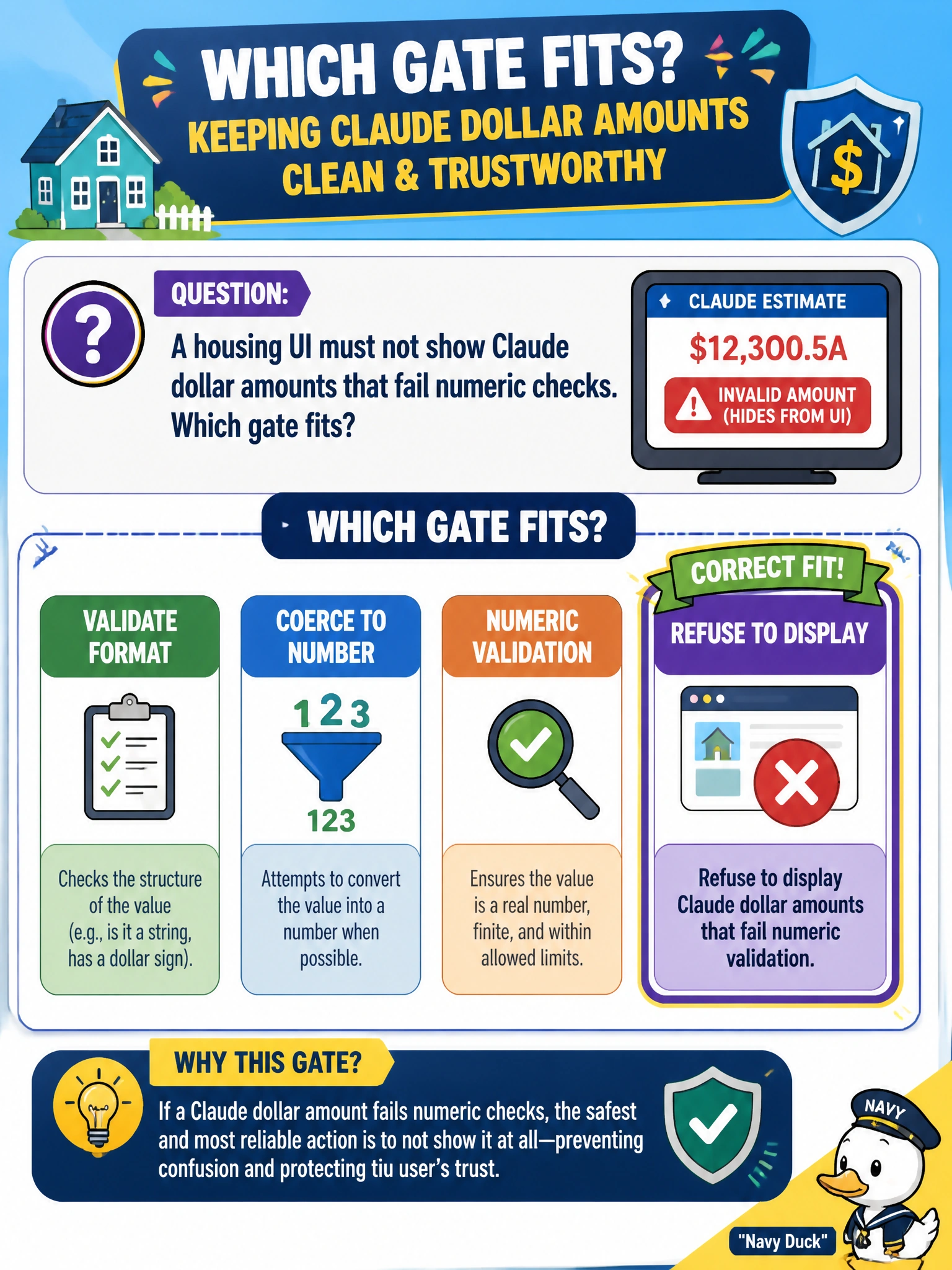
A housing UI must not show Claude dollar amounts that fail numeric checks. Which gate fits?
Select an answer to reveal the explanation.
Short Explanation
If the dollar amount doesn't pass numeric validation, don't put it on the resident's screen—blank beats a bad figure. Logging, formatting, or caching a number only matters once it's already valid—none of those catch the broken one.
Full Explanation
Refusing to display Claude dollar amounts that fail numeric validation is the correct UI gate for housing resident interfaces. That gate works because invalid currency strings—extra symbols, impossible magnitudes, non-numeric tokens—can mislead applicants about rent, deposits, or benefit estimates. Blank or explicit "unavailable" states are safer than showing a bad figure that looks authoritative on a municipal screen. Logging Claude dollar amounts passing validation for audit history fails as a UI gate because it only records valid figures and does nothing to stop invalid ones from reaching the resident screen. Formatting Claude dollar amounts passing validation for display consistency fails as a gate because it only changes how valid figures look and does not block invalid amounts that failed numeric checks. Caching Claude dollar amounts passing validation to reduce UI latency fails as a gate because it speeds up valid figures while leaving no barrier to invalid dollar strings being shown to residents. Exam caveat: numeric validation is syntactic/range checking, not eligibility determination; a well-formed number can still be programmatically wrong and needs policy engines or human review where required. Operational check: parse and range-check every Claude money field, suppress display on failure, log the raw string for debugging without showing it, and alert housing product owners when suppression rates rise after a prompt change.