
A court export job consumes Claude summaries for legal clerks. Which defensive parse step fits?
Select an answer to reveal the explanation.
Short Explanation
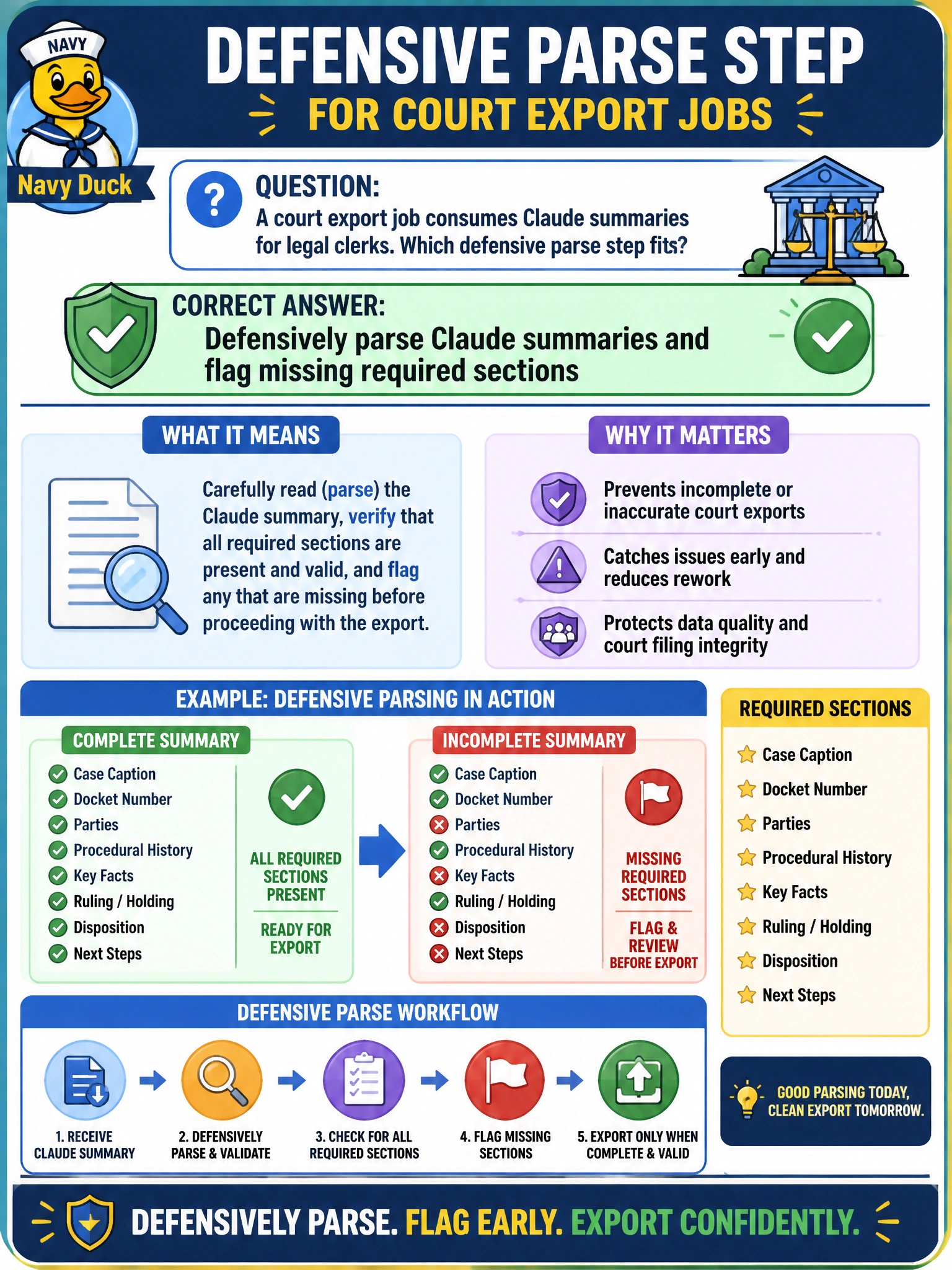
You can't rely on Claude's stop reason to prove every required section is there, and prettifying markdown won't catch gaps either. Caching an old parse won't verify this summary, so parse it and flag what's missing.
Full Explanation
Defensively parsing Claude summaries and flagging missing required sections protects court export jobs that legal clerks depend on. That step works because model summaries can omit holdings, parties, dates, or seal indicators while still reading smoothly. Explicit section checks convert "sounds complete" into a machine-verifiable export gate before clerks rely on the package for calendaring or disclosure decisions.
Trusting Claude stop reasons to confirm required sections exist fails because stop reasons only explain why generation ended, not whether required sections are actually present. Normalizing summary markdown styling for consistent clerk export formatting fails because cosmetic formatting doesn't verify that required sections exist; it only changes how the output looks. Caching prior summary parses to accelerate repeat export jobs fails because cached results from earlier runs can't verify the current summary's required sections, and Claude output can vary between jobs.
Exam caveat: section presence does not guarantee section quality; a present but wrong holding still needs human legal review. Operational check: maintain a required-section manifest per export type, parse Claude output against it, block export and queue for clerk review when any section is missing, and trend missing-section rates by prompt version.