
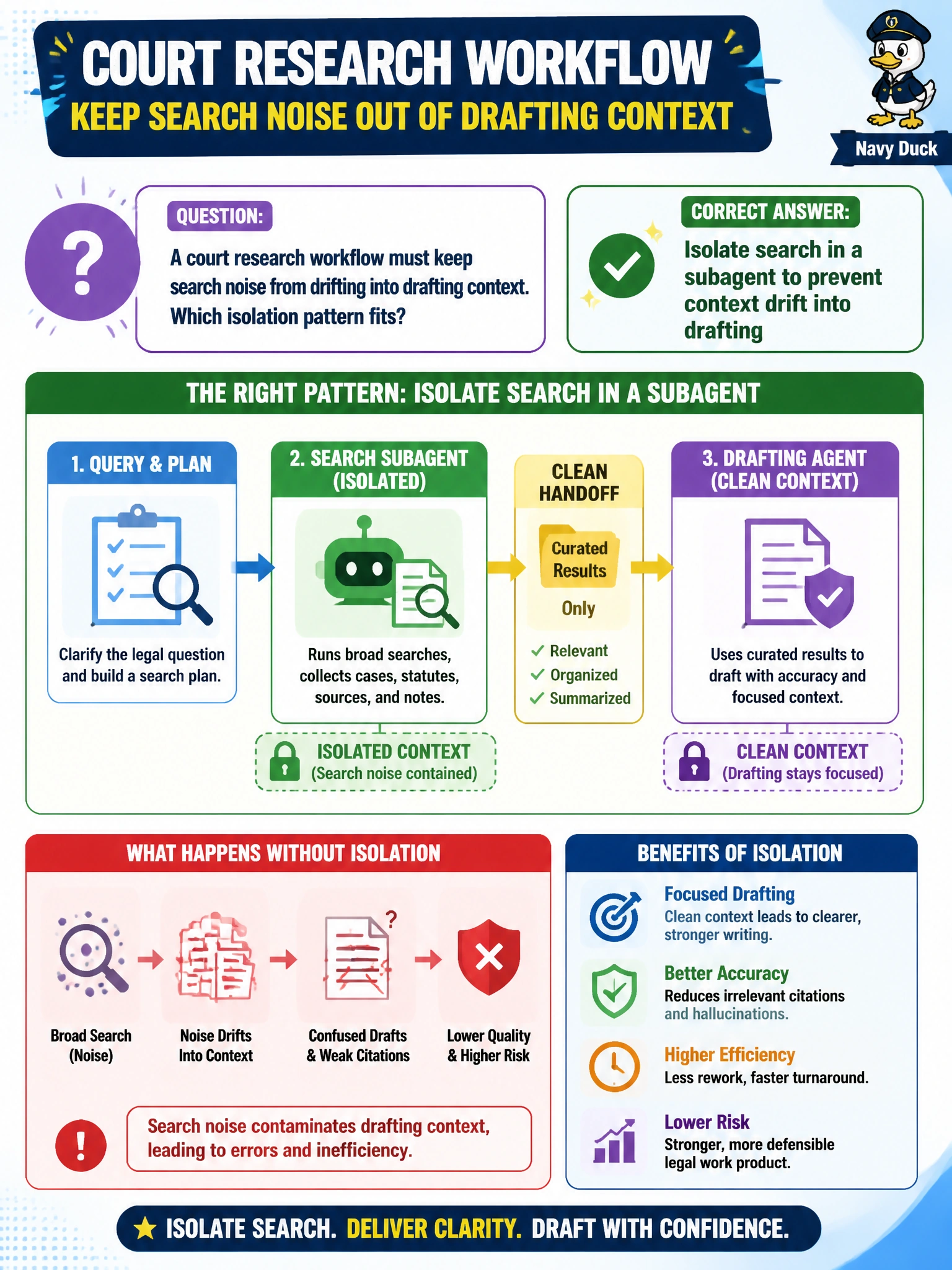
A court research workflow must keep search noise from drifting into drafting context. Which isolation pattern fits?
Select an answer to reveal the explanation.
Short Explanation
Search dumps muddy drafting—park the hunt in a subagent so the parent thread stays clean for the brief.
Full Explanation
Isolating search in a subagent to prevent context drift into drafting is the right pattern for court research workflows because search dumps are noisy while drafting needs a clean, citation-focused thread. A subagent can chase case-law hits, filter irrelevance, and return a curated brief of authorities; the parent drafting agent then writes from that distillation instead of from an unbounded mash of raw hits. Isolation keeps retrieval entropy from contaminating tone, structure, and citation discipline in the clerk-facing draft.
Summarizing search hits in the parent thread before starting drafting fails because the summary still lands in the drafting context, bringing irrelevant details, conflicting passages, and distractors that pull the draft off-issue instead of keeping search noise isolated. Mirroring drafting context into the search agent for better relevance tuning fails because it couples the two contexts instead of isolating them, letting drafting concerns bleed into research and search noise bleed back into the draft. Caching prior search results in shared memory for reuse across drafting tasks fails because shared memory lets stale or irrelevant search results drift into multiple drafting threads, so research noise is not isolated from the drafting context.
Exam caveat: subagent isolation still requires a strict handoff schema (cited holdings, pinpoint cites, adverse authority flags); a vague prose dump from the subagent recreates drift in miniature. Operational check: run a research-then-draft scenario with isolation enabled, inspect parent context for absence of raw search HTML/snippets, and score drafts for on-issue citations versus a non-isolated baseline.