
A 311 session nears the context-window limit during a long resident chat. What management step fits?
Select an answer to reveal the explanation.
Short Explanation
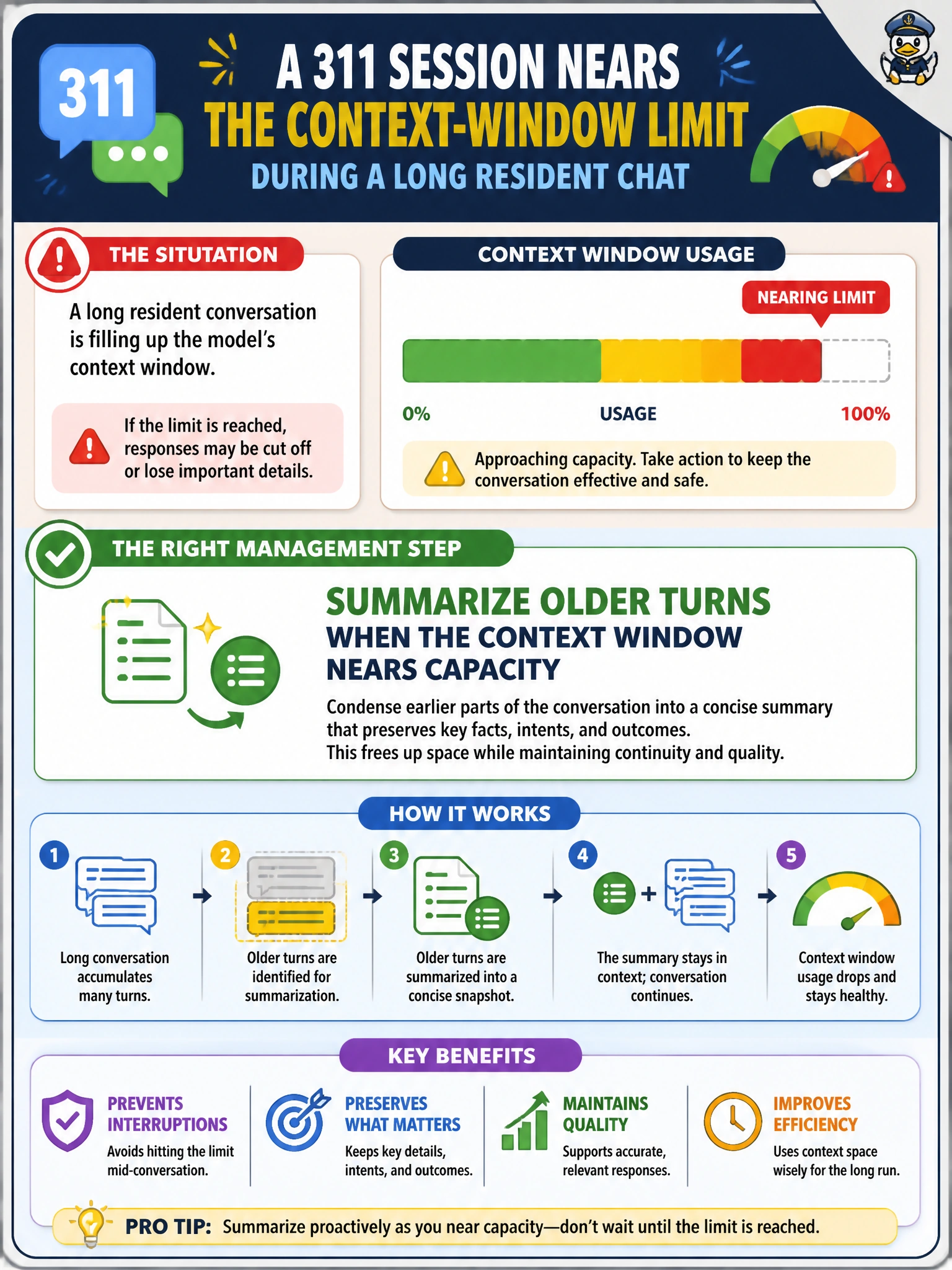
Long 311 chats fill up—summarize the older turns when the window's getting tight so the ticket still fits.
Full Explanation
Summarizing older turns when a 311 session nears the context-window limit is the correct management step because long resident chats accumulate status updates, clarifications, and tool results that eventually exhaust Claude’s window. Compaction preserves ticket goals, open addresses, and commitments while reclaiming tokens from redundant chit-chat and repeated confirmations. The resident experience continues with continuity of intent instead of an abrupt hard failure when the window fills.
Truncating history to recent turns to stay within token budget fails because it cuts out earlier resident details, ticket goals, and commitments that may still be relevant, replacing intelligent compaction with a blind hard cut that loses continuity. Storing the full transcript in ticket notes and resuming with empty context fails conceptually—it dumps the civic work product into notes but starts the model with no active context, forcing the resident to repeat themselves and breaking the flow of the request. Raising sampling temperature to compress older turns in place fails because temperature controls randomness in generated responses, not token usage; it cannot shrink older messages or create room in a full context window.
Exam caveat: naive summaries can omit a critical constraint the resident stated early (accessibility need, callback number); use structured summary schemas that force those fields to persist. Operational check: replay a long 311 transcript until near capacity, trigger summarization, confirm key ticket fields remain in the compact prefix, and verify subsequent Claude turns still route and respond correctly within the remaining window.