
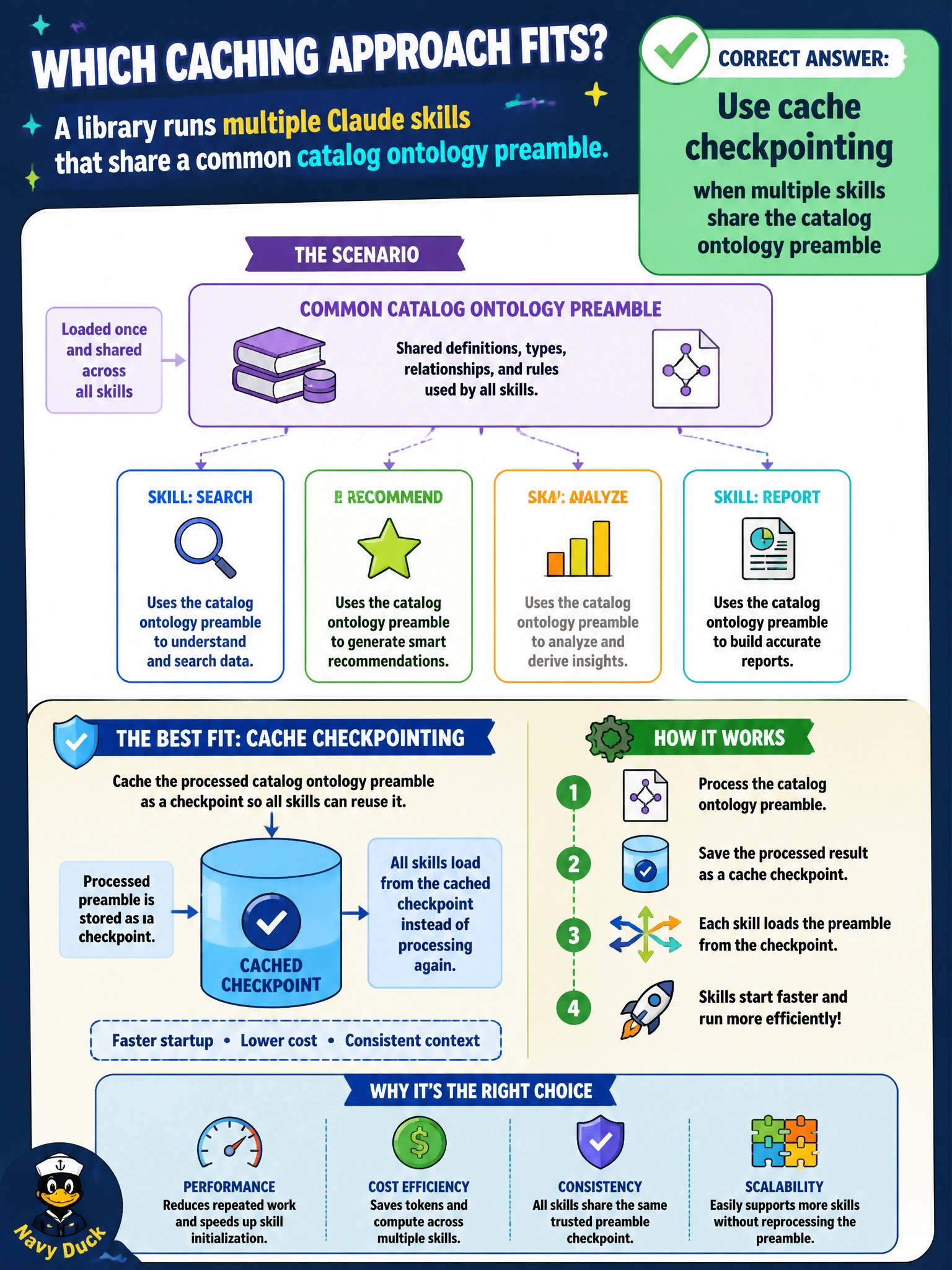
A library runs multiple Claude skills that share a common catalog ontology preamble. Which caching approach fits?
Select an answer to reveal the explanation.
Short Explanation
Same ontology, many skills—checkpoint that shared catalog preamble so you're not rebuying it every call. Breaking the checkpoint up per call, caching whole transcripts, or fetching it fresh each time just brings the cost right back.
Full Explanation
Using cache checkpointing when multiple library skills share a catalog ontology preamble is the correct caching approach because the ontology is a large, stable shared prefix across skill invocations. Checkpointing lets subsequent skills reuse the already-cached ontology tokens instead of rebuilding them as fresh input on every call, which matters when circulation, reference, and discovery skills all start from the same catalog concepts. Shared checkpointing preserves consistency of ontology wording while cutting repeated token spend across the skill fleet.
Setting cache breakpoints after variable arguments for each separate individual skill call fails because it fragments the shared ontology prefix, preventing skills from reusing the same cached checkpoint and forcing repeated reconstruction of the stable catalog concepts. Enabling extended cache lifetime for complete skill execution transcripts across separate sessions fails because it caches variable, session-specific outputs rather than the immutable shared preamble, risking stale transcript reuse without reducing the ontology prefix cost. Loading the ontology with just-in-time retrieval inside each skill execution context fails because it fetches the shared prefix fresh on every call instead of reusing an established checkpoint, so the library still pays repeatedly for the same catalog structure.
Exam caveat: skills that mutate or specialize the ontology mid-session can invalidate checkpoints; treat the shared preamble as immutable for cache purposes and version specialized overlays separately. Operational check: invoke two skills that declare the same ontology checkpoint, confirm the second call records a cache hit on the shared prefix, and re-run after an ontology version bump to prove the new checkpoint ID is required before hits resume.