
A school district must control cost spikes on student homework helpers. Which output control fits?
Select an answer to reveal the explanation.
Short Explanation
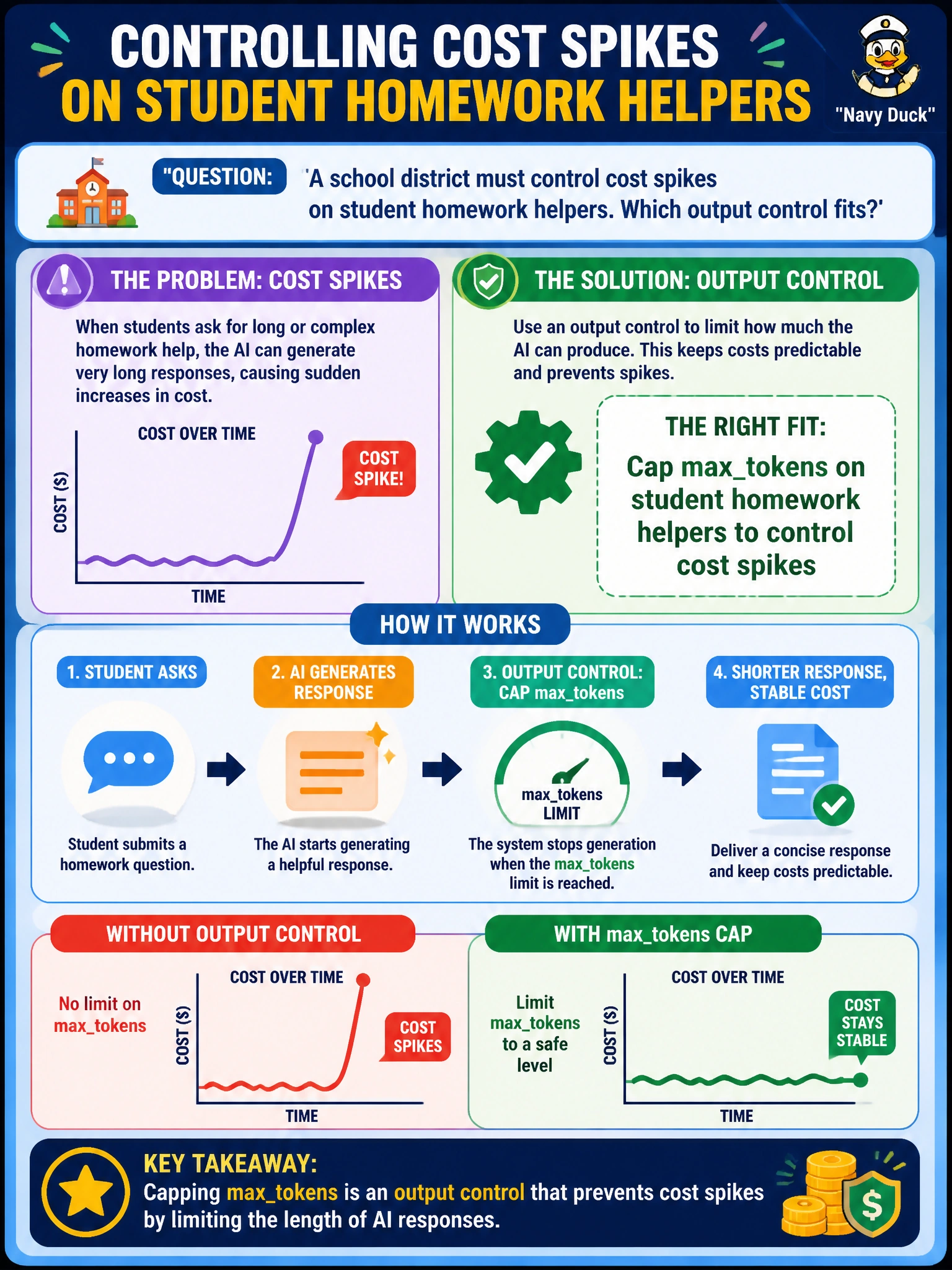
Homework helpers can ramble—cap max_tokens so one chat spiral doesn't torch the district budget.
Full Explanation
Capping max_tokens on student homework helpers controls cost spikes because output length is a primary driver of Claude spend on chatty educational assistants. School districts face bursty evening usage; streaming replies in real time doesn't limit total tokens, so a few verbose sessions can still dominate the month’s budget and crowd out other instructional tools. A deliberate max_tokens ceiling keeps answers usefully bounded, encourages concise tutoring style, and gives FinOps a hard stop when demand surges.
Streaming homework replies in real time fails because it bills for every generated token regardless of delivery speed, so runaway completions can still be expensive and pedagogically weaker than focused guidance. Raising temperature on homework helpers fails conceptually—higher randomness doesn't cap output length and can produce longer, less focused replies, so it swaps a hard limit for unpredictable billing. Tuning top_p sampling on homework helpers fails because sampling adjustments don't bound output length; student volume is typically the larger spike risk and needs a hard token ceiling, not just a probability nudge.
Exam caveat: caps that are too aggressive can truncate worked examples mid-solution; tune by subject and grade band, and pair with clear “continue” UX rather than a single tiny ceiling for every course. Operational check: load-test homework helpers at peak concurrent students with the chosen max_tokens, chart cost per session and truncation rate, and adjust the cap until finance and curriculum owners both accept the tradeoff.