
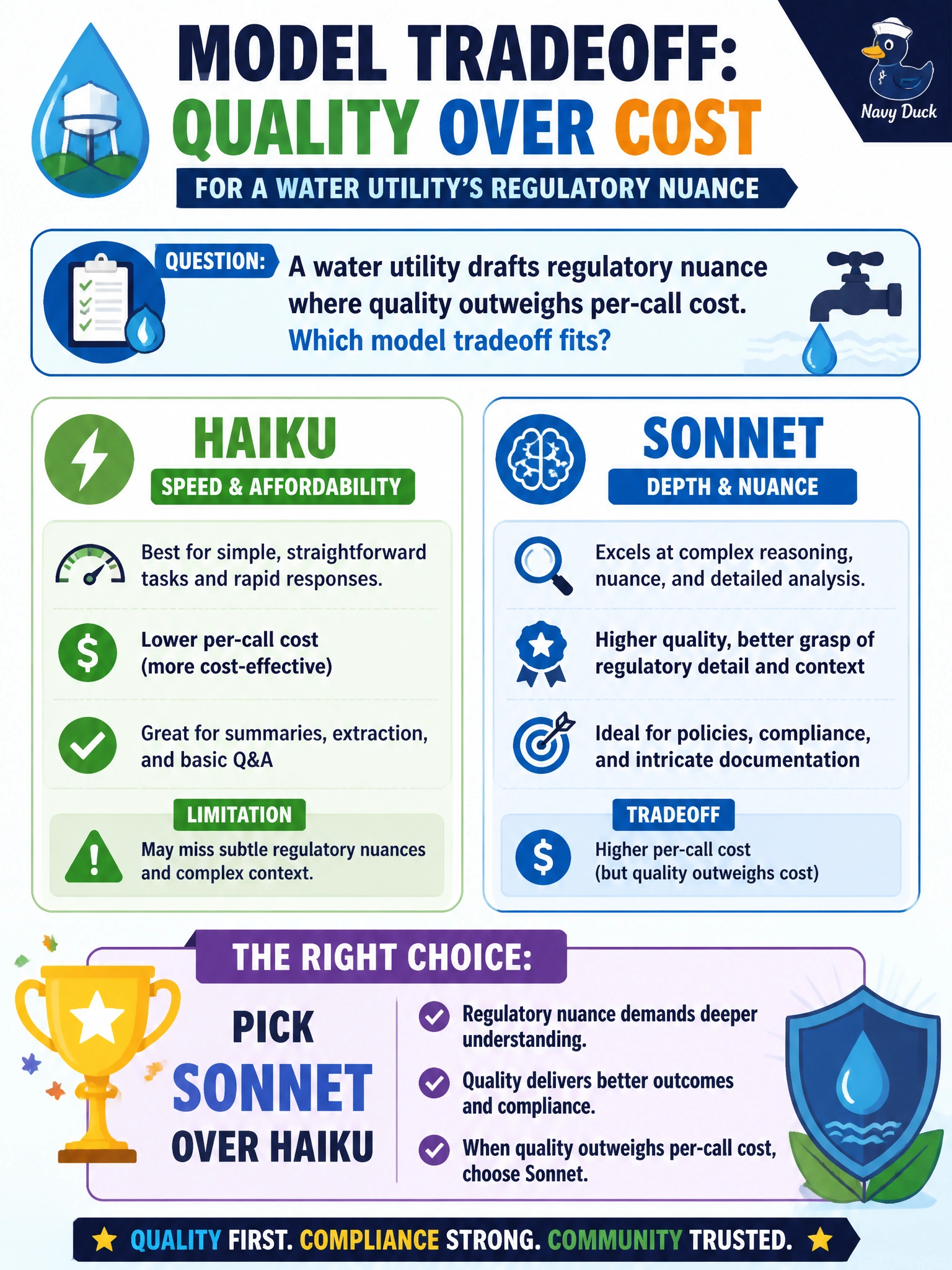
A water utility drafts regulatory nuance where quality outweighs per-call cost. Which model tradeoff fits?
Select an answer to reveal the explanation.
Short Explanation
Compliance wording isn't the place to pinch pennies—if nuance matters more than nickels, pick Sonnet over Haiku.
Full Explanation
Picking Sonnet over Haiku when regulatory nuance outweighs per-call cost is the correct water-utility tradeoff because compliance language, permit conditions, and enforcement nuance demand higher instruction fidelity than routine FAQ triage. When a wrong clause paraphrase can misstate discharge limits or monitoring duties, the marginal token cost of a stronger model is cheaper than remediation, regulator friction, or public trust damage. Sonnet is therefore the proportionate choice for drafting where quality is the dominant constraint and volume is secondary.
Using Haiku over Sonnet for compliance drafts to reduce latency and cost fails because it asserts a false economy—many compliance passages are exactly where weaker models hallucinate or oversimplify. Routing compliance drafts to Opus for routine summaries to conserve budget fails conceptually by overspending on simple tasks instead of matching model tier to risk. Preferring Haiku with extended context for nuanced regulatory interpretation tasks fails because unit-price optimization that misses the accuracy bar is not savings; it is deferred liability for the utility.
Exam caveat: Sonnet is not automatically correct on every regulation—grounding in the utility’s approved policy corpus and human legal review remain mandatory for enforceable language. Operational check: score Haiku vs Sonnet on a sealed set of regulatory drafting prompts with counsel-rated rubrics, compare cost per accepted draft, and route only the nuance class to Sonnet while leaving low-risk FAQs on cheaper tiers.