
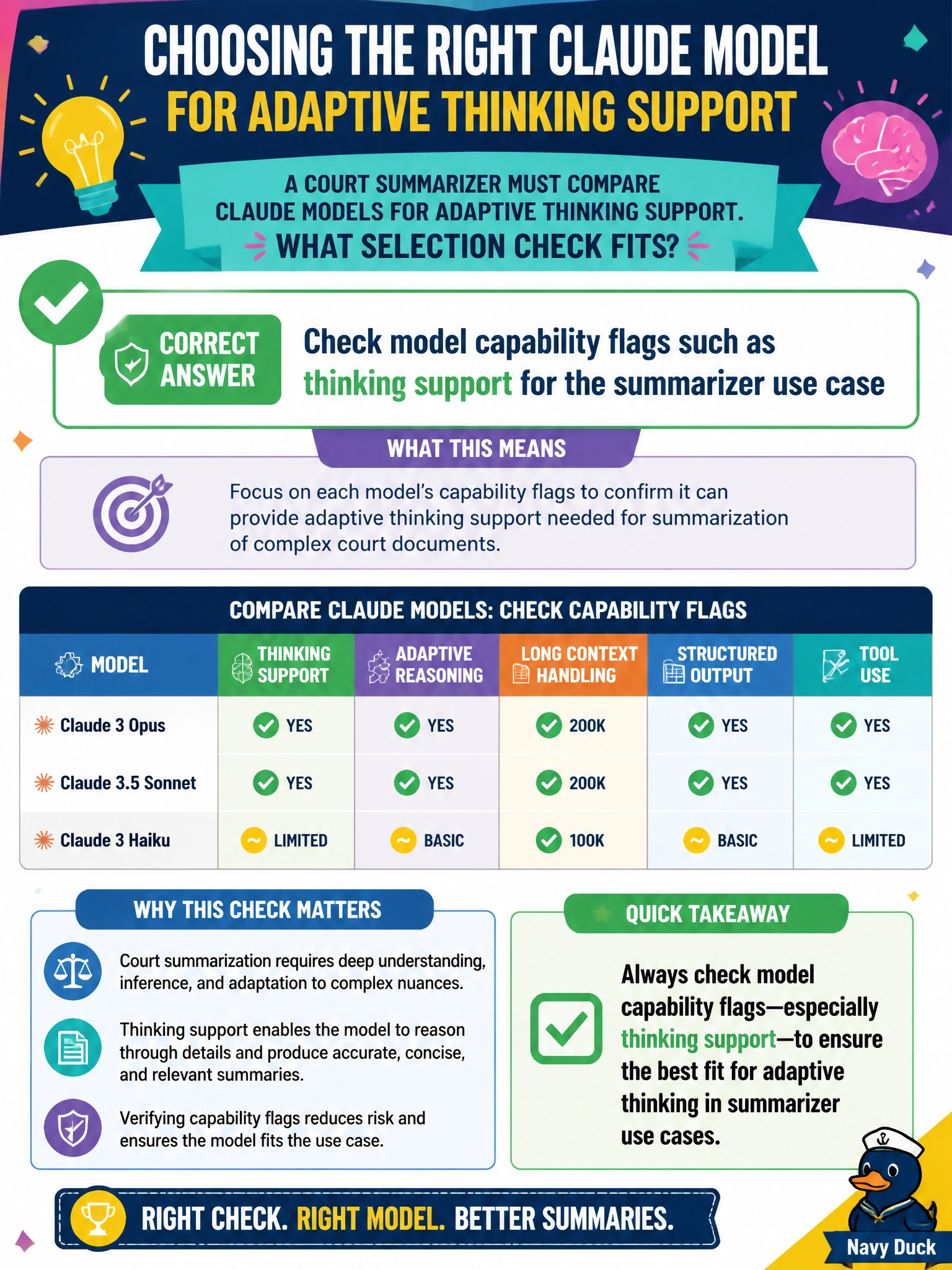
A court summarizer must compare Claude models for adaptive thinking support. What selection check fits?
Select an answer to reveal the explanation.
Short Explanation
Not every model thinks the same way—check the capability flags, especially thinking support, before you pick for court summaries.
Full Explanation
Checking model capability flags such as thinking support for a court summarizer use case is the correct selection step because Claude tiers are not feature-identical. Adaptive thinking (extended deliberation) can improve summarization of complex filings, multi-issue dockets, and conflicting exhibits, but only when the chosen model actually exposes that capability. Capability-aware comparison prevents a court IT team from buying a tier that offers vision support yet lacks the deliberation features the summarizer workflow assumes.
Checking model capability flags such as vision support for the summarizer use case fails because vision support addresses image or multimodal input, not the API-supported thinking features needed for judicial summarization quality. Checking model capability flags such as prompt caching for the summarizer use case fails conceptually—tiers differ in reasoning depth and thinking availability, and prompt caching does not confer adaptive thinking, so relying on it leads to runtime surprises. Checking model capability flags such as extended output tokens for the summarizer use case fails because extended output controls response length rather than deliberation, and focusing on it overlooks the thinking capability that may be material for long, contested filings even if simpler dockets do not need it.
Exam caveat: capability flags change over time; a model that lacks thinking today may gain it later, and enabling thinking can increase latency and cost that court SLAs must absorb. Operational check: query the provider’s model capability metadata for each candidate, run paired summarizer evals with thinking on and off on sealed sample filings, and record which flag combinations meet clerk quality and turnaround requirements before procurement locks a tier.