
A city routes high-volume 311 intent labels and nuanced ordinance drafts to Claude. Which model split fits?
Select an answer to reveal the explanation.
Short Explanation
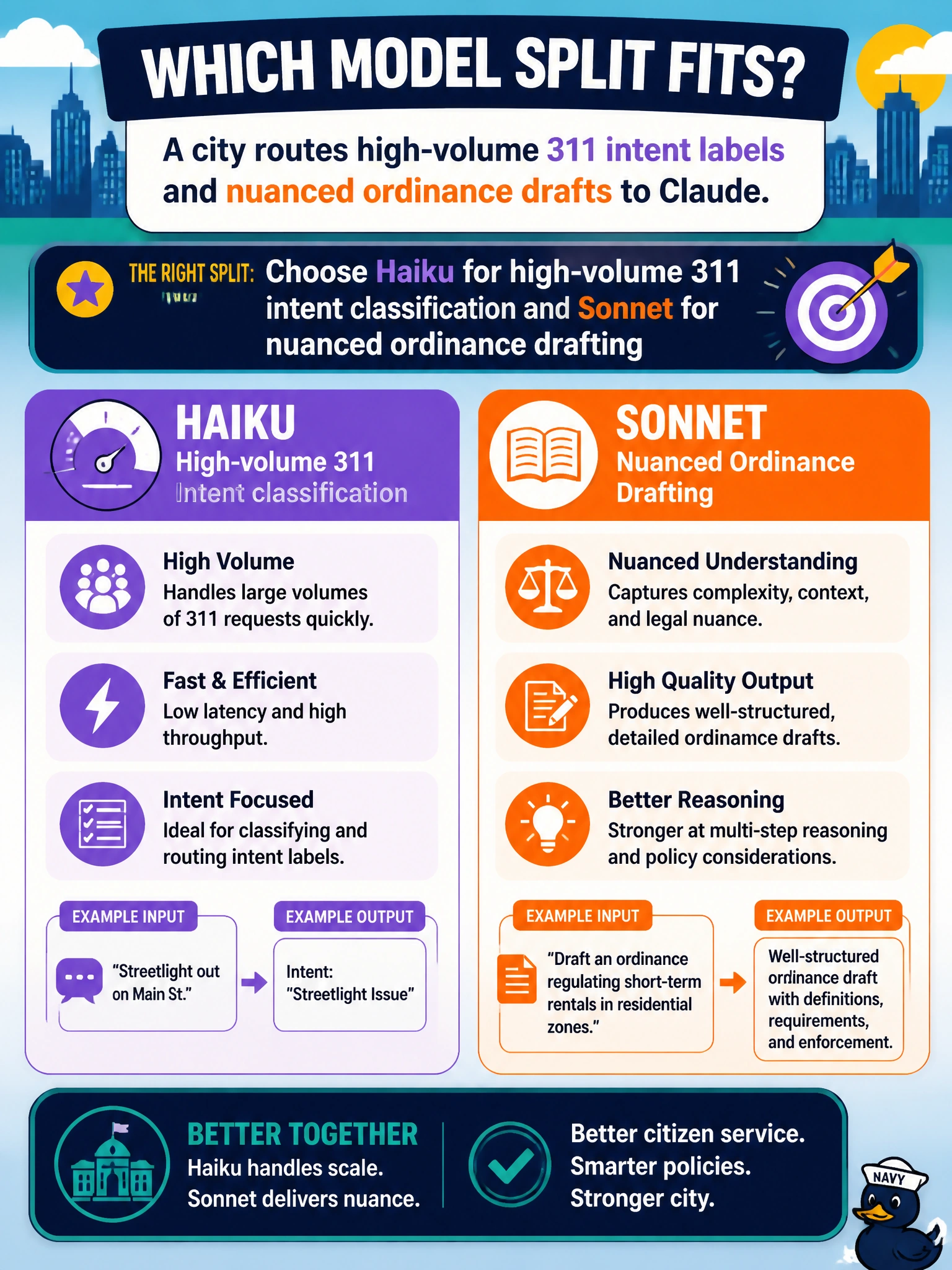
You don't need a heavyweight model to sort routine 311 tickets, and you don't want a lightweight one drafting legal text either. Haiku handles the high-volume intent labels fast and cheap, while Sonnet takes on the nuanced ordinance drafting that needs careful wording.
Full Explanation
Choosing Haiku for high-volume 311 intent classification and Sonnet for nuanced ordinance drafting matches Claude model tiers to civic task shape. Intent labels on inbound 311 traffic are repetitive, latency-sensitive, and cost-sensitive; Haiku’s speed and price fit that firehose when accuracy bars are met. Ordinance drafting needs richer instruction following, careful phrasing, and fewer catastrophic wording errors, so Sonnet is the proportionate step up. The split preserves budget for volume while reserving stronger models for work where quality dominates. Choosing Opus for high-volume 311 intent classification and Sonnet for nuanced ordinance drafting work fails because it assigns the most expensive model to repetitive, latency-sensitive ticket labels, inflating municipal spend without a matching accuracy gain on routine classification. Using Haiku for the nuanced ordinance drafting work and Opus for the simple intent labels fails conceptually because it inverts the quality-cost curve—the cheaper model lands on high-stakes legal nuance while the pricier model labels trivial tickets. Choosing Haiku for high-volume 311 intent classification and nuanced ordinance drafting fails because it pushes nuanced ordinance drafting onto a model built for speed rather than the careful phrasing and instruction following that legal text requires. Exam caveat: a static Haiku/Sonnet split still needs periodic evals; intent drift, new ordinance domains, or Haiku regressions can flip which tier clears the accuracy bar. Operational check: maintain separate eval sets for 311 labeling and ordinance drafting, track cost per thousand tickets versus draft acceptance rate, and require a documented promotion path when a task class outgrows its assigned tier.