
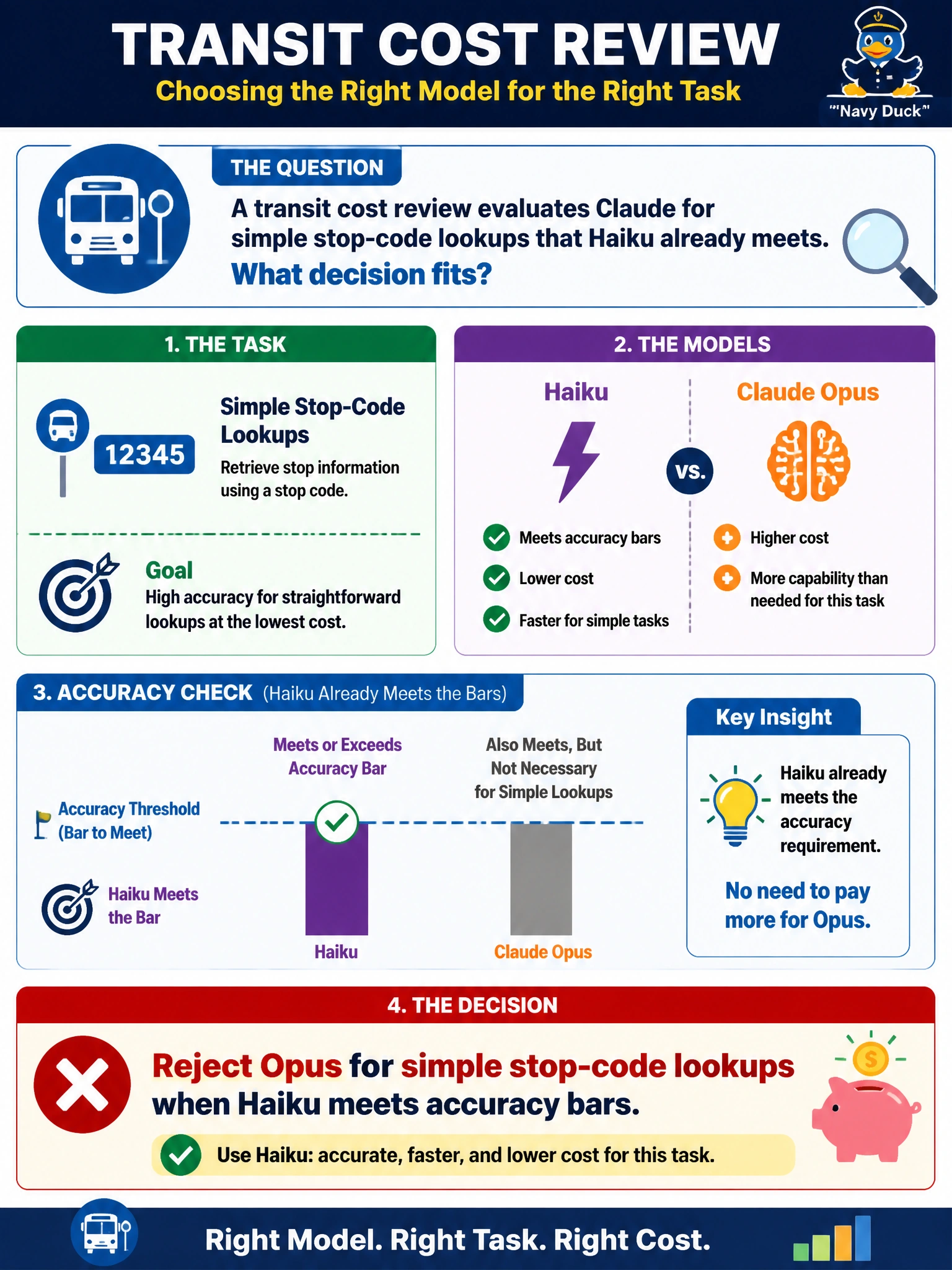
A transit cost review evaluates Claude for simple stop-code lookups that Haiku already meets. What decision fits?
Select an answer to reveal the explanation.
Short Explanation
Looking up a stop code isn't rocket science—if Haiku hits the accuracy bar, don't burn Opus dollars.
Full Explanation
Rejecting Opus for simple transit stop-code lookups when Haiku already meets accuracy bars is the correct cost decision because model selection should be driven by measured fitness, not brand prestige. Stop-code retrieval is a narrow, high-frequency rider task where latency and unit cost dominate once accuracy thresholds are satisfied. Keeping Haiku on that path frees Opus budget for complex trip planning, disruption messaging, or accessibility edge cases that actually need deeper reasoning.
Mandating Opus for every stop-code lookup regardless of accuracy needs fails because it inflates transit AI spend without improving a task Haiku already clears. Disabling Haiku so only the most expensive model can answer riders fails conceptually by removing the efficient tier that exists precisely for high-volume, lower-complexity civic queries. Picking Opus solely because the model name sounds more official fails because naming optics are not an evaluation method and will not survive FinOps or procurement scrutiny.
Exam caveat: “Haiku meets the bar” is an empirical claim—seasonal schedule changes, multilingual stop names, or new agency codes can invalidate prior accuracy results and force a temporary tier bump. Operational check: run a labeled stop-code eval on Haiku and Opus side by side, compare accuracy, p95 latency, and cost per thousand lookups, and document a written rule that Opus is blocked for this path unless Haiku falls below the published accuracy threshold.