
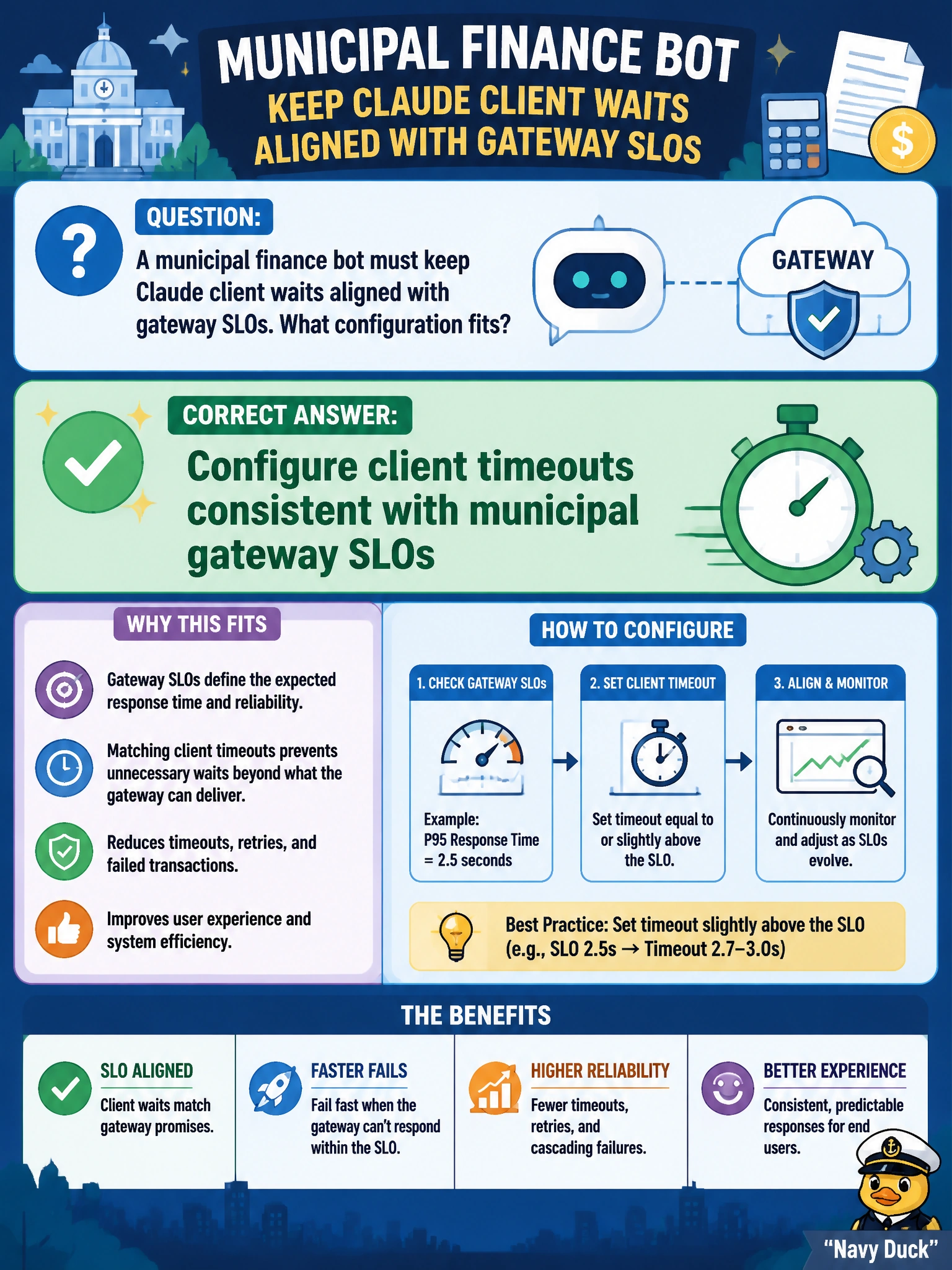
A municipal finance bot must keep Claude client waits aligned with gateway SLOs. What configuration fits?
Select an answer to reveal the explanation.
Short Explanation
Finance gateways have clocks—tune Claude client timeouts to those SLOs so hangs don't melt the helpdesk.
Full Explanation
Configuring Claude client timeouts consistent with municipal finance gateway SLOs aligns user-facing waits with the service levels the city already publishes for payment, budget inquiry, and AP automation paths. Matched timeouts let the client fail fast when the gateway cannot meet its SLO, free worker threads, surface actionable errors to helpdesk staff, and avoid orphaned finance sessions that appear healthy while hanging indefinitely. Consistency also simplifies incident response: timeout metrics map cleanly to the same SLO dashboards operations already watches.
Setting infinite client timeouts so every Claude call waits forever fails because hung finance sessions accumulate, exhaust connection pools, and leave residents and clerks without a clear failure signal. Ignoring gateway SLOs and using random timeout values per request fails conceptually because unpredictable waits break capacity planning and make SLO breaches undiagnosable. Disabling timeouts entirely to maximize hanging sessions fails for the same operability reason—civic finance bots need bounded waits, retries with jitter, and defined fallbacks, not endless blocking.
Exam caveat: client timeout must be slightly inside the gateway’s worst-case SLO budget after accounting for retries; setting it longer than upstream budgets can still strand work that the gateway has already abandoned. Operational check: inject a delayed Claude mock past the configured timeout, confirm the finance bot returns a controlled error within SLO, emits metrics tagged by endpoint, and does not leave zombie sessions in the municipal gateway pool.