
A library catalog agent receives huge tool result sets that must feed Claude carefully. Which engineering practice fits?
Select an answer to reveal the explanation.
Short Explanation
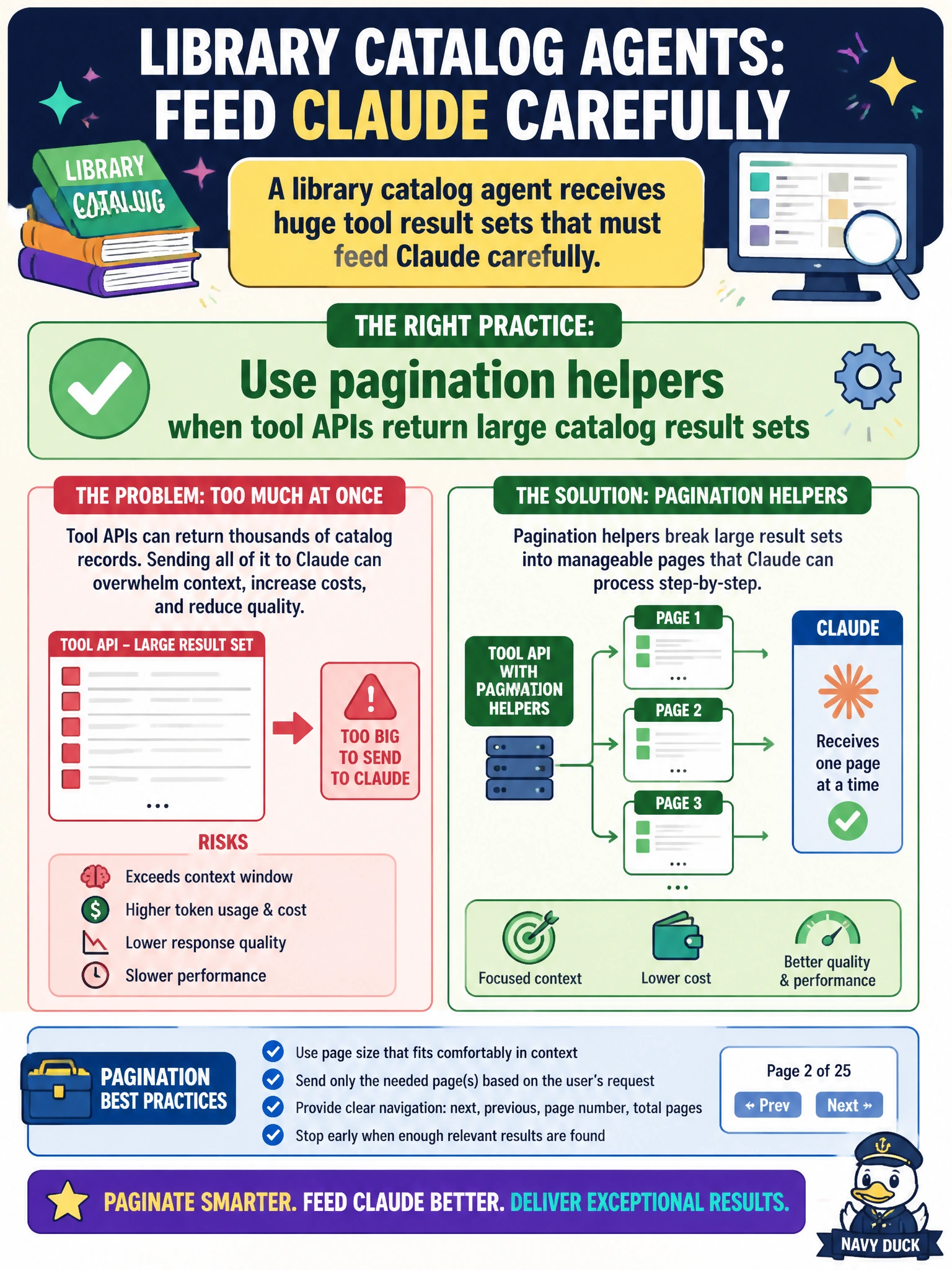
Caching query plans in working memory won't shrink what you send Claude, so you still need pagination to bound the result set. Issuing parallel shard calls just speeds up how fast a flood of rows arrives, which doesn't fix context overload. Storing big catalog sets in session state doesn't help Claude digest them, so you should page the API and feed it bite-sized slices instead.
Full Explanation
Using pagination helpers when library catalog tool APIs return large result sets is the right engineering practice because Claude’s context window and tool-turn budgets are finite. Catalog searches can yield thousands of bibliographic rows; paging lets the agent fetch a bounded page, decide whether more is needed, and feed only relevant slices into subsequent reasoning. Pagination tokens and page-size controls also protect municipal library infrastructure from unbounded result bodies that inflate latency, cost, and failure rates. Caching catalog query plans in agent working memory fails because it stores retrieval instructions rather than bounding the data actually delivered to Claude, so repeated searches can still overflow context and bury relevant records under un-paginated rows. Issuing parallel tool calls to fetch available catalog shards concurrently fails because it multiplies the volume of records arriving at once, overwhelms the context window with uncoordinated shards, and still feeds Claude more than it can reliably reason over without paging. Storing large catalog result sets in agent session state for later turns fails because it does not reduce the size of each Claude turn, bloats session memory, and still leaves the agent to page through or summarize massive cached dumps before it can answer. Exam caveat: pagination alone does not guarantee relevance—poor page size or missing sort criteria can still waste turns on low-value rows before the agent reaches the needed titles. Operational check: run a catalog search known to exceed one page, confirm the agent follows next-page tokens, logs page counts, and only inserts summarized or selected rows into Claude’s next turn rather than the full raw dump.