
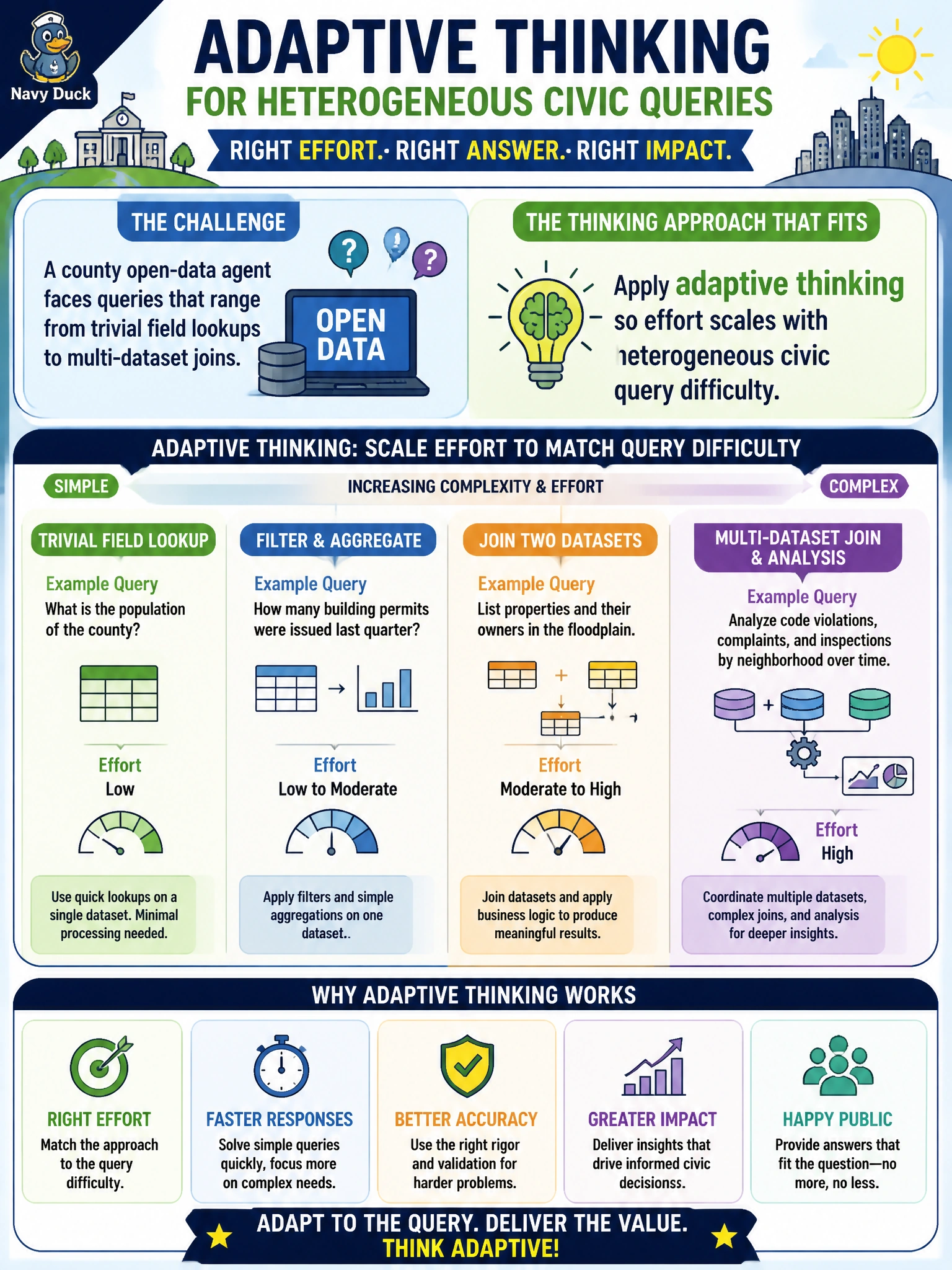
A county open-data agent faces queries that range from trivial field lookups to multi-dataset joins. Which thinking approach fits?
Select an answer to reveal the explanation.
Short Explanation
Some open-data asks are one field; others braid three datasets—adaptive thinking scales the brainpower to the mess.
Full Explanation
County open-data queries range from trivial field lookups to multi-dataset joins, so adaptive thinking—scaling deliberation with difficulty—fits heterogeneous civic workloads. Easy lookups stay cheap and fast for analysts; complex joins receive more reasoning budget without forcing every civic field lookup into a low-latency, concise-trace mode that would starve hard joins of needed depth.
Prioritizing low-latency thinking with concise traces for responsive civic field lookups fails because it applies the same thin reasoning to every query and leaves complex multi-dataset joins without the extended deliberation they need; routine catalog questions stay quick, but hard joins arrive under-cooked. Allocating extended deliberation budgets for transparent multi-dataset civic join reasoning fails conceptually—the query mix does vary, and trivial one-field lookups should stay cheap and fast rather than always drawing a heavy budget; complex joins need more thought, but easy ones do not. Standardizing moderate reasoning depth with templated traces across civic query types fails because it forces both easy lookups and hard joins into the same middle depth, so trivial work overspends and complex joins cannot reach the depth needed for novel join paths or schema quirks across evolving municipal datasets.
Exam caveat: adaptive policies need clear difficulty signals (intent class, number of datasets, join depth) so the router does not under-think hard queries or overspend on easy ones. Operational check: classify a golden set of open-data questions by difficulty, confirm adaptive thinking assigns higher effort to multi-dataset joins, and track accuracy versus cost after rollout to county analysts.