
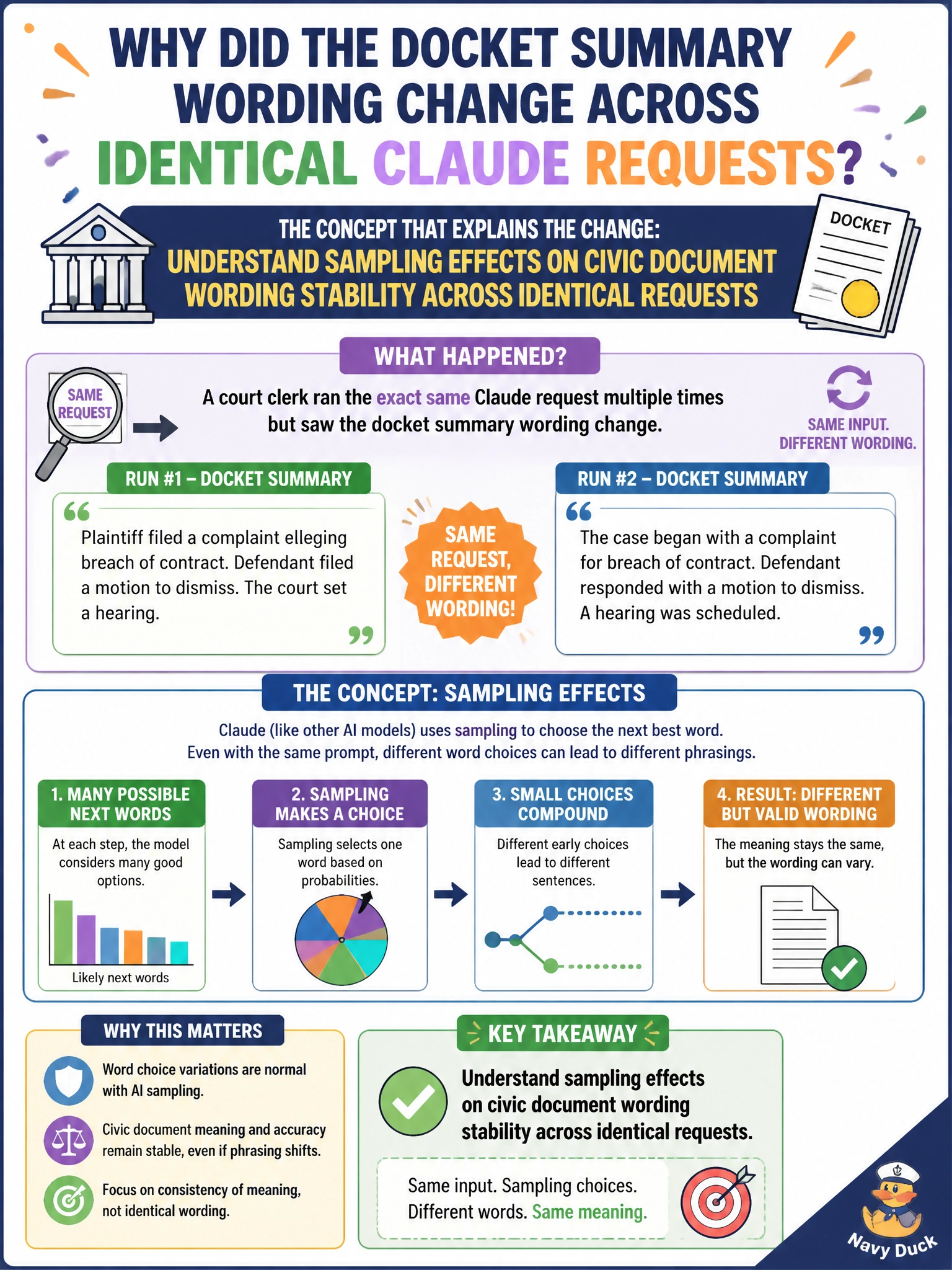
A court clerk sees docket summary wording change across identical Claude requests. What concept explains the change?
Select an answer to reveal the explanation.
Short Explanation
Same docket in, slightly different summary out—sampling nudges the wording. That's normal LLM behavior.
Full Explanation
Docket summary wording that changes across identical Claude requests is explained by sampling effects on generation: stochastic decoding can alter phrasing while often preserving gist. Court clerks should treat this as expected LLM behavior unless temperature and related controls are intentionally tightened for stability in judicial workflows.
Examining docket template revision history in the case-management system for recent updates fails because the docket template is unchanged and only the model-generated wording varies across successful responses. Reviewing prompt caching behavior for civic docket summary consistency across repeated requests fails conceptually—if caching were active, identical requests would return the same cached wording rather than varied paraphrases. Inspecting context window capacity for civic docket summary truncation patterns across filings fails because context limits cause truncation or errors, not paraphrased successful summaries delivered with HTTP 200.
Exam caveat: civic legal summaries may require higher stability for audit and judge-facing packets; pin decoding parameters or cache approved summaries keyed by docket hash once a clerk accepts them. Operational check: replay identical docket inputs, measure lexical variance, and decide whether to lower temperature, add a canonicalization step, or store the first accepted summary as the clerk-facing record of truth.