
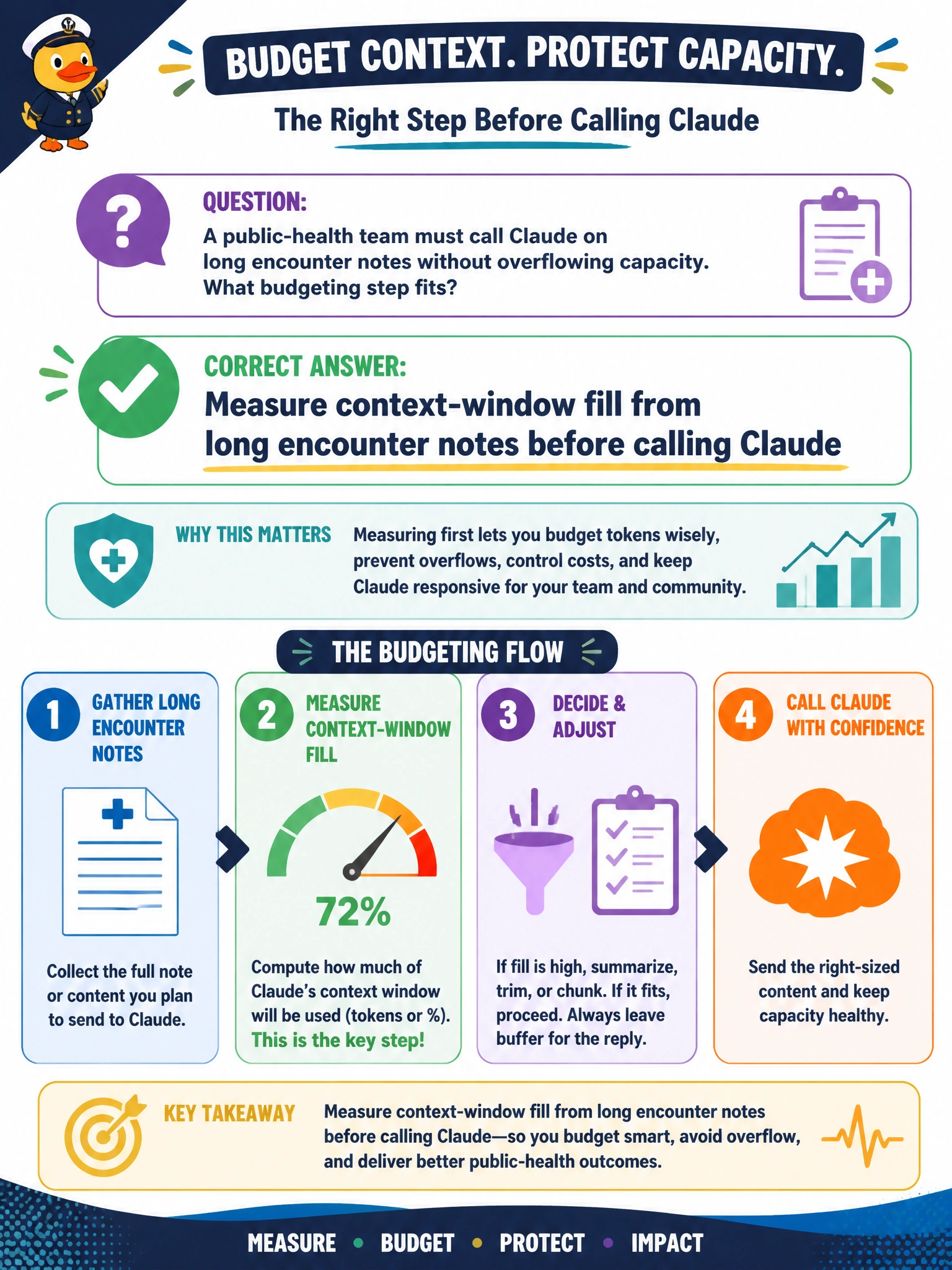
A public-health team must call Claude on long encounter notes without overflowing capacity. What budgeting step fits?
Select an answer to reveal the explanation.
Short Explanation
Long encounter notes eat the window—measure fill first so Claude isn't drowning before the call starts.
Full Explanation
Calling Claude on long public-health encounter notes requires measuring context-window fill before the request. Budgeting tokens for notes, system instructions, tools, and the expected summary prevents silent truncation or hard failures that drop clinically relevant history needed for continuity of care and accurate public-health reporting.
Counting output tokens after the response to plan the next input window fails because budgeting must happen before the call; post-response output counts do not measure pre-call context-window fill and arrive too late to prevent overflow or dropped clinical history. Applying response caching thresholds to approximate encounter note token length fails because cache thresholds do not measure actual input tokens and cannot reliably bound the notes, system instructions, and tools sent to Claude before the request. Monitoring request latency metrics to estimate context-window consumption fails as observability malpractice: latency is an indirect, unreliable proxy for token fill and will not stop an oversized call before it reaches Claude.
Exam caveat: when notes exceed the window, use retrieval or summarization cascades rather than dropping the newest or oldest note without an audit trail of what was omitted. Operational check: instrument pre-call token estimates for encounter packs, block or chunk when fill exceeds a safe threshold, and log which note IDs entered the window for clinical review.