
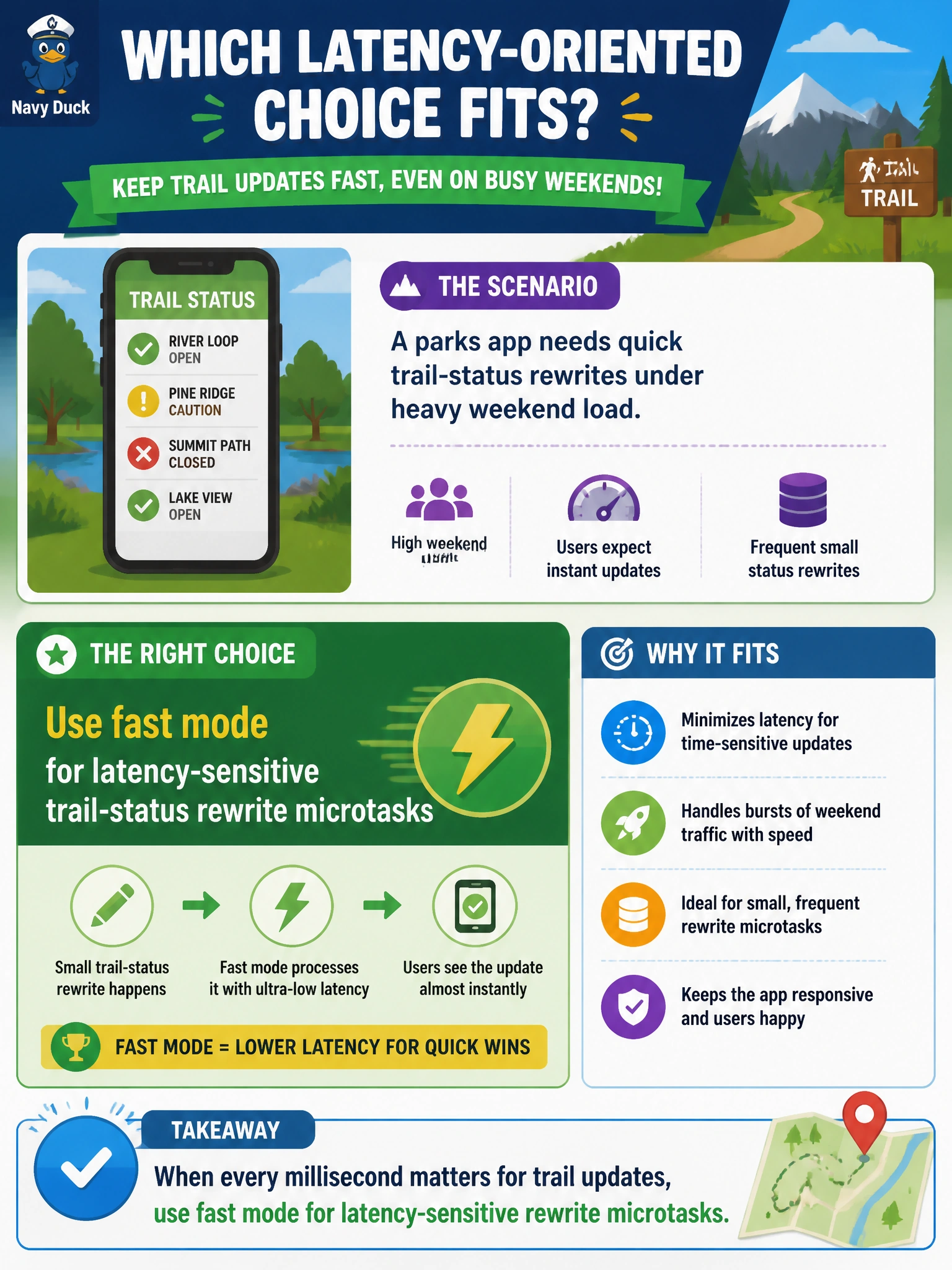
A parks app needs quick trail-status rewrites under heavy weekend load. Which latency-oriented choice fits?
Select an answer to reveal the explanation.
Short Explanation
Weekend trail chatter needs speed, not deep thought—fast mode handles those tiny status rewrites. Don't waste a microtask on extended thinking, a nightly batch, or a manual review queue when hikers need the update now.
Full Explanation
Under heavy weekend parks traffic, trail-status rewrite microtasks are latency-sensitive: fast mode (or an equivalent low-latency path) fits short rewrites that must update visitor-facing copy quickly. Matching mode to task size keeps the app responsive when many concurrent visitors refresh closures, hazards, and open/closed conditions after storms or events.
Enabling extended thinking mode for short trail-status rewrite microtasks fails because deep deliberation adds delay and cost without improving a trivial status paraphrase visitors only need in seconds. Batching urgent trail-status updates into nightly processing windows fails conceptually—weekend visitors need current conditions now, not a next-day digest that strands hikers with stale guidance. Routing weekend trail-status rewrites through manual review queues fails as an availability anti-pattern that delays the rewrite path precisely when demand and safety communication peak.
Exam caveat: fast paths still need factual grounding from the authoritative trail-status source so speed does not invent closures or reopen unsafe segments. Operational check: load-test weekend rewrite QPS with fast mode enabled, verify p95 latency stays within the parks SLA, and alert if the service falls back to stale status without a visible last-updated timestamp.