
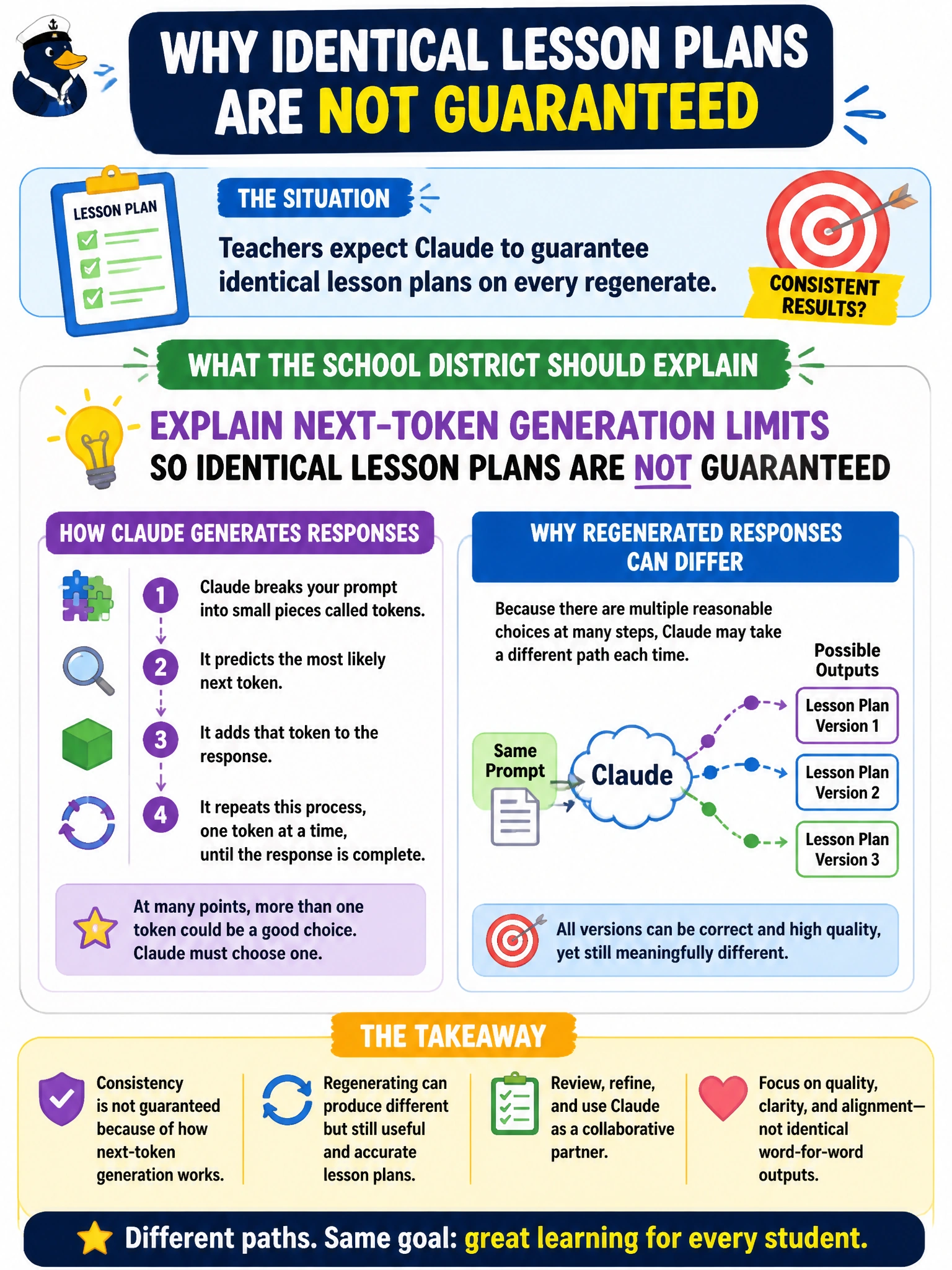
Teachers expect Claude to guarantee identical lesson plans on every regenerate. What should the school district explain?
Select an answer to reveal the explanation.
Short Explanation
Claude writes the next token, not a cached lesson draft for direct reuse—regenerate and the lesson plan can shift. Set that expectation.
Full Explanation
School districts must explain next-token generation limits: Claude samples a continuation rather than treating knowledge cutoff dates as fixing wording, so regenerated lesson plans are not guaranteed identical. Setting that expectation prevents false defect reports and encourages teachers to treat regenerate as a new draft, then lock approved versions in the LMS.
Describing prompt caching as saving a lesson draft for direct reuse across classrooms fails because prompt caching does not make regenerations identical; cached inputs still produce newly sampled tokens. Explaining knowledge cutoff dates as fixing lesson wording during repeated generation fails conceptually—knowledge cutoffs bound training data, not output wording, and the model still computes new tokens per request. Clarifying system prompt version updates as holding regeneration to prior phrasing fails as an inaccurate product claim that will be contradicted on first retry; system prompts guide behavior but do not lock phrasing.
Exam caveat: if stability across system prompt version updates is required for accessibility or legal review, store the approved plan as an artifact and regenerate only into a draft channel—not as the system of record. Operational check: document non-determinism in teacher guidance, provide a "save approved version" action, and test that saved artifacts do not change when viewed later without regeneration.