
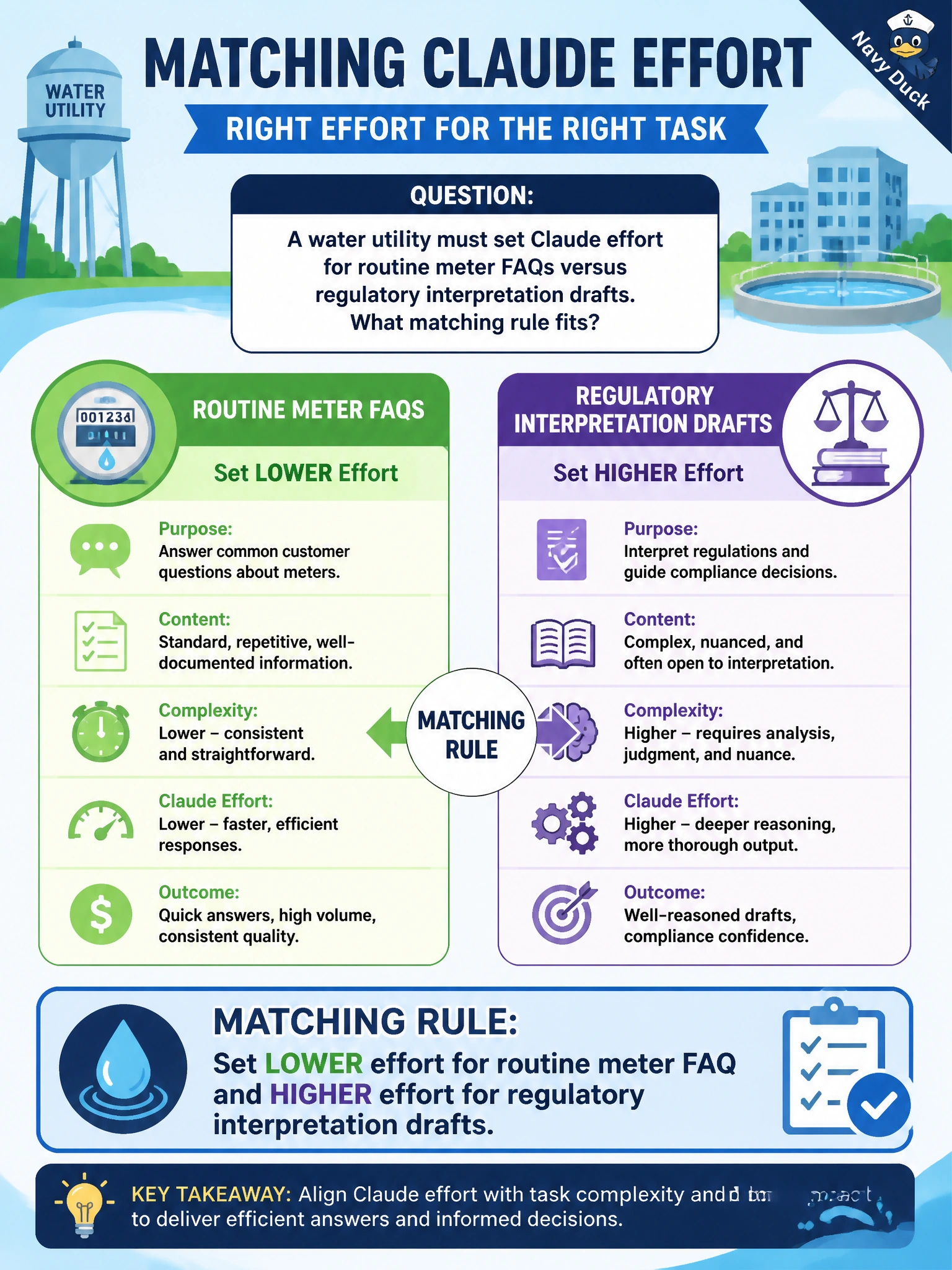
A water utility must set Claude effort for routine meter FAQs versus regulatory interpretation drafts. What matching rule fits?
Select an answer to reveal the explanation.
Short Explanation
Meter FAQ is a quick tap; regulatory drafts need the heavy wrench—match effort to difficulty.
Full Explanation
Water-utility Claude effort should track task difficulty: lower effort for routine meter FAQs and higher effort for regulatory interpretation drafts. Effort controls allocate deliberation budget; matching them to stakes and complexity improves latency and cost on simple asks while preserving quality on compliance-sensitive writing that may be reviewed by regulators or legal counsel.
Always using maximum effort for one-line meter reading hours answers fails because it burns latency and tokens on questions that do not need deep reasoning and can slow customer portals during peak billing periods. Using minimum effort for complex regulatory interpretation drafts fails conceptually—under-thinking raises omission and misstatement risk in regulated utility language where precision matters. Ignoring effort controls because utility tasks never vary in difficulty fails when the workload clearly spans FAQ brevity and multi-source regulatory synthesis across statutes and internal standards.
Exam caveat: higher effort is not a substitute for grounding in the actual regulation text via retrieval or attached excerpts—deliberation without sources still invents. Operational check: tag request classes (meter FAQ vs regulatory draft), set effort defaults per class, and monitor both p95 latency and factual-error rates after the mapping ships into the utility service desk.