
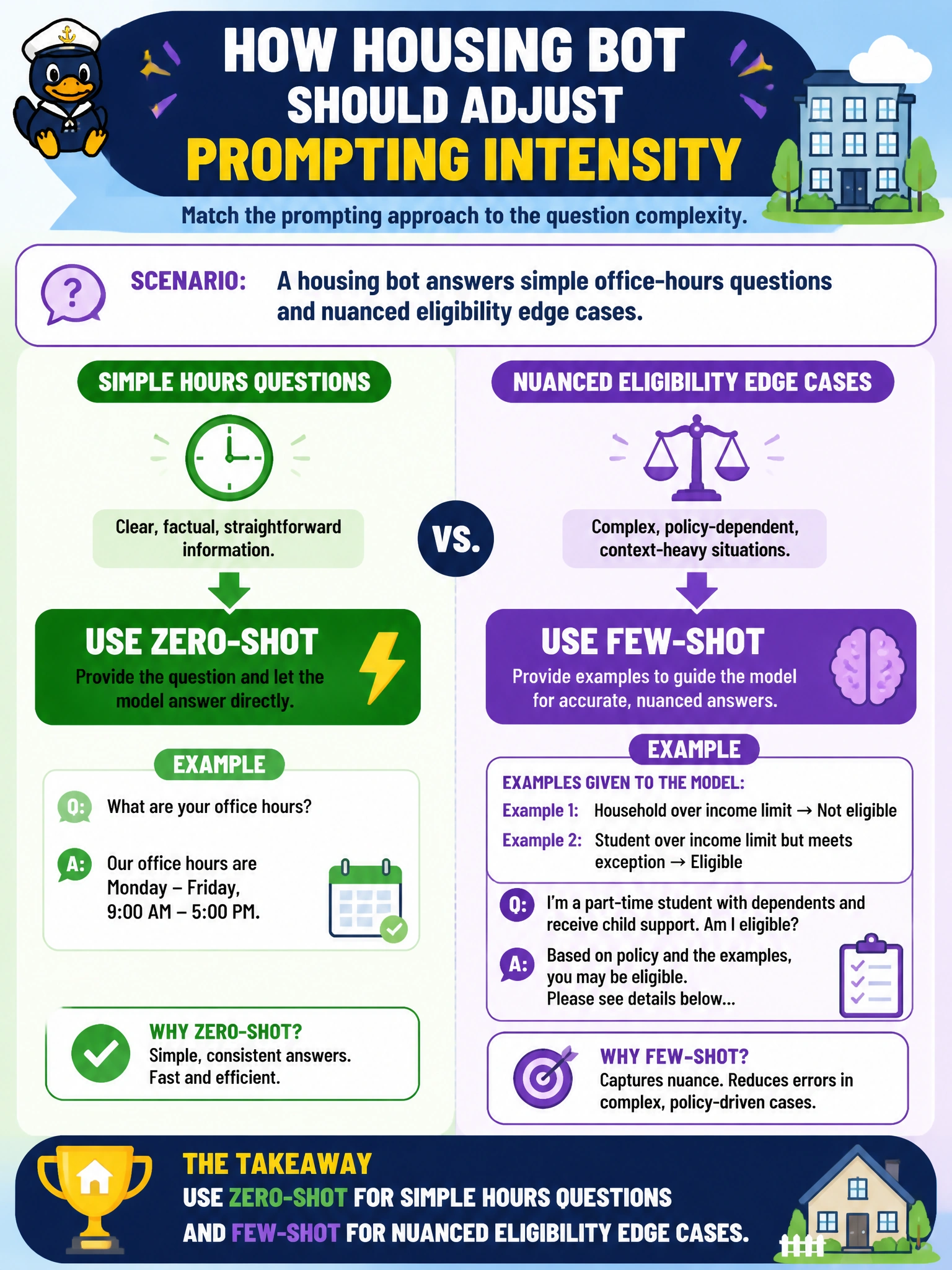
A housing bot answers simple office-hours questions and nuanced eligibility edge cases. How should prompting intensity differ?
Select an answer to reveal the explanation.
Short Explanation
Office hours are easy—zero-shot. Tricky eligibility edges need a few examples so Claude sees the pattern.
Full Explanation
Prompting intensity should match housing-question difficulty: zero-shot suffices for simple office-hours facts, while few-shot examples help Claude mirror nuanced eligibility edge-case reasoning. That split conserves tokens on easy asks and supplies pattern evidence where policy exceptions confuse residents—exactly the civic tradeoff between desk FAQs and benefit determinations.
Use few-shot for simple hours questions and zero-shot for nuanced eligibility edge cases fails because it reverses the correct split: few-shot is unnecessary overhead for trivial office-hours facts, while zero-shot lacks the pattern evidence Claude needs to reason consistently through nuanced eligibility edge cases. Use zero-shot for simple hours questions and for nuanced eligibility edge cases fails because while zero-shot is fine for simple hours, it gives Claude no demonstrations for edge cases, where apply/deny logic patterns are exactly what improve consistency and reduce contradictory advice across households. Use few-shot for simple housing hours questions and few-shot for nuanced eligibility edge cases fails because it stacks examples onto simple office-hours questions that zero-shot already answers, wasting context and cost without improving an already trivial answer path.
Exam caveat: few-shot exemplars must be accurate, current with local housing rules, and non-discriminatory; a wrong example teaches the wrong eligibility pattern at scale. Operational check: maintain two prompt profiles (hours zero-shot; eligibility few-shot with reviewed cases), route by intent classifier, and re-eval edge-case accuracy after any exemplar change before promoting to the resident-facing housing bot.