
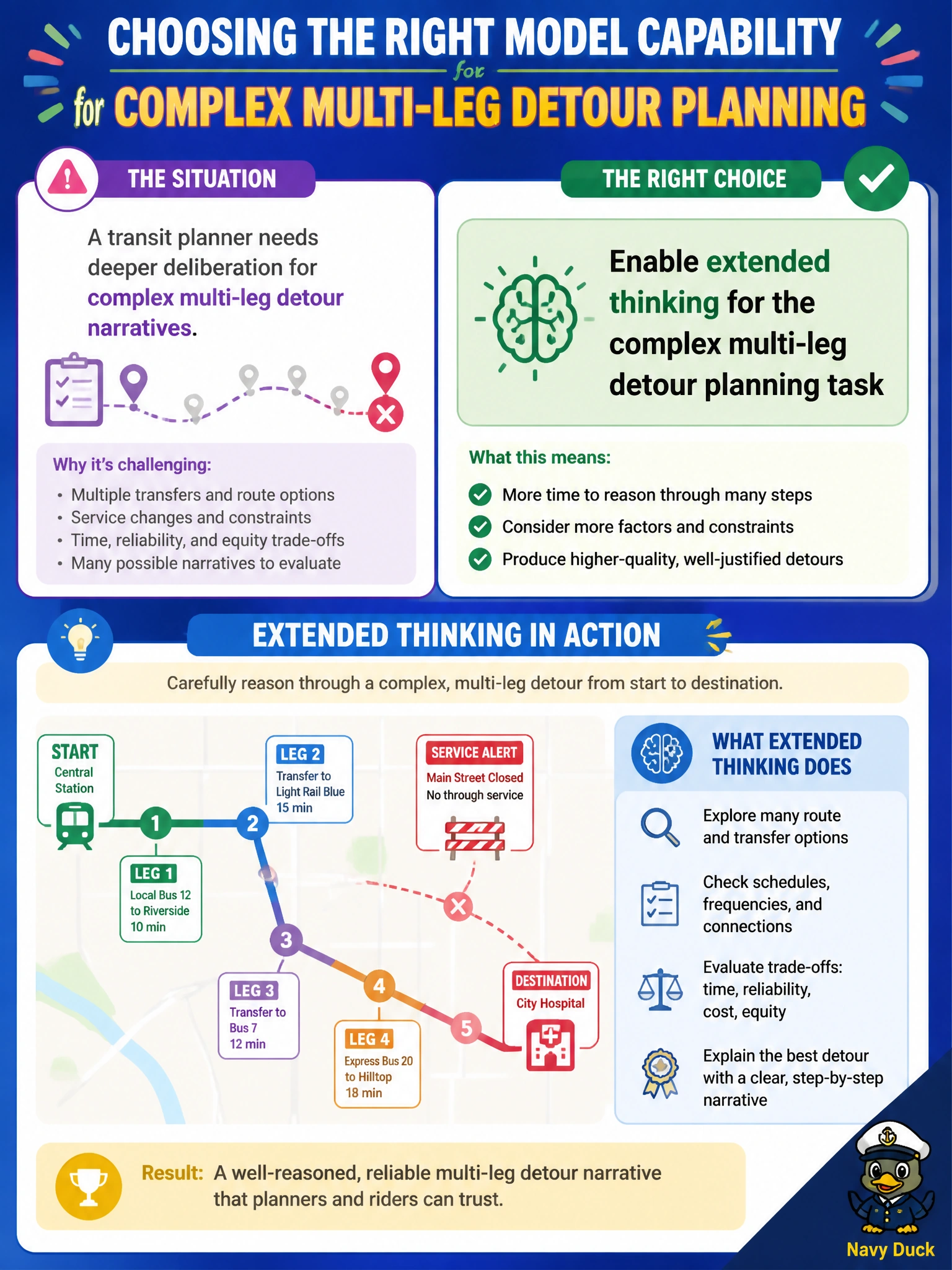
A transit planner needs deeper deliberation for complex multi-leg detour narratives. Which model capability choice fits?
Select an answer to reveal the explanation.
Short Explanation
Messy multi-leg detours need more thinking time, so turn on extended thinking instead of prompt caching. Raising the temperature just adds randomness, and you could end up with conflicting detour advice. Boosting max output tokens only makes the reply longer; it won't help the model reason through transfers and advisories.
Full Explanation
Complex multi-leg detour narratives spanning agencies benefit from extended thinking so the model can deliberate over constraints, transfers, and conflicting advisories before drafting rider-facing text. Enabling that capability matches task difficulty: deeper planning reduces shallow, incomplete detour stories when routes and disruptions interact.
Enabling prompt caching for the complex multi-leg detour planning task fails because prompt caching only reduces latency and cost for repeated context; it does not improve the model's ability to reason through multi-hop constraints and exception cases.
Raising sampling temperature for diverse multi-leg detour planning narratives fails because it adds randomness to the output; complex detours require consistent, reliable routing guidance rather than varied, potentially contradictory alternatives.
Increasing max output tokens for the detailed multi-leg detour planning task fails because it only allows a longer response, not deeper reasoning; the model can still miss constraints and transfers while simply writing more words.
Exam caveat: extended thinking increases latency and cost—reserve it for complex planning tasks, not every three-word status ping.
Operational check: A/B a representative multi-leg outage with and without extended thinking, score completeness of transfer instructions and agency coverage, and enable extended thinking only when quality gains justify the latency budget.