
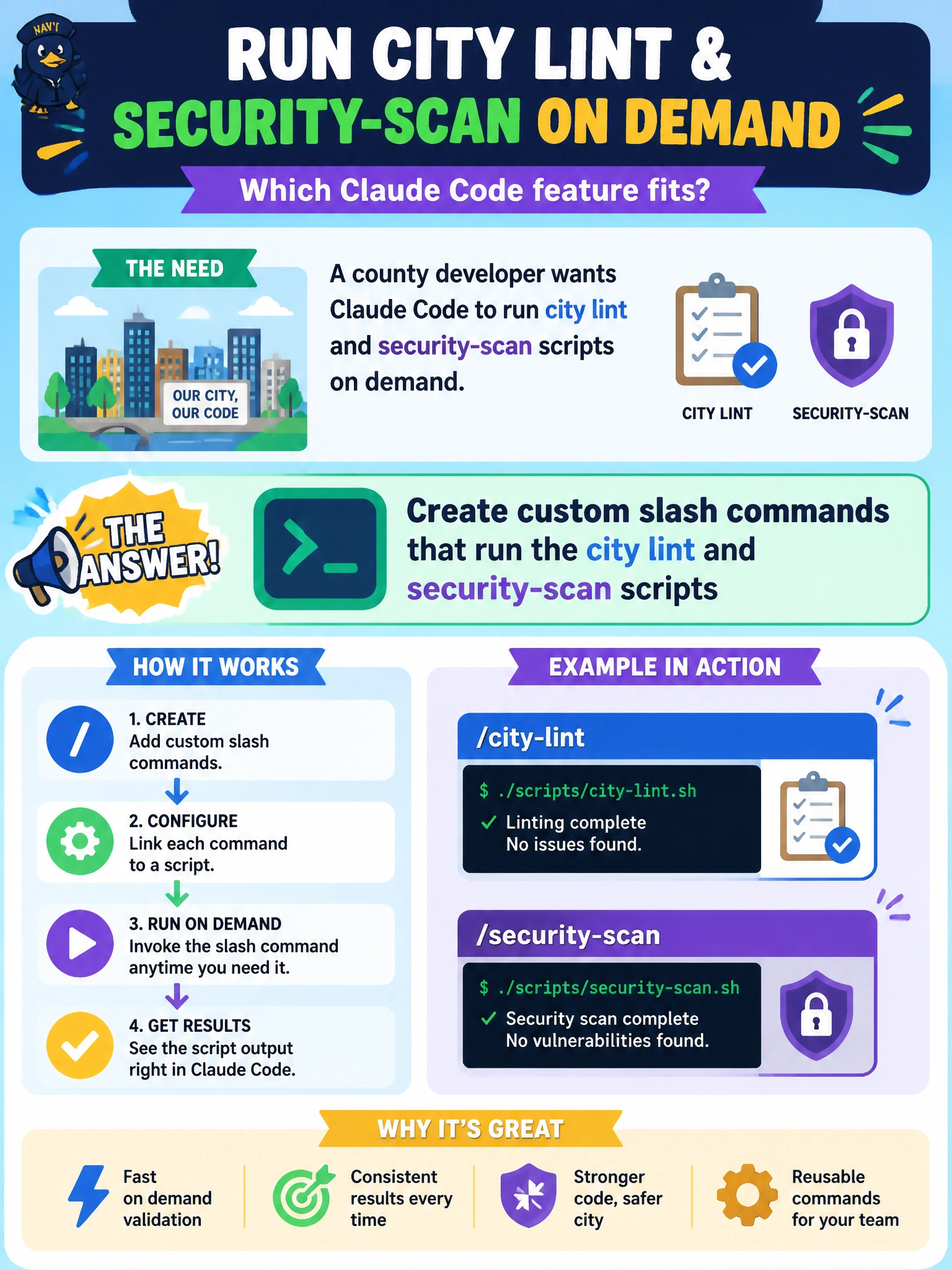
A county developer wants Claude Code to run city lint and security-scan scripts on demand. What Claude Code feature fits?
Select an answer to reveal the explanation.
Short Explanation
Adding the scripts to CLAUDE.md only gives Claude context—it won't run them on demand. Wire custom slash commands in Claude Code so city CI helpers are one slash away.
Full Explanation
Repeatable city lint and security-scan workflows belong in reusable Claude Code commands rather than ad hoc improvisation. Creating custom slash commands that run the city lint and security-scan scripts works because developers invoke the same reviewed command definitions on demand, reducing mistaken one-liners and keeping CI helpers consistent with official scripts. County engineers get speed without inventing shell each time. Configuring a lifecycle hook that runs lint automatically after file edits fails because it runs automatically on edits instead of on demand, and it does not create a reusable command for both the lint and security-scan scripts. Adding the lint and security-scan scripts to CLAUDE.md for project context fails because CLAUDE.md only supplies background context to Claude and does not create an executable on-demand command that runs the scripts. Defining a specialized subagent to audit city code for lint and security findings fails because a subagent is an autonomous assistant rather than a reusable on-demand command bound to the city's exact lint and security-scan entry points. Exam caveat: slash commands should wrap approved scripts from the repo or CI system—custom commands that embed divergent logic recreate shadow pipelines. Operational check: define Claude Code slash commands that call the city’s canonical lint and security-scan entry points, document them in the developer guide, and confirm they match the same scripts CI runs on pull requests.