
A city engineering team starts Claude Code in a permit-service repo and needs coding standards loaded. What first practice fits?
Select an answer to reveal the explanation.
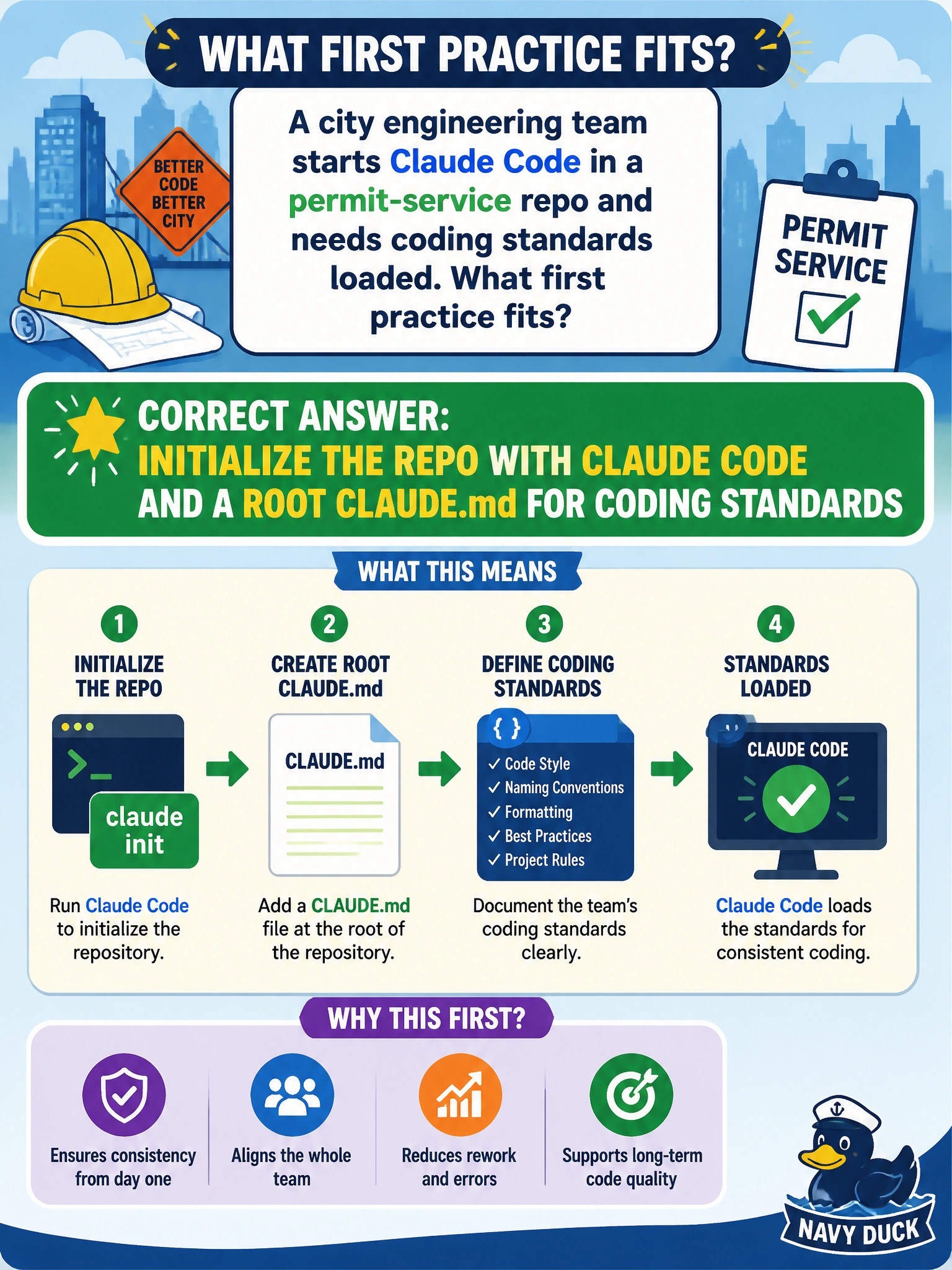
Short Explanation
New permit-service repo? Stand up Claude Code with a root CLAUDE.md that states the house coding rules—don't bury them in a subfolder CLAUDE.md that only applies to part of the repo.
Full Explanation
New municipal repos that adopt Claude Code need durable coding standards at initialization, not a nested CLAUDE.md buried in a subfolder that only applies to part of the repo. Initializing the permit-service repo with Claude Code and a root CLAUDE.md for coding standards works because the repository carries house rules for style, security, testing, and permit-domain conventions into every session, reducing rediscovery and inconsistent advice. City engineering can onboard contributors against the same written baseline. Creating a nested CLAUDE.md in a subfolder instead of a root CLAUDE.md fails because subfolder-scoped standards do not apply repo-wide and diverge by directory. Storing team coding standards in user-level settings instead of a shared repo file fails conceptually: user-level settings are not a reviewable repo artifact shared by the team and won't travel with the repository. Defining coding standards in a custom slash command for manual loading each session fails as quality control for a permit service that must stay consistent because it relies on engineers remembering to load the standards every time. Exam caveat: a root CLAUDE.md must stay accurate—stale standards that contradict CI linters create conflicting guidance Claude may follow. Operational check: when standing up Claude Code in a permit-service repo, add a reviewed root CLAUDE.md aligned to city lint and security rules, and verify a fresh session loads those standards repo-wide rather than relying on a nested subfolder CLAUDE.md.