
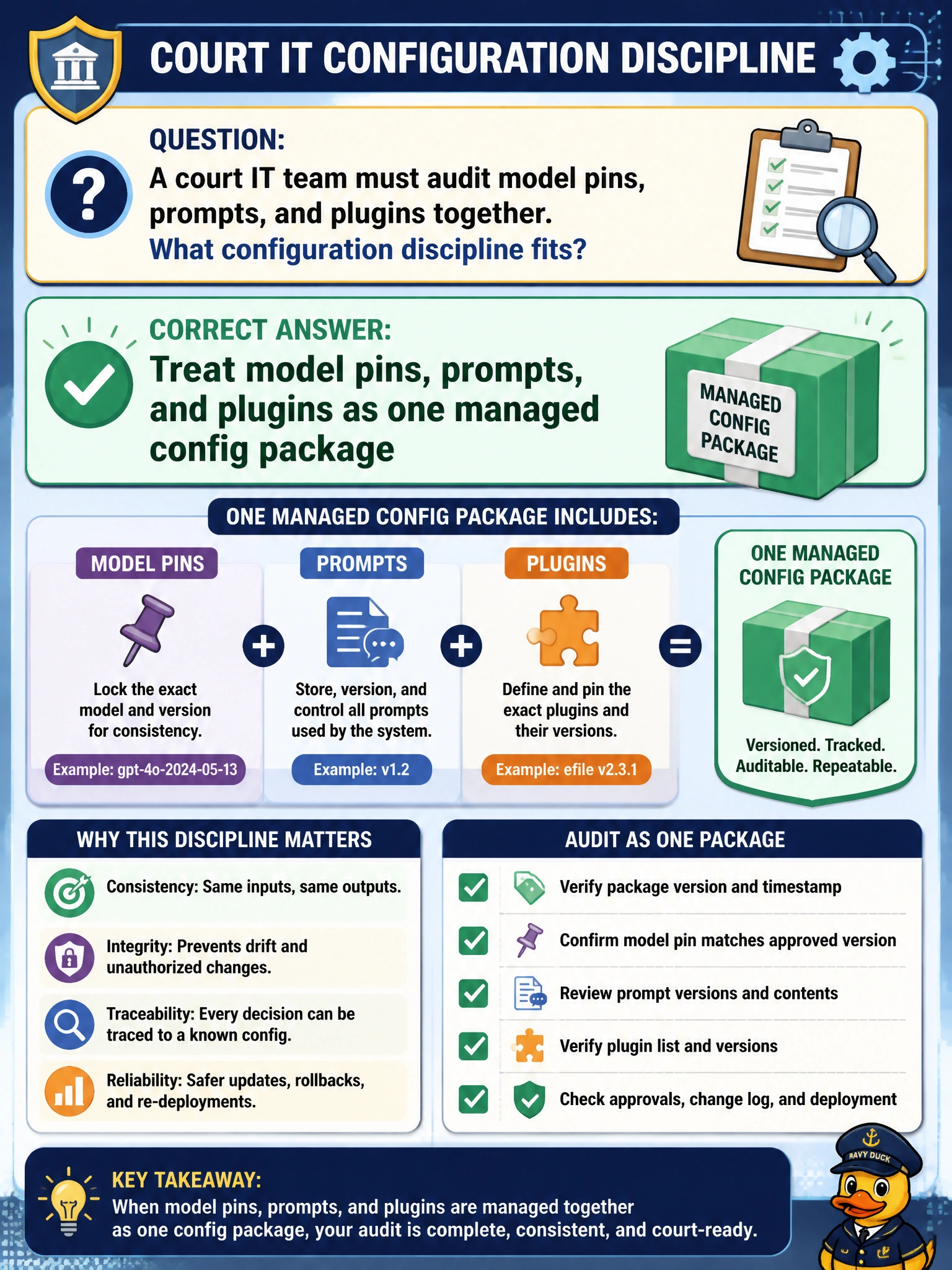
A court IT team must audit model pins, prompts, and plugins together. What configuration discipline fits?
Select an answer to reveal the explanation.
Short Explanation
Courts audit systems, not mystery piles. Bundle model pins, prompts, and plugins as one config package so reviewers see the whole Claude stack.
Full Explanation
Court IT audits need a coherent view of what actually shapes Claude behavior—not disconnected fragments. Treating model pins, prompts, and plugins as one managed config package works because reviewers can evaluate the combined stack that determines answers, tools, and side effects, and operators can promote or roll back that package together across environments. Courts reduce "works on my laptop" variance when the package is the unit of change for judicial-support assistants. Storing prompt text in version control and tracking model versions in release notes fails because it handles prompts and models separately from plugins, so interactions between model, prompt, and plugin go unreviewed and incidents become harder to reconstruct. Approving model upgrades through change tickets and reviewing plugins during incident response fails conceptually because it omits prompts from the managed scope and never reviews the combined stack, missing the behavior drivers that affect case-adjacent guidance. Consolidating plugin allowlists in asset inventory and documenting prompts in team wiki pages fails as scope error: it splits plugins and prompts from model pins, even though plugins change capabilities and data access just as prompts do. Exam caveat: packaging components together still requires listing contents and owners; a zip of unknowns is not a managed package for court audit evidence. Operational check: define a court Claude config package manifest (model pin, prompt files, plugin BOM), change them through one release process with reviewers, and present that package in audit evidence for each environment.