
A transit rider app must avoid inventing arrival times beyond published GTFS. What content-boundary design fits?
Select an answer to reveal the explanation.
Short Explanation
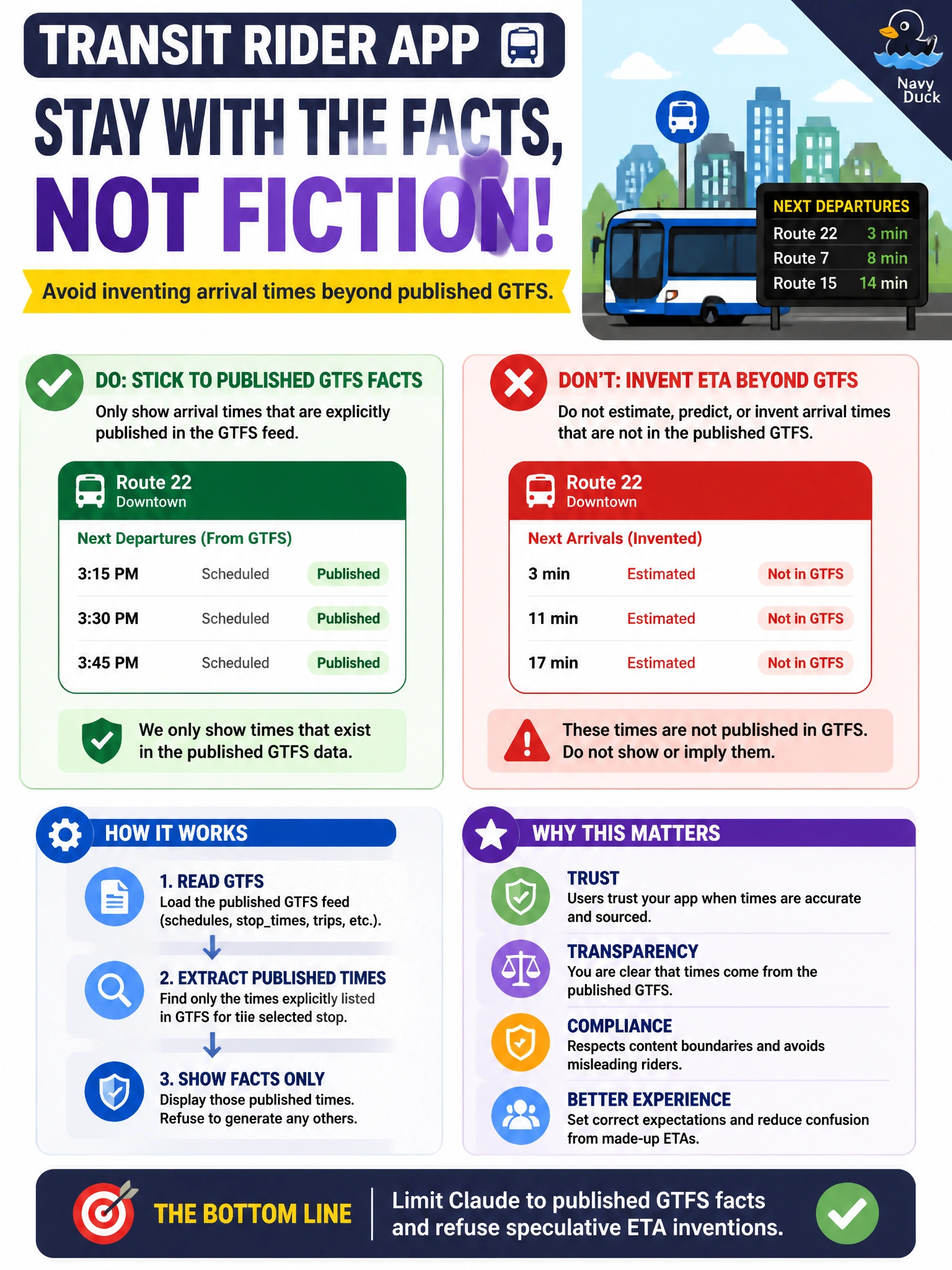
Riders trust clocks, not vibes, so you keep Claude fenced to published GTFS. When the feed goes quiet, you say there's no reliable ETA instead of letting Claude interpolate, average, or infer one.
Full Explanation
Transit rider assistants must stay inside published schedule truth rather than inventing comfort answers. Limiting Claude to published GTFS facts and refusing speculative ETA inventions works because riders make trip decisions on clock-facing data; fabricating arrivals when feeds are silent creates operational and safety risk and erodes trust when buses do not appear. The app can explain that live data is unavailable instead of guessing. Supplementing GTFS gaps with interpolated ETA predictions labeled as estimates fails because interpolated predictions are still not published GTFS facts and can mislead riders into expecting arrivals the agency never promised. Extending GTFS static schedules with historical average travel times for missing trips fails because historical averages are not published GTFS facts and present inferred data as schedule truth. Presenting GTFS static times as live ETAs using vehicle pattern inference fails because static times are not live ETAs and vehicle-pattern inference invents real-time certainty the feed does not publish. Exam caveat: "published GTFS" includes knowing when the feed is stale or incomplete; refusal or "no reliable ETA" is preferred over hallucination, and real-time extensions still need clear provenance. Operational check: require schedule answers to cite GTFS tool results, return a structured "unavailable" state when tools return empty, and regression-test silent-feed prompts to ensure Claude does not invent minute-level ETAs.