
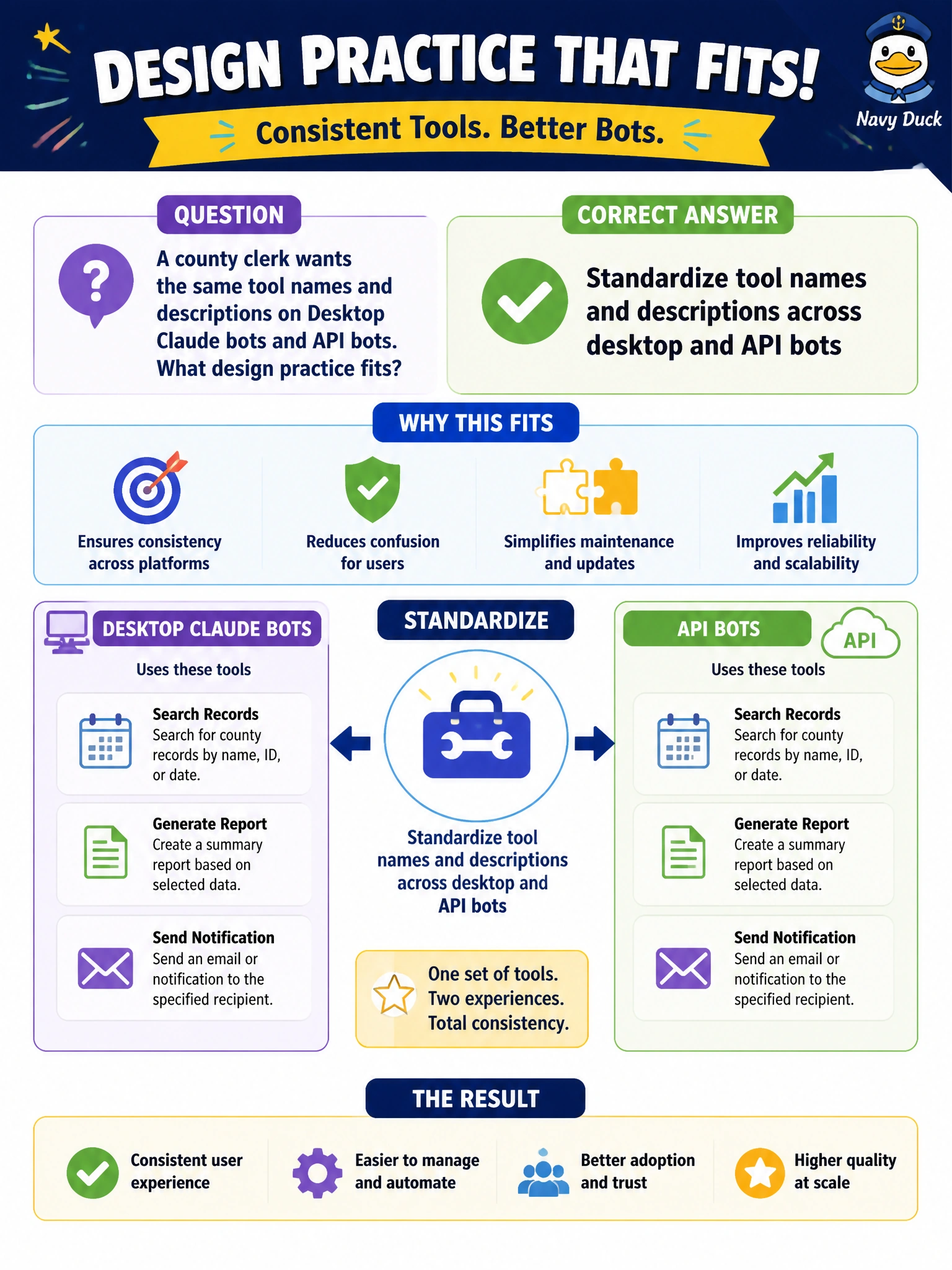
A county clerk wants the same tool names and descriptions on Desktop Claude bots and API bots. What design practice fits?
Select an answer to reveal the explanation.
Short Explanation
Clerks shouldn't relearn tool names when they switch hosts. Standardize names and descriptions across Desktop and API bots.
Full Explanation
Tool naming consistency across hosts reduces clerk error and simplifies support when the same municipal capabilities appear on Desktop Claude and API bots. Standardizing tool names and descriptions across desktop and API bots works because identical semantics let staff and engineers reason about one contract—parameters, side effects, and failure modes—regardless of which Claude surface invokes the tool. County clerk workflows that look up records, queue tickets, or fetch forms benefit when "the search tool" means the same thing everywhere. Reusing backend tool logic consistently while tailoring descriptions per host fails because tailoring descriptions per host means clerks see different descriptions for the same capability on Desktop and API bots, creating training debt and mistaken invocations. Maintaining a central tool catalog for reference while deploying host aliases fails because host aliases expose the same tool under different names on Desktop and API bots, creating a second, opaque contract for the same operational capability. Aligning parameter schemas closely while localizing display names per host fails as design: localized display names mean the same tool appears under different names on each host, increasing misfires and breaking the shared contract. Exam caveat: identical names must still map to equivalent authorization and data scopes; renaming alone does not fix a Desktop tool that is more privileged than its API twin. Operational check: publish a county tool catalog with canonical names, descriptions, and parameters; generate Desktop and API tool definitions from that catalog; and run parity tests that the same tool call shape works on both hosts.