
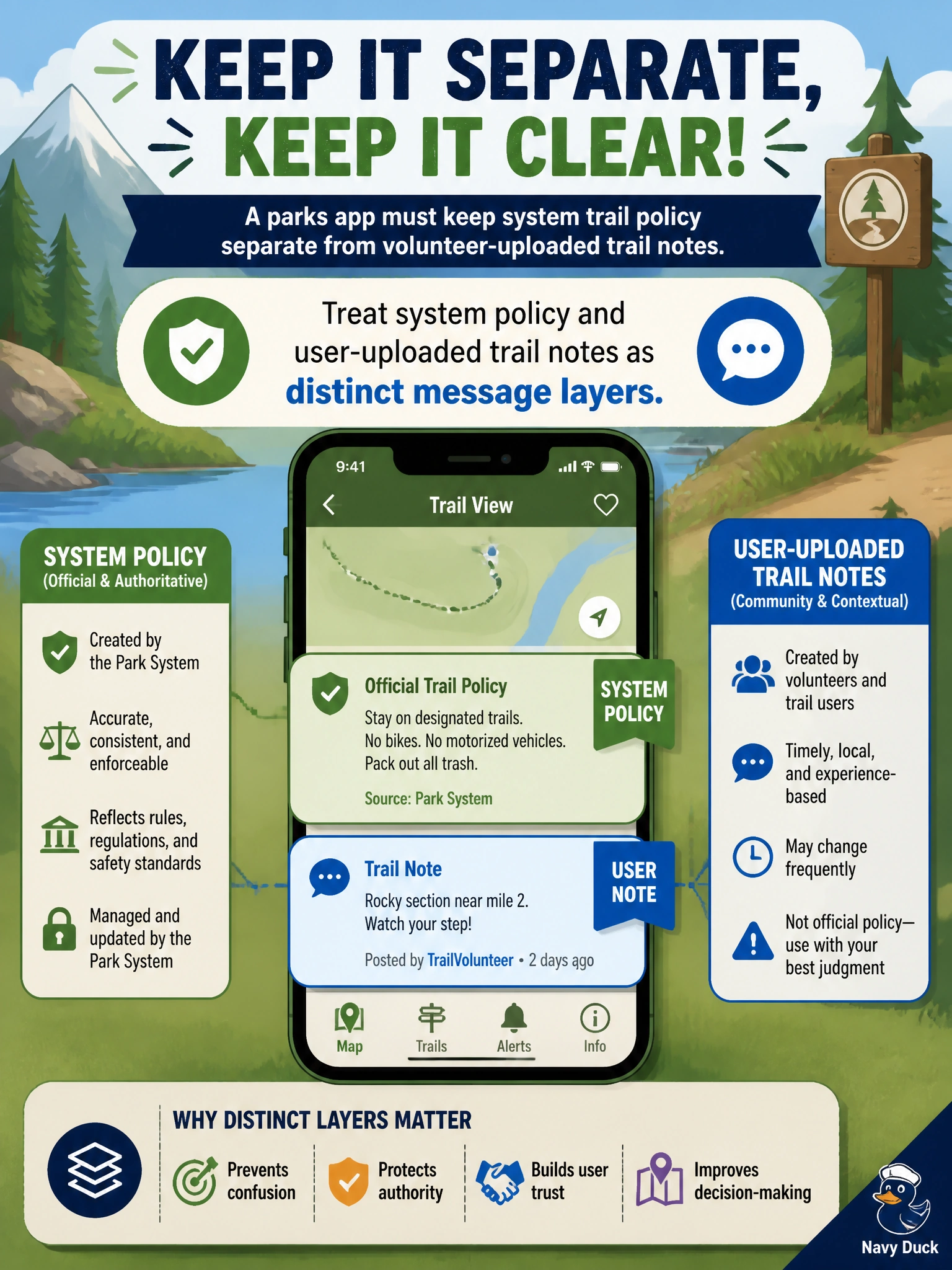
A parks app must keep system trail policy separate from volunteer-uploaded trail notes. What content design fits?
Select an answer to reveal the explanation.
Short Explanation
Official park rules and someone's muddy trail note are not the same layer. Keep policy and uploads labeled separately so Claude knows what is trusted.
Full Explanation
Trusted park policy and volunteer-uploaded trail notes must remain distinct inputs so Claude does not treat field gossip as ordinance. Treating system policy and user-uploaded trail notes as distinct message layers works because role and trust labels tell the model which text is authoritative guidance versus situational observation that may be incomplete, outdated, or wrong. Parks apps can still surface volunteer notes while preventing them from silently rewriting closure rules, hazard policy, or access restrictions. Consolidating policy and trail notes in the user turn with descriptive headings fails because headings do not restore the layer boundary; Claude can still weigh a volunteer observation equally against an ordinance when both sit in the same user message. Formatting volunteer trail notes as system instructions to improve recall fails because it promotes crowd uploads to system-level authority, making Claude treat anecdotes as governing rules rather than marked user context. Rendering system policy as quoted field notes for unified display context fails because it disguises official ordinance as volunteer observation, erasing the provenance that makes park policy authoritative. Exam caveat: distinct layers still require retrieval and prompt design that actually prefers policy on conflicts; labels alone do not help if the application concatenates everything with equal weight. Operational check: store policy in a system/developer layer, place volunteer notes in a clearly marked user or tool layer, and test conflict cases ("volunteer says open" vs "policy says closed") to confirm Claude cites official policy first.