
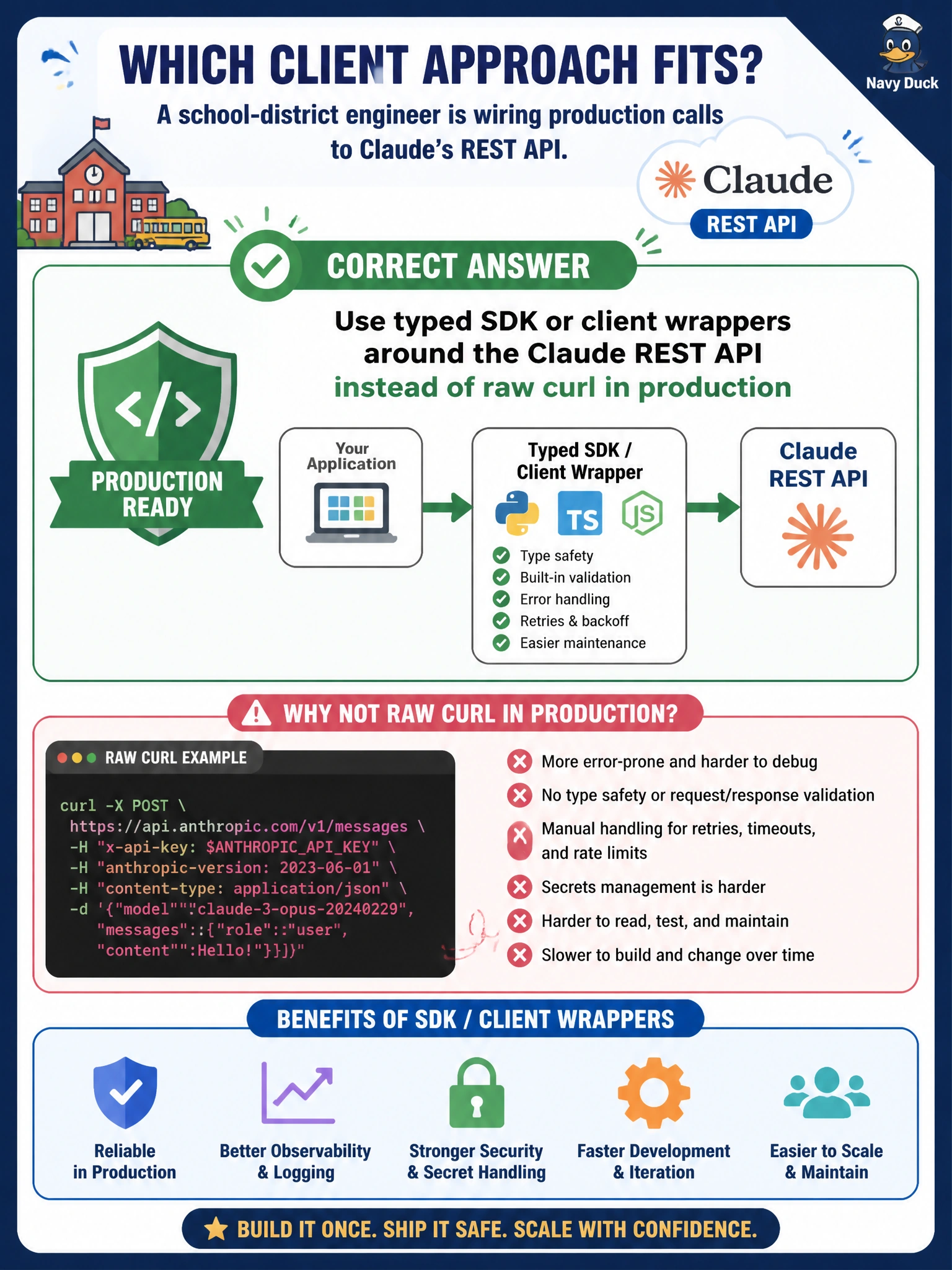
A school-district engineer is wiring production calls to Claude's REST API. Which client approach fits?
Select an answer to reveal the explanation.
Short Explanation
You shouldn't run production student-data traffic on raw curl and manual JSON strings. Wrap Claude's REST API in a typed client you can maintain.
Full Explanation
School-district engineers wiring production calls to Claude's REST API should use typed SDK or client wrappers instead of raw curl in production. Supported clients fit because they encode authentication headers, request/response types, retries, and error handling in maintainable code paths appropriate for student-adjacent workloads. Typed wrappers improve refactor safety, observability hooks, and consistent timeout behavior across services that generate IEP-related or instructional assistants. Building backend Claude integrations with raw curl and manual JSON strings fails by concept: hand-built HTTP is brittle under failure modes, drops structured retries and typing, and lacks the maintainability production district traffic needs. Sending production Claude requests via browser fetch with keys embedded in client JavaScript bundles fails by concept: it exposes API keys to the browser, bypasses server-side retries and error handling, and puts student data flows at risk. Copying curl examples from API docs into deploy scripts to handle live district student traffic fails by concept: it hardcodes fragile shell invocations without typed wrappers, retries, or observability, rejecting the safety benefits of supported clients. Exam caveat: using an SDK does not remove the need to handle stop_reason, validate outputs, and enforce district data-handling policies—and teams should still pin SDK versions for reproducible deploys. Operational check: replace a production-bound curl prototype with a typed Claude client wrapper in the school-district service, add unit tests around request construction, and verify retries/timeouts behave under injected network faults before cutover.