
A housing team must operate Claude beside a case-management API. How should they document failures?
Select an answer to reveal the explanation.
Short Explanation
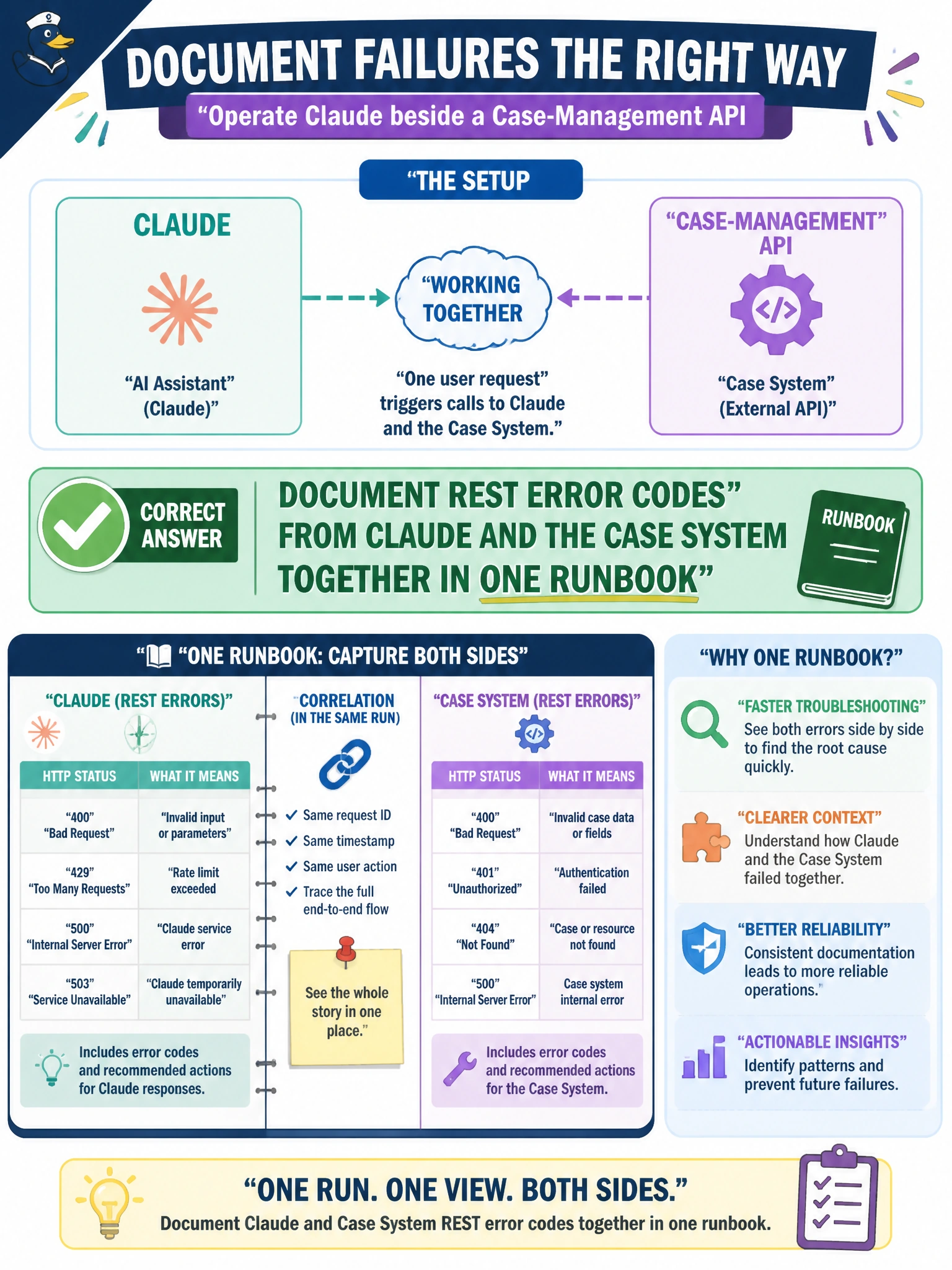
When Claude and the case system both can fail, operators need one map—not two folklore binders. Put those REST error codes in a shared runbook.
Full Explanation
Housing teams operating Claude beside a case-management API should document REST error codes from Claude and the case system together in one runbook. Unified failure documentation works because operators diagnosing a broken housing workflow cannot know a priori whether the fault is model-side (rate limits, auth, timeouts) or case-system-side (validation errors, conflict codes, downstream outages). One runbook maps symptoms to likely sources, retry guidance, escalation paths, and resident-facing messaging so on-call staff recover faster. Capturing Claude token usage metrics in the runbook alongside caseworker shift notes fails by concept: it clutters failure documentation with metrics and staffing notes instead of mapping Claude and case-system error codes to symptoms, retries, and escalation paths. Storing case API error codes in the ticketing backlog while keeping Claude errors in prompt logs fails by concept: it splits failure documentation across two locations, so operators cannot see Claude and case-system codes together in one runbook when diagnosing a broken housing workflow. Recording HTTP status codes for the case API in the developer wiki for release tracking fails by concept: it omits Claude error codes, targets release tracking rather than incident response, and leaves on-call staff without a shared runbook for outage mitigation. Exam caveat: runbooks must stay versioned with the APIs they describe—when Claude or case-management status codes change, update the shared document—and must avoid dumping sensitive case details into public status pages. Operational check: simulate a Claude 429 and a case-API 503 in staging, walk an on-call housing operator through the single runbook, and confirm they select the correct mitigation for each code without asking which system owns the error.