
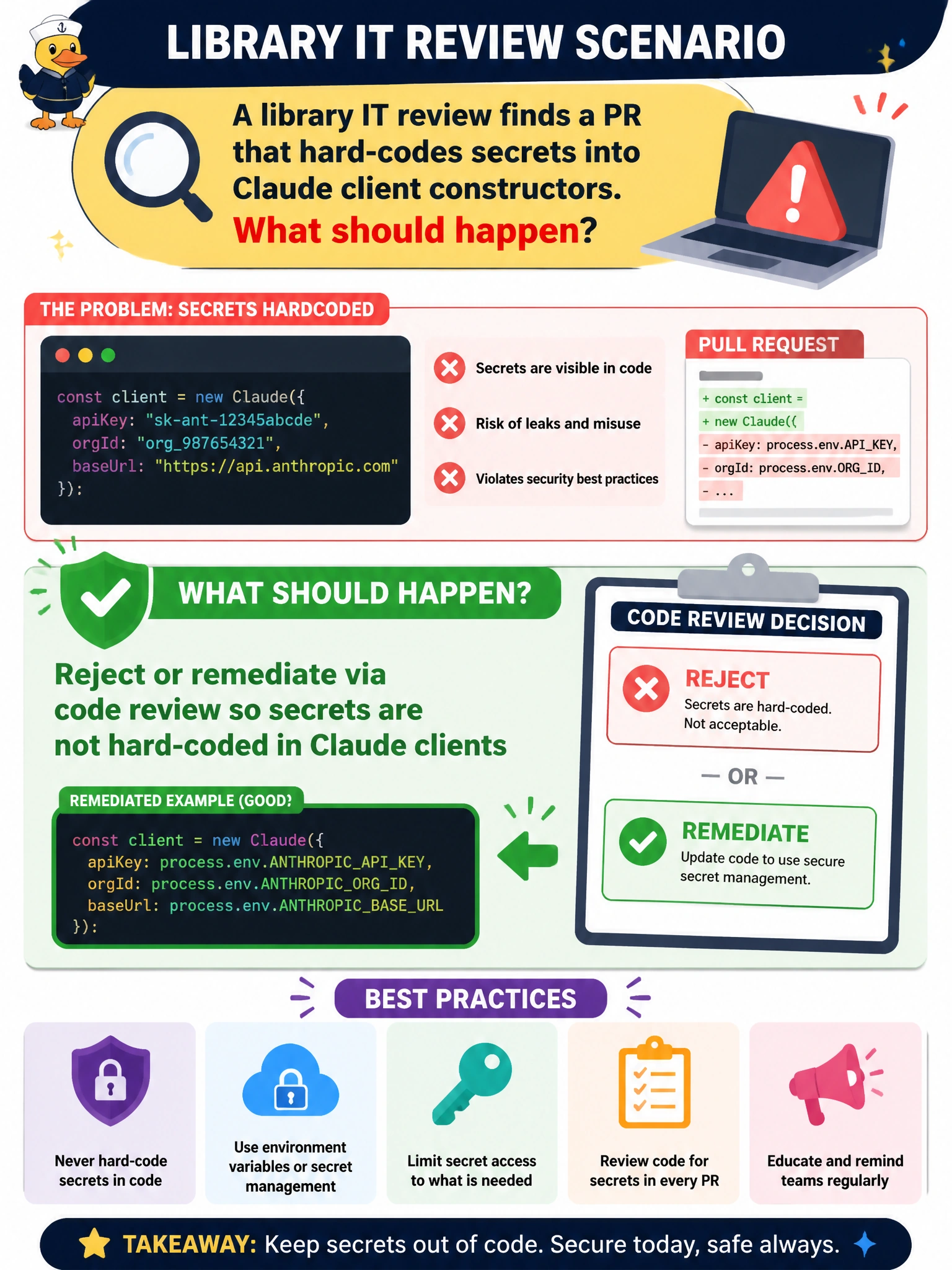
A library IT review finds a PR that hard-codes secrets into Claude client constructors. What should happen?
Select an answer to reveal the explanation.
Short Explanation
API keys don't belong tattooed on the constructor. Code review is the librarian that catches that before it shelves into production.
Full Explanation
Library IT reviews that find a PR hard-coding secrets into Claude client constructors must reject or remediate via code review so those secrets are not hard-coded. Code review is the correct control point because credentials in source become durable leaks through git history, forks, and build logs, exposing municipal API access. Remediation means moving secrets to a managed secret store or environment injection and rotating any key that appeared in the PR. Approving the constructor change and relying on private repository access fails by concept: repository privacy is not a secret store, and hard-coded credentials remain exposed to anyone with repository access, CI pipelines, build logs, and forks. Merging the pull request and encoding the hard-coded key with Base64 fails by concept: Base64 is encoding, not encryption, and it leaves the credential in source where anyone with repository access can decode it. Accepting the hard-coded value and managing rotation through commit history and redeploys fails by concept: git history permanently retains the secret, and redeploys do not remove the embedded credential or make rotation trustworthy. Exam caveat: after remediation, rotate the exposed key, scrub or rewrite history if policy requires, and add automated secret scanning so future Claude client PRs fail CI before human review—code review alone is necessary but stronger when paired with scanners. Operational check: fail the library PR in review, move the Claude API key to the approved secret manager, confirm the client reads the secret at runtime, rotate the leaked key, and re-run secret scanning on the branch until clean.