
A water-utility team deploys Claude tool-argument builders. What should the CI pipeline do before release?
Select an answer to reveal the explanation.
Short Explanation
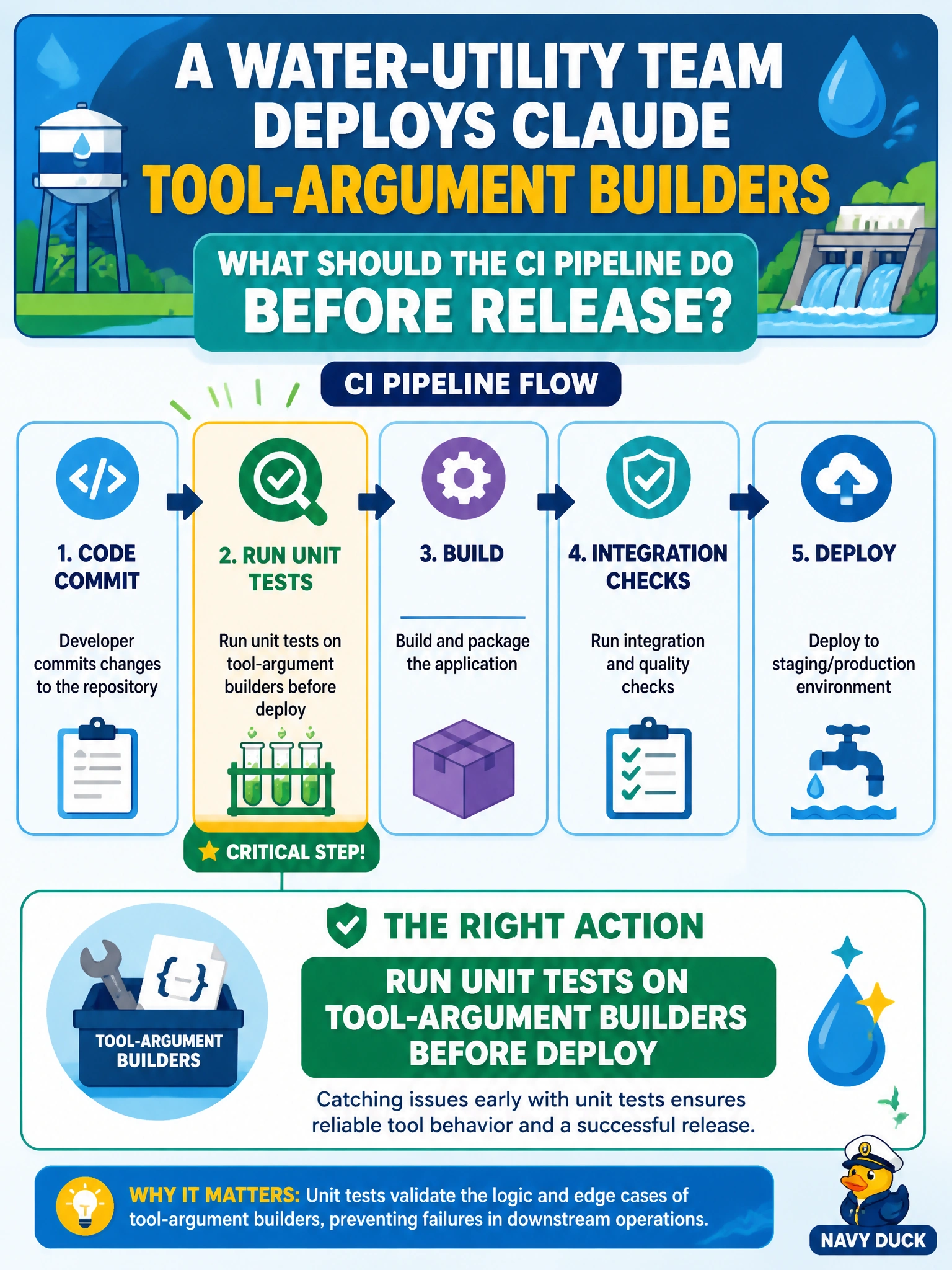
Valve-adjacent tools deserve a dress rehearsal. Unit-test those argument builders in CI before they touch the utility's deploy train.
Full Explanation
Water-utility teams deploying Claude tool-argument builders should run unit tests on those builders in CI before release. Pre-deploy unit testing fits because tool arguments are the bridge between Claude's structured calls and operational systems that may open valves, query SCADA-adjacent services, or update work orders: malformed arguments are high-impact defects that CI can catch cheaply with fixtures for required fields, enums, and boundary values. Green tests on builders give release managers evidence that argument construction still matches the tool schema. Running performance benchmarks on Claude API latency in CI fails by concept: latency measurements do not verify that tool-argument builders emit schema-correct arguments, and they cannot replace unit tests as a pre-release gate for utility operations. Rendering sample prompts in staging for visual review fails by concept: visual inspection is not a reliable automated gate and cannot catch malformed tool arguments before release. Collecting code coverage metrics from utility billing modules fails by concept: coverage from unrelated billing code does not exercise the Claude tool-argument builders and provides no release gate for the arguments themselves. Exam caveat: unit tests on builders do not replace integration tests against the real tool endpoint or safety interlocks on physical systems—argument shape correctness is necessary but not sufficient for operational safety. Operational check: add CI jobs that construct tool arguments for valid and invalid cases, fail the pipeline on schema mismatches, and block deploy until the water-utility Claude tool-argument suite is green.