
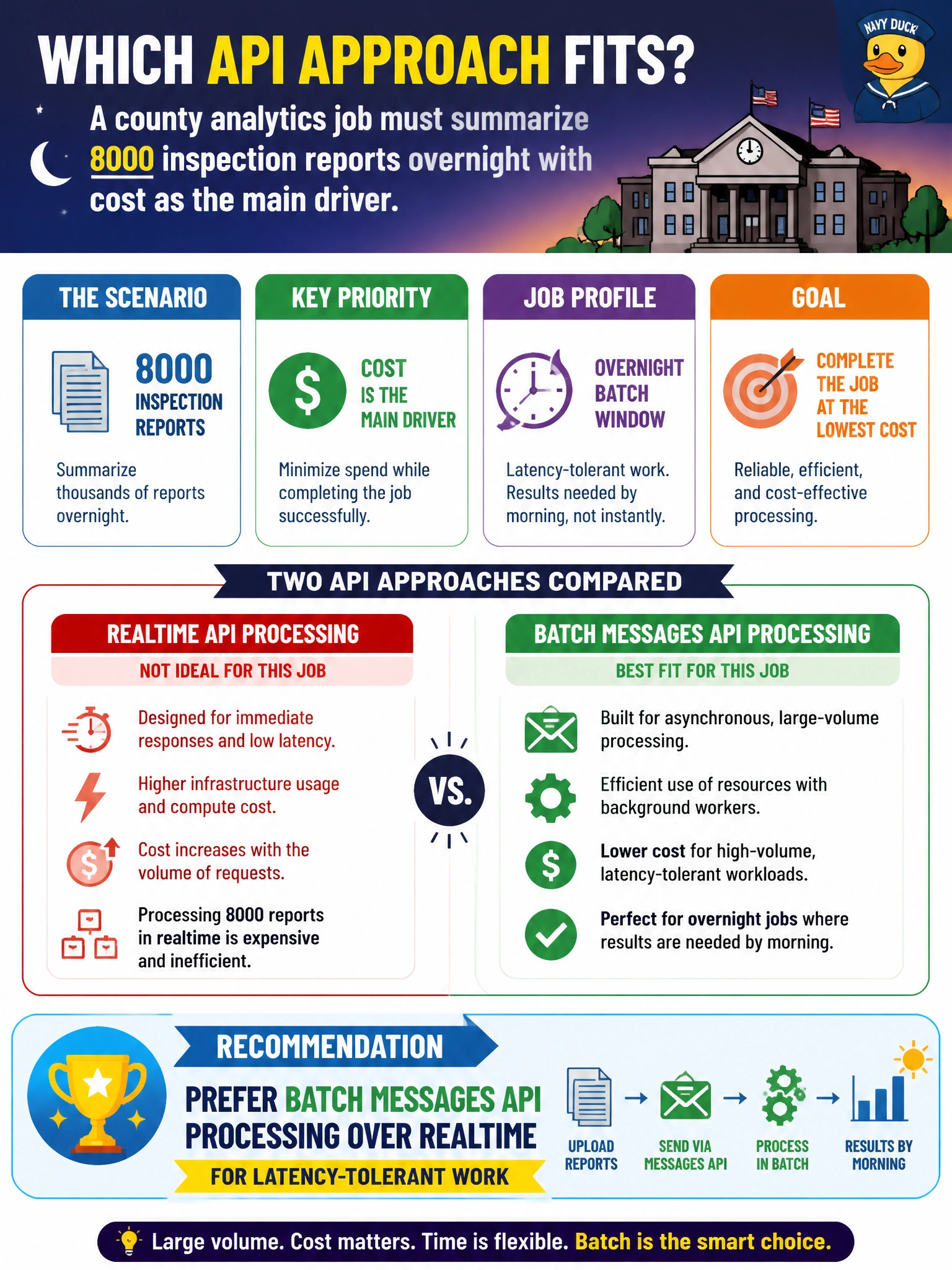
A county analytics job must summarize 8000 inspection reports overnight with cost as the main driver. Which API approach fits?
Select an answer to reveal the explanation.
Short Explanation
Eight thousand overnight reports aren't a reason to send realtime Messages API requests across the night just for faster turnaround. Batch processing is the night-shift workhorse when cost rules.
Full Explanation
County analytics jobs that must summarize thousands of inspection reports overnight with cost as the main driver should prefer batch Messages API processing over realtime. Batch is correct for latency-tolerant, high-volume civic summarization because it aligns price/throughput with overnight windows instead of interactive chat economics. Conceptually this matches municipal inspection analytics: morning digests matter, sub-second per-report replies do not, and forcing realtime burns budget without improving the business outcome. Send realtime Messages API requests across the night for faster turnaround fails by concept: it chases latency on a latency-tolerant job and pays interactive prices for work that can wait until morning. Use synchronous API calls with extended thinking for deeper report reasoning fails operational design—overnight work should not block with a single invocation, and extended thinking adds cost and latency that violate the cost-first mandate. Stream responses with prompt caching to prioritize interactive latency overnight fails requirements analysis: optimizing for streaming interactivity adds complexity and cost to an overnight batch where morning delivery is the only deadline. Exam caveat: batch-versus-realtime selection follows latency tolerance and cost; overnight 8000-report jobs are classic batch. Keep county inspection-report framing. Operational check: submit the summarization set via batch Messages API, track cost versus a realtime pilot sample, deliver morning outputs to analysts, and alert if jobs miss the overnight window without falling back to interactive spam.