
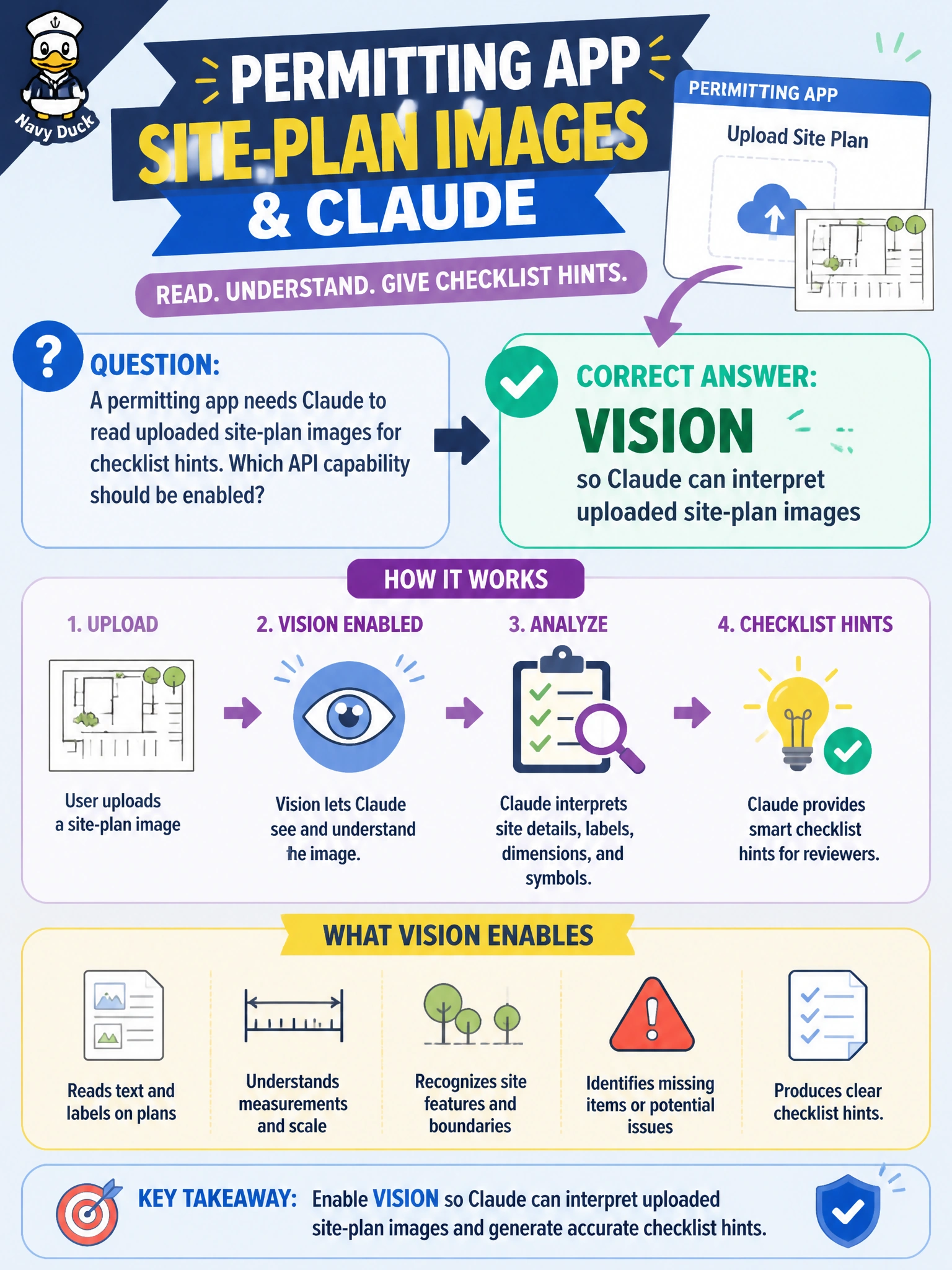
A permitting app needs Claude to read uploaded site-plan images for checklist hints. Which API capability should be enabled?
Select an answer to reveal the explanation.
Short Explanation
Site plans are pictures, not novels. Turn on vision so Claude can actually see the upload before it hints the checklist.
Full Explanation
Permitting apps that ask Claude for checklist hints from uploaded site-plan images require multimodal vision on the Messages API. Enabling vision so Claude can interpret those images is correct because site plans are visual artifacts—setbacks, labels, legends, stamps—that text-only channels cannot see. Conceptually this lets the assistant ground checklist hints in what was actually uploaded rather than relying on tool use to fetch checklist rules from the permit database, which cannot see the plan and defeats the visual upload workflow.
Embeddings to find similar site-plan images by vector search fails by concept: vector similarity can surface related drawings but provides no visual signal from the specific uploaded plan, so Claude cannot interpret that plan for checklist hints. Prompt caching to reuse checklist prompts across applications fails modality requirements—the stem needs Claude to read the uploaded plan to produce checklist hints during the session, and reusing cached text prompts still leaves the live interaction without vision. Tool use to fetch checklist rules from the permit database fails usability and accuracy; it abandons the visual upload path the app already collects by substituting a database lookup for image understanding.
Exam caveat: vision/multimodal items are decided by whether the model must see images; do not substitute prompt caching for vision, since caching checklist prompts across applications still leaves Claude unable to read the uploaded plan. Keep permitting site-plan framing. Operational check: enable vision-capable Messages API inputs, accept site-plan image uploads into the request, constrain hints to visible checklist cues, and UAT with real plan images plus a text-only negative control to prove vision is doing the work.