
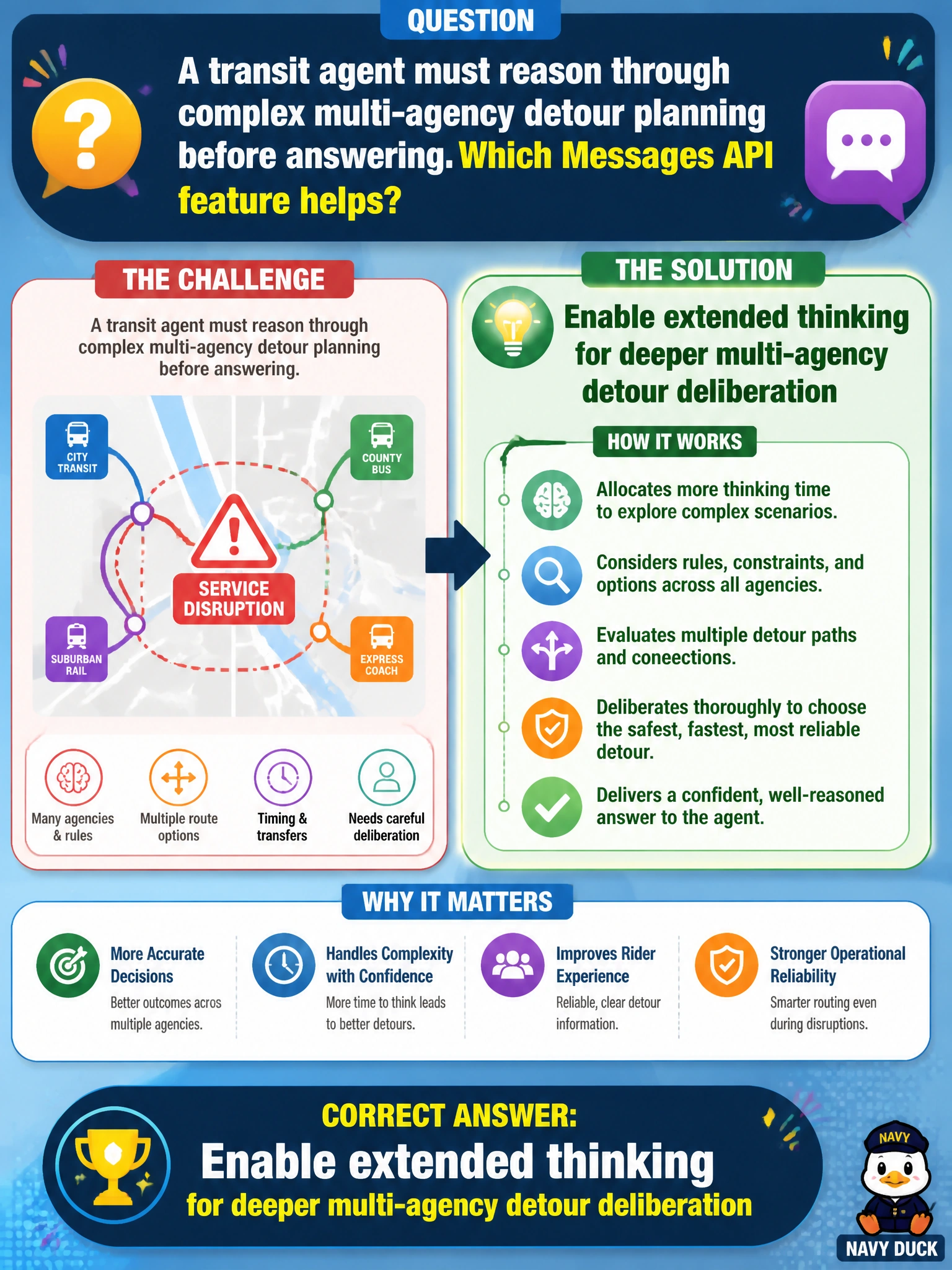
A transit agent must reason through complex multi-agency detour planning before answering. Which Messages API feature helps?
Select an answer to reveal the explanation.
Short Explanation
Multi-agency detours are spaghetti maps. Extended thinking gives Claude room to untangle before it speaks to riders.
Full Explanation
Transit agents planning complex multi-agency detours need deeper deliberation before answering riders. Enabling extended thinking for that deliberation is correct because extended thinking modes allocate structured reasoning capacity for multi-constraint planning—agency boundaries, alternate routes, timing windows, accessibility impacts—before committing to a resident-facing answer. Conceptually this avoids shallow, random replies that come from raising temperature on problems that are inherently multi-step and cross-organizational.
Raising temperature for more varied output fails by concept: it maximizes randomness at the expense of plan quality on a complexity-heavy stem. Enabling prompt caching for faster multi-agency detour deliberation fails because caching only speeds repeated prompts; detour planning needs room for constraints and stepwise reasoning. Increasing max tokens for extended multi-agency detour deliberation output fails similarly: a longer output limit does not provide deeper reasoning, and without extended thinking the model can still give brittle routing advice when agencies interact.
Exam caveat: extended-thinking items pair with complex planning stems; do not pick 'raise temperature' variety distractors. Keep multi-agency transit detour framing. Operational check: enable extended thinking for detour intents, evaluate answer quality on multi-agency scenarios, monitor latency/cost tradeoffs, and fall back to simpler modes only for trivial single-route FAQs.